
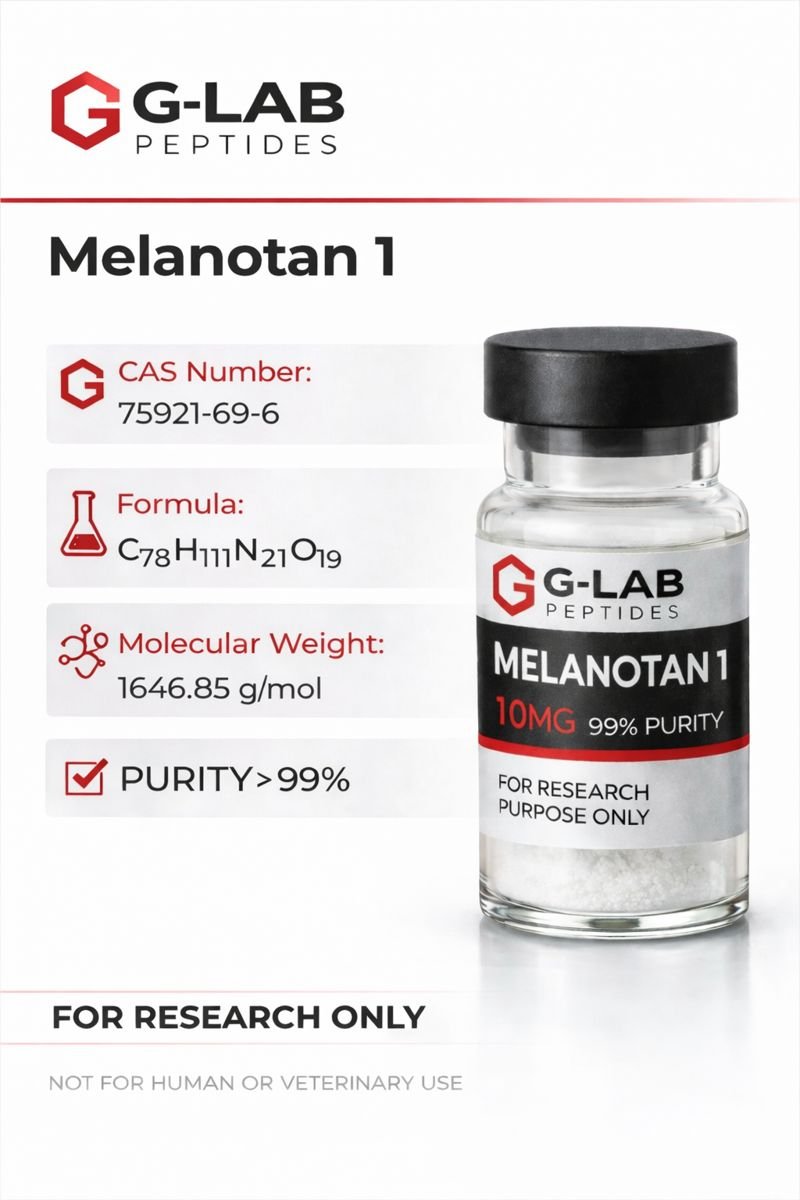
Melanotan 1 (10mg)
$48.90
| Quantity | Discount | Price |
|---|---|---|
| 5 - 8 | 5% | $46.46 |
| 9+ | 10% | $44.01 |
Free shipping on orders over $200!
- Satisfaction Guaranteed
- No Hassle Refunds
- Secure Payments
Melanotan 1 (10 mg)
Research-grade α-MSH analog / selective MC1R agonist
Melanotan 1 (MT-1) — also known as Afamelanotide, NDP-α-MSH, or [Nle⁴-D-Phe⁷]-α-MSH — is a synthetic linear 13-amino acid peptide engineered from the endogenous melanocortin hormone α-melanocyte-stimulating hormone (α-MSH). It contains two stabilizing amino-acid substitutions (Norleucine⁴ and D-Phenylalanine⁷), which significantly enhance its melanogenic potency, receptor selectivity, and metabolic stability.
Melanotan 1 is a highly selective MC1R agonist, unlike Melanotan 2 (which activates MC1R, MC3R, MC4R and MC5R). Because of this selectivity, MT-1 is studied primarily for melanogenesis, DNA photoprotection, oxidative-stress resistance, pigmentation disorders, and phototoxicity research, avoiding the off-target sexual and behavioral effects associated with MT-II.
Afamelanotide (Melanotan 1) is approved only in specific regions for erythropoietic protoporphyria (EPP) photoprotection but remains research-only in most jurisdictions.
Specifications
Synonyms: Melanotan 1, MT-1, Afamelanotide, NDP-α-MSH, [Nle⁴-D-Phe⁷]-α-MSH
Sequence: Ac-Ser-Tyr-Ser-Nle-Glu-His-D-Phe-Arg-Trp-Gly-Lys-Pro-Val-NH₂
Molecular Formula: C₇₈H₁₁₁N₂₁O₁₉
Molecular Weight: ~1646.9 g/mol
Class: Synthetic melanocortin-1 receptor (MC1R) agonist / α-MSH analog
Presentation: Lyophilized powder, 10 mg per vial (research purity ≥98%)
Mechanism of Action and Melanocortin Pathways
Melanotan 1 selectively activates the MC1R receptor on melanocytes:
1. MC1R activation → cAMP increase → melanin synthesis
Binding of MT-1 to MC1R increases intracellular cAMP, leading to:
Upregulation of tyrosinase
Increased eumelanin synthesis
Enhanced melanosome distribution
Darker pigmentation with stronger photoprotective properties
2. DNA photoprotection and oxidative stress resistance
β-eumelanin produced via MC1R activation:
Exhibits strong UV-absorbing and antioxidant properties
Reduces UV-induced DNA photolesions (e.g., CPDs, 6-4 photoproducts)
Enhances keratinocyte and melanocyte survival in UV-stress models
3. Anti-inflammatory and immunomodulatory effects
MC1R activation also influences:
Downregulation of NF-κB inflammatory pathways
Reduction of pro-inflammatory cytokines in UV-exposed tissue
Enhanced cutaneous barrier and repair responses
4. No MC4R activation → no sexual side effects
Unlike Melanotan 2, MT-1 does not significantly activate MC3R/MC4R; therefore it:
Does not induce pro-erectile or libido-related CNS effects
Avoids the sympathomimetic and behavioral effects associated with MT-II
Pigmentation Research and Photoprotection
UV-Protection and DNA Repair Studies
Research demonstrates that MT-1–induced eumelanin:
Strengthens natural photoprotection
Decreases UV-generated cyclobutane pyrimidine dimers (CPDs)
Reduces oxidative DNA damage
Improves keratinocyte survival following UV challenge
Pigmentation disorders
MT-1 has been studied in:
Erythropoietic protoporphyria (EPP) – increased light tolerance
Vitiligo – repigmentation when combined with UV therapy
Photodermatoses – reduction in photosensitivity markers
Because of its selectivity, MT-1 is considered the cleanest pharmacological tool for studying melanin biology without CNS interference.
Systemic and Dermatologic Research Applications
1. Oxidative stress modulation
MC1R agonism increases antioxidant defenses:
Enhancement of superoxide dismutase activity
Reduced ROS accumulation in UV-challenged cells
Improved cell survival under oxidative stress
2. Immunomodulation
MT-1 reduces inflammatory mediator release:
TNF-α
IL-1β
IL-6
COX-2 pathway mediators
3. Pain, phototoxicity and porphyria models
Because eumelanin shields phototoxic molecules from UV activation, MT-1 is widely used to study:
Phototoxicity attenuation
Porphyrin-related photoreaction mechanisms
Behavioral light-avoidance models
4. Cosmetic and pigmentation science
In vitro research uses MT-1 to model:
Controlled melanogenesis pathways
UV-resistant pigmentation
Melanosome transport biology
Safety, Limitations and Regulatory Status
Approved only in limited contexts
Afamelanotide (MT-1) is approved in the EU, USA, and Australia only for EPP under specialist supervision. Outside this, MT-1 exists strictly as a research compound.
Research-reported adverse effects
From clinical and experimental data:
Mild nausea
Hyperpigmentation (focal or diffuse)
Increased appearance of nevi (requires monitoring in clinical contexts)
Occasional flushing or fatigue
Key distinctions from Melanotan 2
MT-1:
Has no documented libido-modulating effects
Possesses a longer-lasting and cleaner MC1R profile
Is considered pharmacologically more predictable for pigmentation studies
Research Use Only – Important Notice
This Melanotan 1 (10 mg) product is supplied exclusively for laboratory research.
Not for human or veterinary use
Not for tanning, cosmetic, therapeutic, or diagnostic applications
Intended only for in vitro testing or controlled animal studies
All descriptions summarize preclinical and mechanistic findings
Not to be interpreted as medical or dosing guidance
References (Non-Wikipedia, with Links)
Dorr RT et al. Pharmacologic characterization of afamelanotide, a novel melanocortin agonist.
https://pubmed.ncbi.nlm.nih.gov/16135082/
Kadekaro AL et al. Alpha-MSH and MC1R regulate DNA repair and melanocyte survival.
https://pubmed.ncbi.nlm.nih.gov/17551931/
Abdel-Malek Z et al. MC1R polymorphisms, UV response, and melanogenesis.
https://pubmed.ncbi.nlm.nih.gov/22170499/
Langendonk JG et al. Afamelanotide therapy in erythropoietic protoporphyria.
https://pubmed.ncbi.nlm.nih.gov/26291367/
Delphi/Scenesse safety and clinical documentation (Afamelanotide regulatory dossier).
https://www.clinuvel.com/
Wong TH et al. MC1R agonists and photoprotection research.
https://pubmed.ncbi.nlm.nih.gov/29704977/
Busca R & Ballotti R. Cyclic AMP and melanogenesis pathways.
https://pubmed.ncbi.nlm.nih.gov/15250929/
Eves PC et al. MC1R activation reduces UV-induced oxidative DNA damage.
https://pubmed.ncbi.nlm.nih.gov/15908788/
Related products
MOTS-c
Price range: $76.90 through $155.00Select options This product has multiple variants. The options may be chosen on the product page
Tesamorelin
Price range: $86.90 through $115.00Select options This product has multiple variants. The options may be chosen on the product page
SS-31
Price range: $65.00 through $210.00Select options This product has multiple variants. The options may be chosen on the product page
 Oxytocin (5mg)