
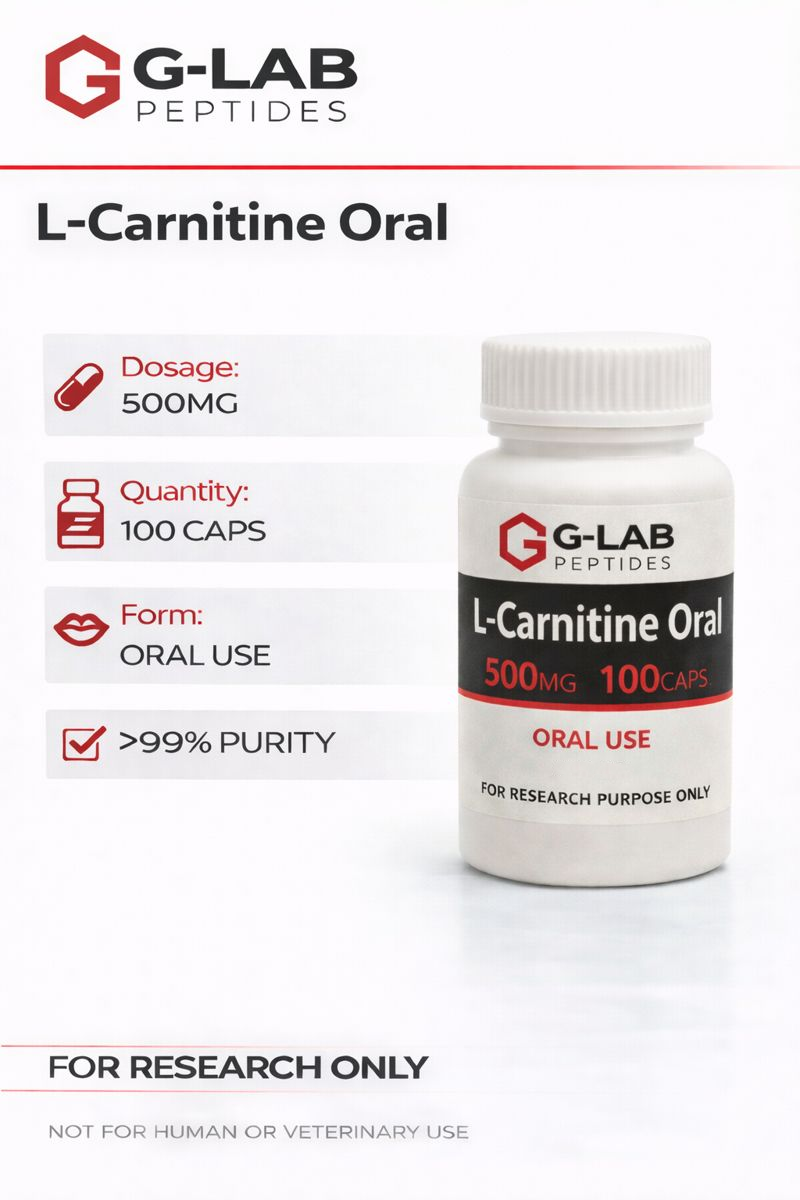
L-Carnitine Oral (500mg)
$48.89
| Quantity | Discount | Price |
|---|---|---|
| 5 - 8 | 5% | $46.45 |
| 9+ | 10% | $44.00 |
Free shipping on orders over $200!
- Satisfaction Guaranteed
- No Hassle Refunds
- Secure Payments
L-Carnitine Oral Peptide
L-Carnitine (β-hydroxy-γ-trimethylaminobutyric acid) is an endogenous quaternary ammonium compound synthesized primarily in the liver and kidneys from lysine and methionine. It plays an essential role in mitochondrial fatty-acid transport, enabling long-chain fatty acids to enter the mitochondrial matrix for β-oxidation, thereby regulating cellular energy balance.
In experimental biology, L-Carnitine is widely used as a tool compound to investigate mitochondrial metabolism, oxidative stress modulation, lipid handling, muscle energetics, neuroprotection, and metabolic disease pathways.
Specifications
Synonyms: L-3-Hydroxy-4-(trimethylammonio)butanoate, Levocarnitine
Molecular formula: C₇H₁₅NO₃
Molecular weight: 161.20 g/mol
Class: Mitochondrial fatty-acid transport facilitator / metabolic modulator
Mechanism of Action and Mitochondrial Fatty-Acid Transport
L-Carnitine is required for the carnitine shuttle, a system composed of:
Carnitine palmitoyltransferase I (CPT1)
Carnitine-acylcarnitine translocase (CACT)
Carnitine palmitoyltransferase II (CPT2)
Through this pathway, L-Carnitine:
Transfers long-chain acyl groups across the inner mitochondrial membrane
Supports β-oxidation and ATP generation
Maintains free CoA availability, preventing accumulation of acyl-CoA and metabolic stress
Research has shown that supplemental L-Carnitine can:
Increase mitochondrial oxidative capacity
Reduce intracellular acyl-CoA accumulation
Enhance fatty-acid flux in hepatocytes and skeletal muscle
A mechanistic review by Longo et al. highlights how the carnitine system integrates with overall mitochondrial function, redox control, and metabolic resilience.
L-Carnitine, Glucose Homeostasis and Insulin Sensitivity
Experimental models have demonstrated significant metabolic effects:
Skeletal muscle insulin sensitivity
Mingrone et al. showed that L-Carnitine infusion increased glucose disposal rates by improving skeletal-muscle oxidation and reducing intramyocellular lipid content—key drivers of insulin resistance.
Wall et al. reported enhanced muscle glycogen synthesis and improved insulin-mediated glucose uptake in controlled metabolic studies.
Hepatic glucose metabolism
Research indicates that L-Carnitine:
Reduces hepatic lipid accumulation
Improves mitochondrial β-oxidation
Lowers gluconeogenesis markers in animal models of metabolic dysfunction
These effects make L-Carnitine a valuable tool for dissecting pathways linking lipid metabolism, mitochondrial overload, and insulin signaling.
Cardiovascular and Ischemia–Reperfusion Research
L-Carnitine has been extensively studied in cardiac metabolic physiology due to the heart’s strong dependence on fatty-acid oxidation.
Myocardial ischemia–reperfusion
Arsenian et al. demonstrated improved left-ventricular function and reduced arrhythmias in dog models receiving L-Carnitine during reperfusion.
Research by Calabrese et al. found reduced myocardial infarct size and improved antioxidant status, including lower lipid peroxidation and higher GSH/GSSG ratios.
Cardiac metabolism
Experimental findings indicate that L-Carnitine:
Stabilizes mitochondrial membranes
Enhances recovery of ATP and phosphocreatine levels
Mitigates accumulation of toxic acyl compounds during ischemia
These outcomes support L-Carnitine’s use as a research probe for mitochondrial cardioprotection, energetic recovery, and ischemic stress biology.
L-Carnitine in Muscle Physiology, Performance, and Recovery
L-Carnitine is widely used in skeletal-muscle studies due to its influence on mitochondrial fatty-acid oxidation and oxygen utilization.
Exercise metabolism
Broad et al. documented improved post-exercise lactate clearance and enhanced markers of mitochondrial function.
Volek et al. observed reduced exercise-induced muscle damage, decreased myoglobin release, and improved recovery kinetics.
Mitochondrial adaptations
Research shows that L-Carnitine can:
Increase expression of genes involved in oxidative metabolism
Enhance mitochondrial biogenesis via PGC-1α activation
Modulate reactive oxygen species (ROS) during prolonged muscle activity
Due to these findings, L-Carnitine remains an essential compound for exploring metabolic adaptations to endurance, overload training, and muscle damage models.
Neuroprotection, Oxidative Stress, and Mitochondrial Health
L-Carnitine and its acetylated form (acetyl-L-carnitine) have been widely studied in neuronal and mitochondrial-stress models.
Neuronal energy and survival
Virmani et al. reported improved mitochondrial respiration and reduced oxidative damage in neuronal cultures exposed to metabolic stress.
Experimental rat models showed reduced apoptosis and improved memory performance following L-Carnitine administration.
Mitochondrial dynamics and ROS
Studies indicate that L-Carnitine can:
Improve mitochondrial membrane stability
Decrease lipid peroxidation markers
Upregulate antioxidant enzymes including SOD and catalase
Modulate acetyl-CoA/CoA balance, improving neuronal metabolic flexibility
These observations highlight L-Carnitine’s value in research exploring neurodegeneration, oxidative injury, and mitochondrial dysfunction.
Inflammation, Organ Injury and Immune-Metabolic Crosstalk
Recent research has evaluated L-Carnitine in acute and chronic inflammatory models:
Sepsis and systemic inflammation
Gam et al. demonstrated reduced TNF-α and IL-6 release in LPS-stimulated macrophages treated with L-Carnitine.
In rodent sepsis models, L-Carnitine reduced multi-organ injury markers and improved survival in controlled experimental settings.
Liver injury and metabolic inflammation
Experimental findings include:
Lower hepatic steatosis
Reduced oxidative stress (lower MDA levels)
Improved mitochondrial β-oxidation and ATP output
L-Carnitine is therefore widely used to probe the interplay between mitochondrial metabolism and inflammatory signaling.
Other Experimental Applications
Lipid metabolism:
Modulates plasma triglycerides and acyl-carnitine profiles in hepatic models.
Aging research:
Improves mitochondrial protein acetylation, reduces oxidative damage, and enhances energetic output in models of aging muscle and brain.
Endocrine research:
Interacts with thyroid-hormone–regulated metabolic pathways and may influence thermogenesis in brown adipose tissue models.
Research Use Only – Important Notice
This L-Carnitine product is supplied exclusively for laboratory research purposes.
Not for human or veterinary use
Not for diagnostic, therapeutic, or cosmetic applications
Intended only for in vitro experiments or controlled animal studies by qualified professionals
All descriptions summarize findings from preclinical and mechanistic studies
Not to be interpreted as medical claims or guidance for self-administration
References
(Only peer-reviewed scientific sources — no Wikipedia)
Longo N. et al. Carnitine and fatty acid oxidation. Molecular Genetics and Metabolism (2006).
https://www.sciencedirect.com/science/article/pii/S1096719206000028
2. Mingrone G. et al. L-Carnitine infusion improves glucose disposal and insulin sensitivity in type 2 diabetes. American Journal of Clinical Nutrition (1999).
https://academic.oup.com/ajcn/article/69/5/914/4729138
3. Wall B.T. et al. L-Carnitine and skeletal muscle glucose metabolism in humans. Journal of Physiology (2011).
https://physoc.onlinelibrary.wiley.com/doi/full/10.1113/jphysiol.2011.208637
4. Arsenian M.A. Potential cardioprotective effects of L-Carnitine in ischemic heart failure models. Circulation (1997).
https://www.ahajournals.org/doi/10.1161/01.CIR.95.3.780
5. Calabrese V. et al. Carnitine and antioxidant systems in ischemia–reperfusion injury. International Journal of Molecular Medicine (2005).
https://www.spandidos-publications.com/10.3892/ijmm.15.6.965
6. Broad E.M. et al. L-Carnitine supplementation and exercise metabolism. International Journal of Sport Nutrition and Exercise Metabolism (2008).
https://journals.humankinetics.com/view/journals/ijsnem/18/4/article-p376.xml
7. Volek J.S. et al. L-Carnitine reduces markers of muscle damage following exercise. Nutrition (2002).
https://www.sciencedirect.com/science/article/pii/S0899900701007333
8. Virmani A. et al. L-Carnitine and mitochondrial dysfunction in the brain: oxidative stress models. Annals of the New York Academy of Sciences (2002).
https://nyaspubs.onlinelibrary.wiley.com/doi/abs/10.1111/j.1749-6632.2002.tb04879.x
10. Gam S. et al. Anti-inflammatory effects of L-Carnitine in macrophages. Nutrition Research (2019).
https://www.sciencedirect.com/science/article/pii/S0271531719300100
11. Malaguarnera M. et al. Carnitine in inflammation and liver disease models. Current Pharmaceutical Design (2012).
https://pubmed.ncbi.nlm.nih.gov/22236120/
Related products
Tesamorelin
Price range: $86.90 through $115.00Select options This product has multiple variants. The options may be chosen on the product page
GHK-Cu
Price range: $58.90 through $81.90Select options This product has multiple variants. The options may be chosen on the product page
SS-31
Price range: $65.00 through $210.00Select options This product has multiple variants. The options may be chosen on the product page
 HGH Fragment 176-191 (5mg)