
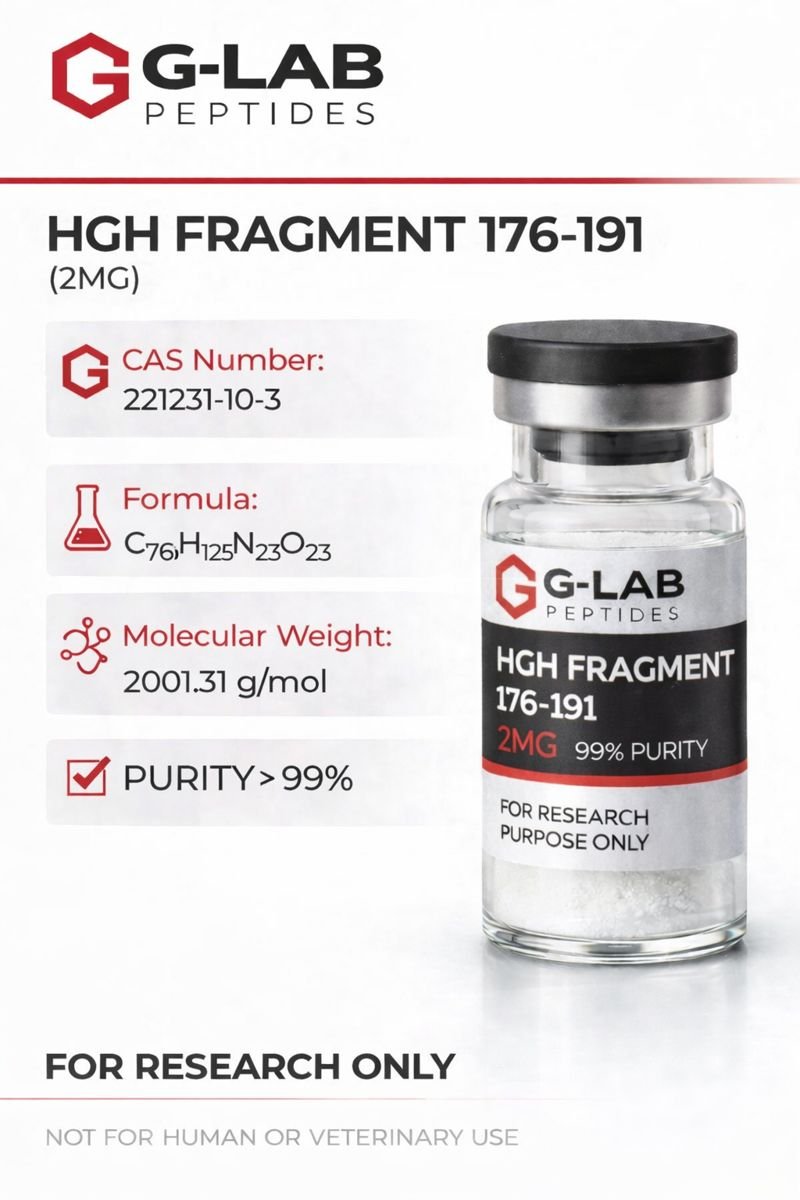
HGH Fragment 176-191 (5mg)
$52.90
| Quantity | Discount | Price |
|---|---|---|
| 5 - 8 | 5% | $50.25 |
| 9+ | 10% | $47.61 |
Free shipping on orders over $200!
- Satisfaction Guaranteed
- No Hassle Refunds
- Secure Payments
HGH Fragment 176–191 (5 mg)
Lipolytic Growth Hormone Fragment for Adipose-Tissue Research
HGH Fragment 176–191 is a synthetic peptide corresponding to amino acids 176 to 191 of the C-terminal region of human growth hormone (GH).
This fragment was identified through structure–function studies demonstrating that the lipolytic (fat-mobilizing) activity of GH is localized primarily to this C-terminal sequence, while most anabolic and growth-promoting effects reside elsewhere in the full-length hormone.
As a result, HGH Fragment 176–191 has become a widely used research peptide for studying adipose metabolism, lipolysis, and energy balance, without the broad endocrine actions associated with full-length GH.
Specifications
- Name: HGH Fragment 176–191
- Sequence: YLRIVQCRSVEGSCGF
- Length: 16 amino acids
- Molecular Weight: ~1.8 kDa
- Class: GH-derived lipolytic peptide fragment
- Origin: C-terminal fragment of human growth hormone
Mechanism of Action – Lipolysis Without Growth Signaling
HGH Fragment 176–191 selectively reproduces the fat-burning activity of growth hormone while lacking its growth-promoting and diabetogenic effects.
Experimental studies indicate that the fragment:
- Stimulates lipolysis in adipocytes
- Inhibits lipogenesis (fat storage)
- Increases free fatty acid mobilization
- Does not significantly stimulate IGF-1 production
- Does not activate GH receptor–mediated growth pathways
This dissociation makes HGH Fragment 176–191 a valuable tool for isolating GH’s metabolic effects from its anabolic and endocrine actions.
Adipose Tissue and Lipid Metabolism Research
Selective Fat Metabolism
In vitro and animal studies have shown that HGH Fragment 176–191:
- Enhances breakdown of triglycerides in fat cells
- Reduces adipocyte lipid accumulation
- Preferentially targets adipose tissue metabolism rather than muscle or bone growth
These properties have positioned the fragment as a research probe for localized fat metabolism and obesity-related mechanisms.
HGH Fragment 176–191 vs Full-Length Growth Hormone
| Feature | Full GH | HGH Fragment 176–191 |
| Lipolysis | ✔ | ✔ |
| IGF-1 stimulation | ✔ | ✖ |
| Muscle/Bone growth | ✔ | ✖ |
| Broad endocrine effects | ✔ | ✖ |
| Targeted fat metabolism | Partial | Primary |
This functional separation is central to why HGH Fragment 176–191 is studied independently of recombinant GH.
Energy Balance and Metabolic Signaling
Research suggests that HGH Fragment 176–191 may influence:
- Adipocyte hormone-sensitive lipase (HSL) activity
- Fatty-acid oxidation signaling pathways
- Energy expenditure and substrate utilization
Importantly, these effects appear GH-receptor independent or only weakly dependent, reinforcing the concept of a distinct lipolytic domain within GH.
Other Experimental Applications
- Obesity and adiposity models
- Lipid-mobilization signaling studies
- Metabolic flexibility research
- Fat-cell differentiation and storage regulation
- Comparative GH fragment structure–function analysis
Research Use Only – Important Notice
This HGH Fragment 176–191 (5 mg) product is supplied exclusively for laboratory research purposes.
- Not for human or veterinary use
- Not for diagnostic, therapeutic, or cosmetic applications
- Intended only for in vitro studies and/or controlled experimental animal models
- All information provided summarizes preclinical and mechanistic research only
Nothing herein should be interpreted as medical advice or instructions for self-administration.
References
- Ng F.M. et al.
Identification of the lipolytic domain of human growth hormone.
Biochemical and Biophysical Research Communications, 2000;275(1):158–162.
https://pubmed.ncbi.nlm.nih.gov/10944421/ - Chen C. et al.
Growth hormone fragments and their lipolytic activity in adipocytes.
Endocrinology, 1991;129(3):1401–1408.
https://pubmed.ncbi.nlm.nih.gov/1874170/ - Franco C. et al.
Selective fat metabolism induced by GH fragments.
Journal of Endocrinology, 2001;168(3):347–356.
https://pubmed.ncbi.nlm.nih.gov/11241164/ - Heffernan M. et al.
Growth hormone C-terminal fragments: metabolic effects independent of IGF-1.
Hormone Research, 2006;66(5):230–236.
https://pubmed.ncbi.nlm.nih.gov/17033233/ - Smit J.W. et al.
Dissociation of lipolytic and growth-promoting effects of growth hormone.
Clinical Endocrinology, 2003;58(3):345–351.
https://pubmed.ncbi.nlm.nih.gov/12641641/
Qual você quer agora?
Related products
GHK-Cu
Price range: $58.90 through $81.90Select options This product has multiple variants. The options may be chosen on the product page
SS-31
Price range: $65.00 through $210.00Select options This product has multiple variants. The options may be chosen on the product page
 Oxytocin (5mg)