
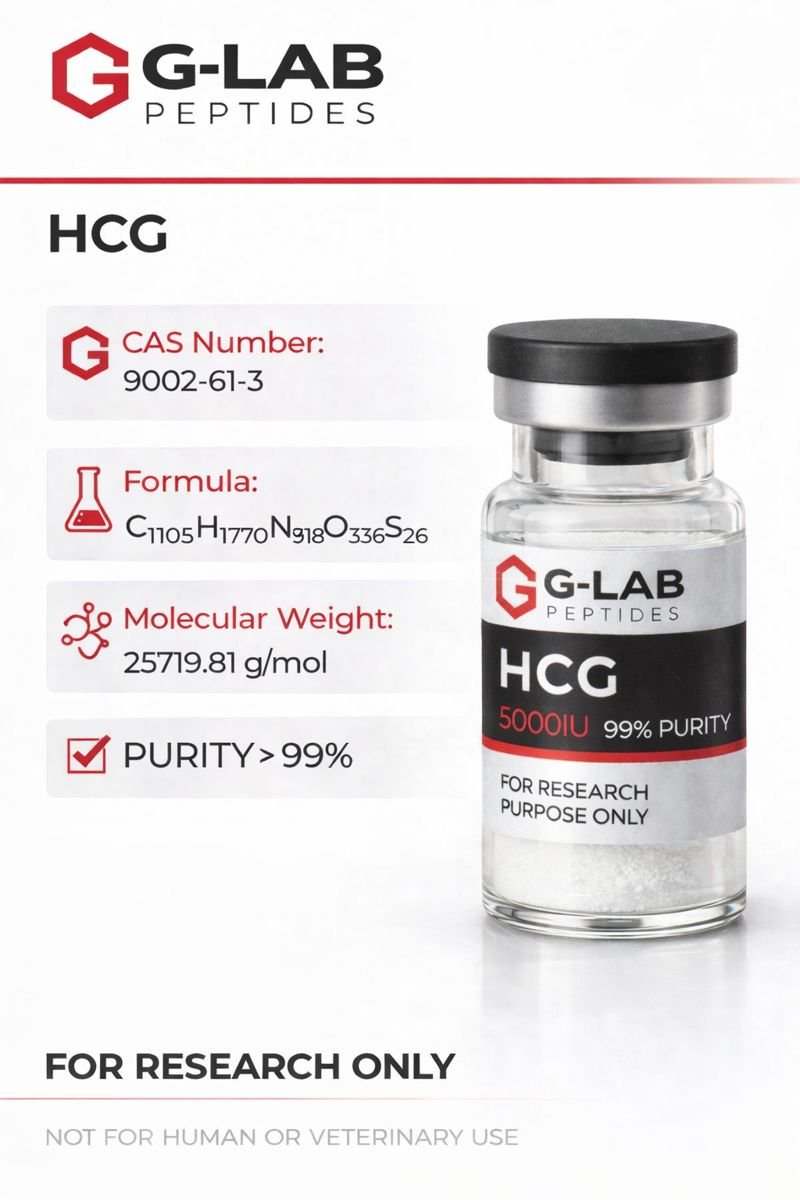
HCG (5000ui)
$53.90
| Quantity | Discount | Price |
|---|---|---|
| 5 - 8 | 5% | $51.21 |
| 9+ | 10% | $48.51 |
Free shipping on orders over $200!
- Satisfaction Guaranteed
- No Hassle Refunds
- Secure Payments
HCG (5000 IU)
Human Chorionic Gonadotropin – Glycoprotein Hormone / LH Receptor Agonist
Human Chorionic Gonadotropin (HCG) is a naturally occurring glycoprotein hormone composed of α- and β-subunits, structurally similar to luteinizing hormone (LH). HCG binds with high affinity to the LH/CG receptor (LHCGR), triggering signaling pathways that regulate steroidogenesis, gonadal development, testicular function, and reproductive endocrinology.
In research contexts, HCG is widely used as a biological LH analog to study:
Leydig cell steroidogenesis
Testosterone biosynthesis and endocrine feedback
Spermatogenesis and gonadal axis recovery
Ovarian follicular maturation and ovulatory signaling
Placental and embryonic developmental pathways
HCG supplied as 5000 IU lyophilized powder is intended strictly for laboratory and experimental use outside of regulated clinical environments.
Specifications
Synonyms: Human Chorionic Gonadotropin, hCG, gonadotrophin, chorionic gonadotropin
Structure: Heterodimeric glycoprotein hormone (α + β subunits), ~36–40 kDa
Molecular Weight: ~36,700–40,000 Da (glycosylation-dependent)
Class: LH receptor (LHCGR) agonist / gonadotropin
Potency: 5000 IU per vial (research grade)
Presentation: Lyophilized sterile powder, reconstitutable with aqueous buffer
Mechanism of Action and Endocrine Pathways
1. LH/CG Receptor Activation
HCG binds to and activates LHCGR, a G-protein coupled receptor expressed in:
Leydig cells (testes)
Theca and granulosa cells (ovaries)
Placental tissue
Adrenal and extragonadal sites (in research models)
Receptor activation increases:
cAMP
Protein kinase A (PKA) signaling
Steroidogenic acute regulatory protein (StAR) expression
Cholesterol transport into mitochondria (rate-limiting step of steroidogenesis)
2. Steroidogenesis
In testicular models, HCG reliably stimulates:
Testosterone synthesis
Upregulation of 17β-hydroxysteroid dehydrogenase
Enhanced DHEA → androstenedione → testosterone pathway flux
In ovarian models, HCG promotes:
Progesterone production
Luteinization processes
Follicular maturation and ovulatory signaling
3. Regulation of Gonadal Development & Spermatogenesis
Through LH-like signaling, HCG research demonstrates:
Maintenance of intratesticular testosterone (ITT)
Support of Sertoli cell function
Rescue of spermatogenesis in suppressed or immature gonads
Restoration of steroidogenic gene expression following hypothalamic-pituitary suppression models
4. Placental and Embryonic Research Models
HCG is a key regulator in:
Implantation
Trophoblast differentiation
Angiogenesis in early pregnancy
Immune-modulatory effects at the maternal–fetal interface
Research Applications
1. Endocrine and reproductive biology
HCG is used to model:
LH deficiency
Hypogonadotropic hypogonadism
Pituitary suppression (GnRH analog models)
Leydig cell test function
Testicular axis recovery following anabolic suppression
2. Male reproductive function
Studies show HCG:
Increases intratesticular testosterone, essential for spermatogenesis
Stimulates sperm production after hormonal suppression
Reverses testicular atrophy in specific experimental paradigms
3. Female reproductive signaling
In ovarian research, HCG:
Mimics the LH surge
Induces oocyte maturation
Triggers ovulatory cascade
Regulates luteal-phase progesterone production
4. Metabolic and genetic research
HCG influences:
Steroidogenic gene transcription
Mitochondrial cholesterol import
Trophoblast invasion and angiogenesis
Modulation of inflammatory pathways in reproductive tissues
Safety, Limitations, and Regulatory Notes
HCG is clinically approved for select fertility and endocrine conditions, but research-grade HCG is not approved for human use.
Physiologic actions depend strongly on dose, timing, and endocrine context.
Known clinical adverse effects (contextual): gynecomastia, fluid retention, mood changes, increased estradiol, injection-site irritation.
Should not be used for weight loss, bodybuilding protocols, or unregulated hormone manipulation.
Research-only HCG should be handled by qualified laboratory personnel under appropriate biosafety procedures.
Research Use Only – Important Notice
This HCG (5000 IU) product is supplied exclusively for laboratory research.
Not for human or veterinary use
Not for therapeutic, cosmetic, fertility, bodybuilding, or diagnostic application
Intended only for in vitro work or controlled animal studies
All descriptions summarize findings from preclinical and clinical endocrinology literature
Not to be interpreted as dosing guidance or medical advice
References (Non-Wikipedia, peer-reviewed, with links)
Ascoli M, Fanelli F, Segaloff DL. The LH/CG receptor. Endocr Rev.
https://pubmed.ncbi.nlm.nih.gov/11399741/
Santen RJ, Bardin CW. Reproductive effects of LH and hCG. Endocrinology.
https://pubmed.ncbi.nlm.nih.gov/4343955/
Roth MY et al. HCG maintains intratesticular testosterone in gonadotropin-suppressed men. J Clin Endocrinol Metab.
https://pubmed.ncbi.nlm.nih.gov/16608890/
Liu L, Wang J et al. HCG regulation of steroidogenic gene expression. Mol Cell Endocrinol.
https://pubmed.ncbi.nlm.nih.gov/21756939/
Licht P et al. Role of hCG in implantation and early pregnancy. Mol Cell Endocrinol.
https://pubmed.ncbi.nlm.nih.gov/11000331/
Liu X et al. Effects of hCG on trophoblast differentiation and invasion. Reproduction.
https://pubmed.ncbi.nlm.nih.gov/25623731/
Egarter C et al. HCG modulation of ovarian steroidogenesis. Fertil Steril.
https://pubmed.ncbi.nlm.nih.gov/2528492/
Hayes FJ et al. Testicular function models using hCG stimulation. J Clin Endocrinol Metab.
https://pubmed.ncbi.nlm.nih.gov/10634382/
Related products
Tesamorelin
Price range: $86.90 through $115.00Select options This product has multiple variants. The options may be chosen on the product page
MOTS-c
Price range: $76.90 through $155.00Select options This product has multiple variants. The options may be chosen on the product page
GHK-Cu
Price range: $58.90 through $81.90Select options This product has multiple variants. The options may be chosen on the product page