
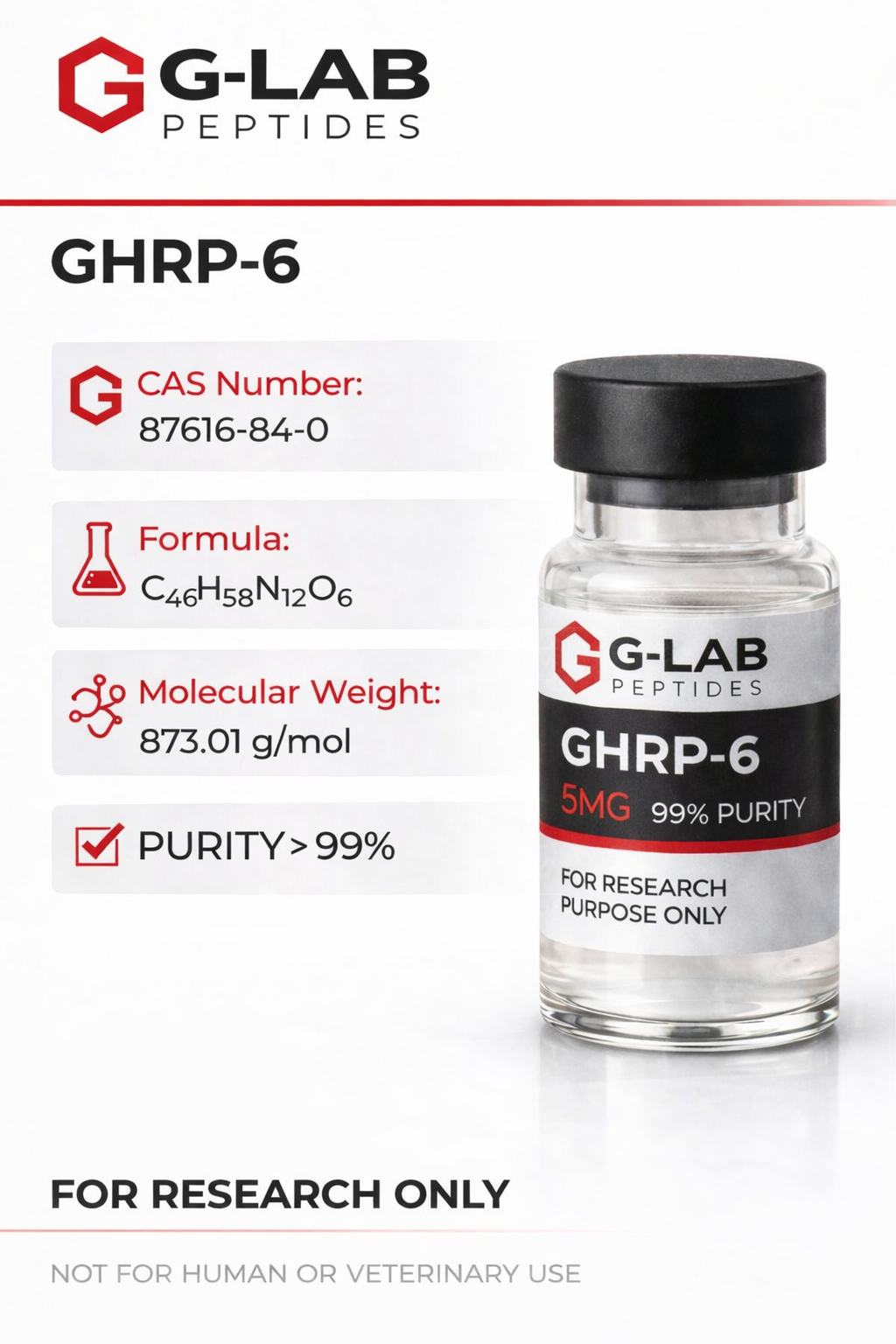
GHRP-6 (5mg)
$30.90
| Quantity | Discount | Price |
|---|---|---|
| 5 - 8 | 5% | $29.35 |
| 9+ | 10% | $27.81 |
Free shipping on orders over $200!
- Satisfaction Guaranteed
- No Hassle Refunds
- Secure Payments
GHRP-6 (5 mg) — Research Peptide
GHRP-6 (Growth Hormone Releasing Peptide-6) is a synthetic hexapeptide belonging to the growth hormone secretagogue (GHS) family. It acts primarily through activation of the GHS-R1a receptor, a G-protein–coupled receptor involved in growth hormone (GH) release, appetite regulation, metabolic signaling, and neuroendocrine pathways. Unlike endogenous ghrelin, GHRP-6 does not require acylation for receptor activation, making it a stable and highly selective research tool.
Specifications
Synonyms: Growth Hormone Releasing Peptide-6, GHRP6, His-D-Trp-Ala-Trp-D-Phe-Lys-NH₂
Sequence: H-His-D-Trp-Ala-Trp-D-Phe-Lys-NH₂
Molecular Formula: C₄₆H₅₆N₁₂O₆
Molecular Weight: 873.02 g/mol
Class: Ghrelin mimetic / GHS-R1a agonist / GH secretagogue
Mechanism of Action: GHS-R1a Activation & GH Release
GHRP-6 binds to the growth hormone secretagogue receptor type 1a (GHS-R1a), a receptor also targeted by endogenous ghrelin. Activation triggers:
• Pituitary GH Secretion
Studies show that GHRP-6 increases pulsatile GH release independently of GHRH pathways, enhancing GH amplitude and frequency in animal and human pituitary models
— through PKC, PLC, intracellular Ca²⁺ mobilization, and inhibition of somatostatin signaling.
• Appetite & Metabolic Signaling
GHRP-6 strongly stimulates NPY/AgRP neurons in the hypothalamus, resulting in increased food-seeking behavior in research animals.
This makes it a widely used tool to study appetite regulation and orexigenic pathways.
• Anti-Inflammatory & Tissue-Repair Modulation
Preclinical models demonstrate that GHRP-6 influences:
fibroblast proliferation
collagen turnover
reduced fibrosis formation
accelerated wound-edge closure
Mechanisms appear linked to CD36 modulation and downstream oxidative-stress pathways.
Experimental Findings in Literature
1. Wound-Healing & Tissue-Repair Research
GHRP-6 has been widely studied for its role in repair processes.
In murine burn-injury models, GHRP-6 reduced inflammation, decreased neutrophil infiltration, promoted angiogenesis, and accelerated granulation tissue formation.
GHRP-6 also modulated cytokines, reducing IL-1β, TNF-α, and oxidative markers.
These data support its use as a research tool for studying anti-fibrotic and pro-repair signaling.
2. Anti-Inflammatory & Cytoprotective Activity
Research demonstrates that GHRP-6 interacts with CD36, contributing to cardioprotective and anti-inflammatory actions.
In ischemia–reperfusion models, GHRP-6 reduced infarct size and improved mitochondrial stability.
GHRP-6 downregulated inflammatory cytokines and oxidative stress mediators.
These findings suggest it is useful for investigating metabolic inflammation, oxidative injury, and cardiac stress pathways.
3. GH Axis, IGF-1 & Metabolic Studies
GHRP-6 is frequently used in endocrine research to study:
GH secretion dynamics
IGF-1 downstream signaling
synergy with GHRH analogues
somatostatin inhibition mechanisms
Studies in rodents and primates show that GHRP-6 increases GH pulses and enhances IGF-1 expression in liver and skeletal muscle, making it a powerful model for growth-axis exploration.
4. Appetite, Feeding Behavior & Hypothalamic Neurobiology
Because of its strong orexigenic effect, GHRP-6 is widely used to investigate:
hypothalamic NPY/AgRP signaling
ghrelin receptor pathways
neuroendocrine control of hunger
Researchers consistently report rapid and significant food intake increases following GHRP-6 exposure in small-animal models.
Research Use Only – Important Notice
This GHRP-6 (5 mg) product is supplied strictly for laboratory research purposes.
Not for human or veterinary use
Not for diagnostic, therapeutic, or cosmetic purposes
Intended for controlled in vitro experiments or preclinical animal research
All descriptions summarize existing scientific findings and do not constitute medical claims
References
1. Martínez Y. et al. “GHRP-6 accelerates wound healing and reduces fibrosis in murine models.” J Pharmacol Exp Ther.
https://pubmed.ncbi.nlm.nih.gov/20519667/
2. Granado M. et al. “GHRP-6 modulates inflammatory cytokines and oxidative stress in muscle-injury models.” Am J Physiol Endocrinol Metab.
https://pubmed.ncbi.nlm.nih.gov/17374609/
3. Nass R. et al. “Stimulation of GH release by GHRP-6 in humans and animal models.” J Clin Endocrinol Metab.
https://pubmed.ncbi.nlm.nih.gov/8398870/
4. Castañeda-Bravo A. et al. “GHRP-6 reduces cytokine-mediated inflammation and tissue damage.” Peptides.
https://pubmed.ncbi.nlm.nih.gov/20153735/
5. Sun Y. et al. “Ghrelin receptor signaling and the pharmacology of GHRP family peptides.” Mol Cell Endocrinol.
https://pubmed.ncbi.nlm.nih.gov/15134870/
6. Bowers CY. “Growth hormone releasing peptides: structure and mechanism.” Endocr Rev.
https://pubmed.ncbi.nlm.nih.gov/16169815/
Related products
SS-31
Price range: $65.00 through $210.00Select options This product has multiple variants. The options may be chosen on the product page
GHK-Cu
Price range: $58.90 through $81.90Select options This product has multiple variants. The options may be chosen on the product page