
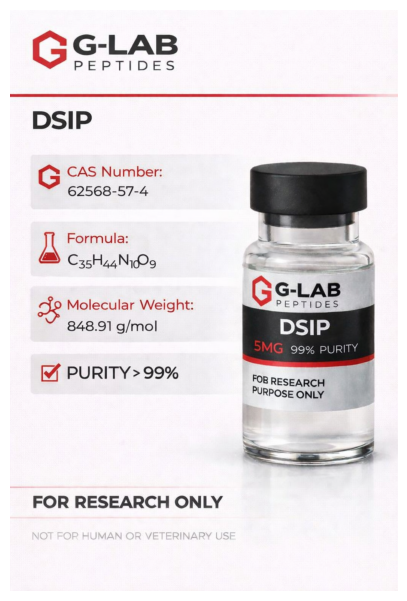
DSIP (5mg)
$48.89
| Quantity | Discount | Price |
|---|---|---|
| 5 - 8 | 5% | $46.45 |
| 9+ | 10% | $44.00 |
Free shipping on orders over $200!
- Satisfaction Guaranteed
- No Hassle Refunds
- Secure Payments
DSIP Peptide (Delta Sleep-Inducing Peptide)
Delta sleep-inducing peptide (DSIP) is a small, naturally occurring neuropeptide originally isolated from cerebral venous blood during experimentally induced sleep. It has been widely explored as a research tool in models of sleep regulation, stress response, pain modulation, neuroprotection, and aging. DSIP is amphiphilic, can cross the blood–brain barrier, and appears in both central nervous system tissues (hypothalamus, limbic system, pituitary) and peripheral organs, although its gene, precursor protein, and receptor(s) remain incompletely defined. PubMed+1
Specifications
Synonyms:
Delta sleep-inducing peptide; DSIP; Trp-Ala-Gly-Gly-Asp-Ala-Ser-Gly-Glu
Sequence (nonapeptide):
Trp–Ala–Gly–Gly–Asp–Ala–Ser–Gly–Glu
Molecular formula:
C₃₅H₄₈N₁₀O₁₅ PubChem+1
Molecular weight:
≈ 848.8 g/mol AAPPTEC
Class:
Endogenous neuropeptide analog / experimental sleep- and stress-modulating peptide
Mechanism of Action and Neuroendocrine Signaling
Experimental evidence suggests that DSIP exerts complex, context-dependent actions in the CNS and endocrine system:
Central distribution and BBB penetration: DSIP-like immunoreactivity has been detected in hypothalamus, limbic structures, and pituitary, as well as in peripheral tissues including gut and pancreas. PubMed More recent work emphasizes that DSIP and DSIP-like peptides can cross the blood–brain barrier, supporting their use as centrally active research tools. Frontiers
Neuronal and receptor-level effects: DSIP can modulate neuronal firing and neurotransmission in various brain regions; studies implicate glutamatergic/NMDA pathways and adrenergic mechanisms in its effects on pineal N-acetyltransferase and circadian neurochemistry. PubMed
Hypothalamic–pituitary–adrenal (HPA) axis and other hormones: DSIP has been reported to influence corticotropin (ACTH) secretion and to interact with glucocorticoid-dependent pathways, but findings are inconsistent across human studies, with some showing reductions in ACTH responses and others showing no major effect. PubMed+1
Given the absence of a clearly identified receptor and precursor gene, current consensus is that DSIP should be regarded as a multifunctional experimental peptide whose mechanisms are still only partially resolved. PubMed
DSIP, Sleep Architecture and Circadian Regulation
DSIP was initially characterized as a putative endogenous sleep factor, particularly linked to slow-wave (delta) sleep:
Early sleep-promoting observations: Original animal work reported enhancement of delta EEG activity and slow-wave sleep when DSIP was administered into specific brain ventricles, leading to its name and early classification as a “sleep peptide.” PubMed+1
Human insomnia model: In a double-blind, matched-pairs study in chronic insomnia patients, repeated intravenous DSIP (25 nmol/kg) was evaluated over several nights. The trial documented modest changes in sleep parameters in some individuals, but overall effects on total sleep time and architecture were limited and variable, highlighting that DSIP is not a robust hypnotic in this setting. PubMed
Critical re-evaluation: A comprehensive neurochemical review concluded that, despite the name, the role of DSIP in sleep regulation remains “an unresolved riddle,” as animal and human data are heterogeneous and a clear, reproducible sleep-promoting effect has not been firmly established. PubMed
Collectively, DSIP is used as a probe in sleep and circadian biology to explore links between neuropeptides, slow-wave activity, and hormone release, but it is not considered a validated therapeutic sleep agent.
DSIP, Stress Systems and Endocrine Function
DSIP has been studied as a modulator of stress-responsive endocrine pathways, particularly those related to the HPA axis:
ACTH and cortisol responses in healthy volunteers: In a randomized, double-blind crossover study in healthy men, intravenous DSIP (25 nmol/kg) altered plasma ACTH dynamics, with reductions in immunoreactive ACTH observed in some conditions, while urinary cortisol output was less consistently affected. PubMed
CRH and meal-induced ACTH/cortisol: Another controlled human study found that DSIP infusion did not significantly change corticotropin-releasing hormone (CRH)- or meal-induced ACTH and cortisol secretion, arguing against a strong inhibitory role in HPA reactivity under those experimental conditions. ScienceDirect
Mood disorders and basal DSIP levels: In patients with major depressive disorder, basal plasma DSIP concentrations have been reported to be higher than in controls and to correlate with cortisol levels and blunted ACTH responses to exogenous CRH, suggesting that DSIP-like activity may be linked to altered HPA axis regulation in depression. PubMed
These mixed findings position DSIP as an informative but complex tool for exploring neuroendocrine feedback, stress adaptation, and their relationships with mood and circadian timing.
DSIP in Pain, Neuroprotection and Aging Models
Beyond sleep and endocrine research, DSIP has been evaluated in models of nociception, neuroprotection, and organismal aging:
Analgesia and nociceptive modulation
Central antinociceptive effects: In mice and rats, intracerebroventricular or intracisternal DSIP produced a strong, dose-dependent antinociceptive effect in tail-pinch and hot-plate tests. This effect was blocked by the opioid antagonist naloxone, implicating opioid-sensitive pathways. PubMed
Circadian dependence of pain modulation: Separate work showed that DSIP administration (1 mg/kg) in rats increased pain threshold preferentially during the dark phase, indicating that peptide-induced analgesia may interact with circadian state and endogenous monoaminergic systems. PubMed
These data support the use of DSIP as a central analgesia model compound, particularly for investigating peptide–opioid and monoaminergic interactions in pain pathways.
Neuroprotection and functional recovery
Peripheral nerve injury model: In a sciatic nerve injury model in mice, repeated intranasal DSIP over 8 days accelerated motor function recovery compared with controls. Histological and functional indices suggested improved axonal regeneration and neuromuscular performance, highlighting DSIP as a candidate tool for studying peptide-based neurorepair strategies. MDPI
Aging, tumor incidence and geroprotection
Long-term Deltaran® study in SHR mice: A DSIP-containing preparation (Deltaran) administered monthly throughout life in female hypertensive rats (SHR) reduced spontaneous tumor incidence by approximately 2.6-fold, decreased chromosomal aberrations in bone marrow cells, slowed age-related reproductive decline, and increased maximum lifespan by about 24% relative to controls. ScienceDirect+1
These findings, while model-specific and not directly translatable to humans, have made DSIP-based formulations a focus of experimental work on stress resistance, genomic stability, and longevity.
Other Experimental Applications
DSIP and DSIP-like peptides are also used in a range of exploratory contexts:
Blood–brain barrier transport: Modern peptide-engineering studies have used DSIP as a template for short peptides that efficiently cross the blood–brain barrier, aiming to deliver neuroactive cargo to the CNS in a controlled manner. Frontiers
Psychiatric and withdrawal research: Historical and contemporary reports describe DSIP-based regimens investigated in patients with chronic pain, substance dependence, or mood disturbances, where improvements in pain perception, withdrawal symptoms, or mood have been noted in small, heterogeneous cohorts. These remain preliminary and largely exploratory. PARTICLE, s. r. o.+1
Overall, DSIP is best viewed as a versatile research peptide for dissecting the interface of sleep, stress biology, nociception, neuroplasticity, and aging rather than as an established therapeutic agent.
Research Use Only – Important Notice
This DSIP (5 mg) product is supplied exclusively for laboratory research purposes.
Not for human or veterinary use
Not for diagnostic, therapeutic, or cosmetic applications
Intended only for in vitro work and/or use in appropriately controlled experimental animal models by qualified professionals
All descriptions above summarize findings from preclinical and mechanistic studies (and limited exploratory clinical research) and are provided for educational and informational purposes only. They must not be interpreted as medical claims or guidance for any form of self-administration, dosing, or clinical use.
References
Kovalzon VM. Delta sleep-inducing peptide (DSIP): a still unresolved riddle. J Neurochem. 2006;98(5):1647-1655. Available at: https://pubmed.ncbi.nlm.nih.gov/16539679/ PubMed
Bes F, et al. Effects of delta sleep-inducing peptide on sleep of chronic insomniac patients: a double-blind matched-pairs study. Neuropsychobiology. 1992;26(4):194-199. Available at: https://pubmed.ncbi.nlm.nih.gov/1299794/ PubMed
Späth-Schwalbe E, et al. Delta-sleep-inducing peptide does not affect CRH- and meal-induced ACTH and cortisol secretion in humans. Psychoneuroendocrinology. 1995;20(4):403-414. Available at: https://www.sciencedirect.com/science/article/abs/pii/030645309400050K ScienceDirect
Bjartell A, et al. Reduction of immunoreactive ACTH in plasma following delta sleep-inducing peptide (DSIP) in healthy subjects. Regul Pept. 1989;25(3):309-318. Available at: https://pubmed.ncbi.nlm.nih.gov/2554357/ PubMed
Lesch KP, et al. Delta sleep-inducing peptide response to human corticotropin-releasing hormone in depression. Biol Psychiatry. 1988;24(8):782-792. Available at: https://pubmed.ncbi.nlm.nih.gov/2839244/ PubMed
Nakamura A, et al. Potent antinociceptive effect of centrally administered delta-sleep-inducing peptide (DSIP). Eur J Pharmacol. 1988;155(3):247-253. Available at: https://pubmed.ncbi.nlm.nih.gov/2853064/ PubMed
Yehuda S, et al. The effects of delta sleep-inducing peptide on pain threshold during light and dark periods in rats. Peptides. 1987;8(5):813-817. Available at: https://pubmed.ncbi.nlm.nih.gov/3679693/ PubMed
Popovich IG, et al. Effect of delta-sleep inducing peptide-containing preparation Deltaran on biomarkers of aging, life span and spontaneous tumor incidence in female SHR mice. Mech Ageing Dev. 2003;124(6):721-731. Available at: https://www.sciencedirect.com/science/article/pii/S0047637403000824 ScienceDirect+1
Tukhovskaya EA, et al. Delta sleep-inducing peptide recovers motor function in a model of sciatic nerve injury. Molecules. 2021;26(17):5173. Available at: https://www.mdpi.com/1420-3049/26/17/5173 MDPI
Mu X, et al. Pichia pastoris secreted peptides crossing the blood–brain barrier: application to sleep regulation. Front Pharmacol. 2024;15:1439536 (includes discussion of DSIP’s role in sleep and stress modulation). Available at: https://www.frontiersin.org/articles/10.3389/fphar.2024.1439536/full Frontiers
Related products
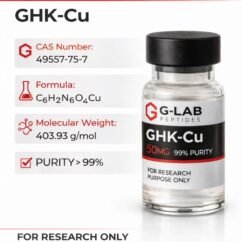
GHK-Cu
Price range: $58.90 through $81.90Select options This product has multiple variants. The options may be chosen on the product page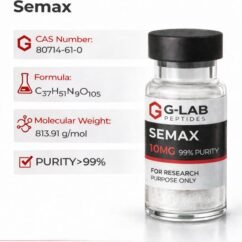
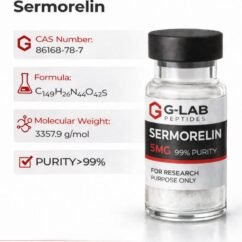
Sermorelin
Price range: $50.90 through $89.90Select options This product has multiple variants. The options may be chosen on the product page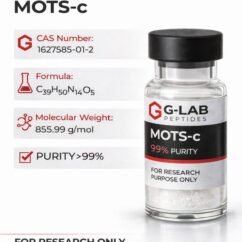
MOTS-c
Price range: $76.90 through $155.00Select options This product has multiple variants. The options may be chosen on the product page
 HCG (5000ui)
  Selank (5mg)