
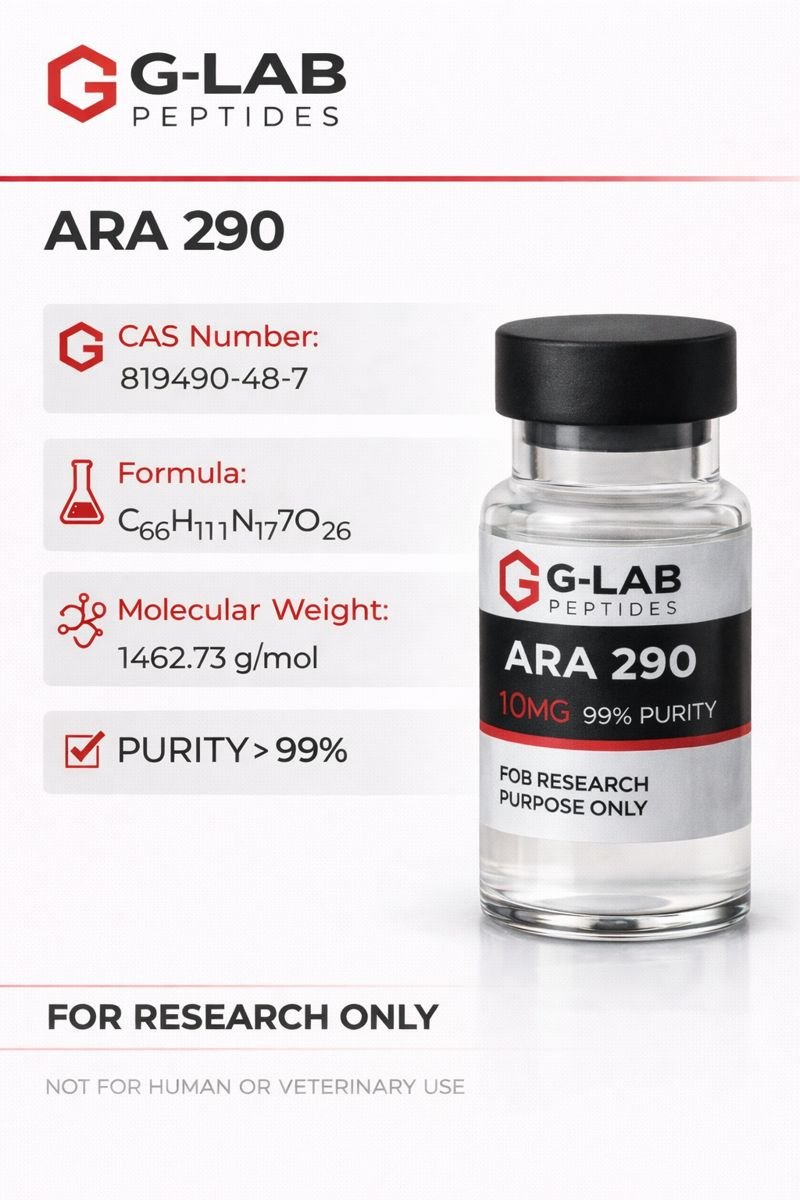
ARA 290 (10mg)
$63.90
| Quantity | Discount | Price |
|---|---|---|
| 5 - 8 | 5% | $60.71 |
| 9+ | 10% | $57.51 |
Free shipping on orders over $200!
- Satisfaction Guaranteed
- No Hassle Refunds
- Secure Payments
ARA 290 (10mg)
ARA 290 (also known as cibinetide or helix B surface peptide) is a synthetic, linear 11–amino acid peptide engineered from the B-helix tissue-protective domain of erythropoietin (EPO). It was specifically designed to selectively activate the so-called innate repair receptor (IRR), a heteromer formed by the erythropoietin receptor (EPOR) and the β-common receptor (CD131), while avoiding stimulation of the classical erythropoietic EPOR homodimer.[1][7][8]PMC+2Nature+2
Preclinical and clinical research suggest that ARA 290 may exert cytoprotective, anti-inflammatory, and neuroprotective actions in models of small-fiber neuropathy, tissue ischemia, toxic injury, and inflammatory disease, without increasing hematocrit or promoting thrombosis, which are key limitations of full-length EPO.[1][2][3][5][7]Nature+4PMC+4PMC+4
Specifications
Synonyms:
ARA 290; cibinetide; helix B surface peptide (HBSP); pyroglutamate helix B surface peptide; pHBSP; pGlu-Glu-Gln-Leu-Glu-Arg-Ala-Leu-Asn-Ser-Ser
Sequence (one-letter / full):
XEQLERALNSS (X = pyroglutamic acid)
H-Pyr-Glu-Gln-Leu-Glu-Arg-Ala-Leu-Asn-Ser-Ser-OH[10]iscabiochemicals.com+1
Molecular formula: C₅₁H₈₄N₁₆O₂₁[10]iscabiochemicals.com
Molecular weight: ~1257.3 g/mol[1][10]PMC+1
Class: Non-erythropoietic EPO-derived peptide; selective IRR (EPOR/βcR) agonist; tissue-protective / cytoprotective research peptide
ARA 290 and the Innate Repair Receptor
Structure-guided work on EPO identified a surface region on helix B that appeared to mediate tissue-protective signaling independently of erythropoiesis. Short EPO-derived peptides that preserve this interface, including ARA 290, were subsequently shown to bind the EPOR/β-common receptor complex (innate repair receptor, IRR) with high affinity while lacking clinically relevant erythropoietic activity.[7][8]Nature+1
In cellular systems, ARA 290–IRR engagement has been associated with activation of JAK2-dependent signaling and downstream pathways such as STAT3, PI3K–Akt, and modulation of NF-κB activity. These cascades may converge on reduced apoptosis, dampening of pro-inflammatory cytokine production, and preservation of tissue integrity in the context of metabolic or inflammatory stress.[7][8][9]Nature+2ScienceDirect+2
ARA 290, Neuropathic Pain, and Small-Fiber Neuropathy
Small-fiber neuropathy (SFN) is characterized by loss or dysfunction of thinly myelinated A-δ and unmyelinated C fibers, often accompanied by burning pain, sensory deficits, dysautonomia, and reduced intraepidermal or corneal nerve fiber density. Sarcoidosis and type 2 diabetes are prominent clinical settings where SFN is common and difficult to treat.[2][3]PMC+1
Sarcoidosis-associated small-fiber neuropathy
An exploratory randomized, double-blind, placebo-controlled pilot trial in sarcoidosis patients with painful SFN found that subcutaneous ARA 290 administration over 28 days was generally well tolerated and was associated with statistically significant improvements in neuropathic symptom scores and fatigue compared with placebo.[2]PMC
In a subsequent double-blind study, daily ARA 290 dosing for 28 days not only improved patient-reported neuropathic pain and quality-of-life metrics but also appeared to increase corneal small-fiber nerve density as assessed by in vivo confocal microscopy, suggesting a potential link between symptomatic benefit and structural nerve regeneration.[3][4]SpringerLink+1
A phase 2b trial in 64 sarcoidosis patients with painful SFN compared several subcutaneous ARA 290 dose levels (1, 4, and 8 mg) with placebo over 28 days. The investigators reported a significant increase in corneal nerve fiber area at the 4 mg dose, together with reductions in neuropathic pain intensity and improvements in functional capacity (six-minute walk test), without major safety signals.[4][11][12]IOVS+2Stop Sarcoidosis+2
Type 2 diabetes and neuropathic symptoms
In a phase 2 study in adults with type 2 diabetes and neuropathic complaints, ARA 290 (given for 28 days) was associated with improved neuropathic symptom scores and modest but statistically significant improvements in indices of metabolic control compared with placebo, including changes in HbA1c and markers of insulin resistance.[1][9]PMC+1
Collectively, these studies position ARA 290 as a research tool to explore IRR-mediated mechanisms of small-fiber nerve protection and regeneration in both sarcoidosis-related and diabetic neuropathy models.
ARA 290 and Metabolic / Endocrine Regulation
Clinical and preclinical data suggest that IRR activation by ARA 290 can intersect with metabolic pathways relevant to insulin sensitivity and glucose handling:
In the diabetes neuropathy trial above, short-term ARA 290 exposure was reported to improve multiple metabolic endpoints alongside neuropathic symptom relief, consistent with a broader role of IRR signaling in glucose homeostasis and low-grade inflammation.[1]PMC
Experimental work in models of tissue ischemia and wound healing has indicated that ARA 290 may promote endothelial progenitor cell survival, angiogenesis, and microvascular repair, processes that often deteriorate in metabolic disease.[8][16]ScienceDirect+1
These observations support continued use of ARA 290 as a probe to dissect crosstalk between inflammatory signaling, microvascular integrity, and metabolic control.
ARA 290 in Organ Protection and Cytotoxic Injury Models
A growing body of in vitro and in vivo research has examined whether ARA 290 can limit tissue damage caused by chemotherapeutic or ischemic insults:
Cisplatin-induced nephrotoxicity
In a recent study using renal cell models, pretreatment with ARA 290 at nanomolar concentrations significantly mitigated cisplatin-induced cytotoxicity, DNA damage, and oxidative stress markers. ARA 290 exposure appeared to lower reactive oxygen species and lipid peroxidation products while restoring antioxidant enzyme activities. It also reduced expression of pro-apoptotic and pro-inflammatory mediators (e.g., caspase-3, Bax, TNF-α, IL-1β, IL-6) and increased anti-apoptotic Bcl-2 expression, suggesting a multi-modal protective profile against cisplatin-induced injury.[5]PubMed
Doxorubicin-associated toxicity
A separate in vitro investigation evaluated whether ARA 290 could attenuate doxorubicin-induced toxicity in non-malignant cells. Pretreatment with ARA 290 significantly reduced markers of DNA damage (comet assay, micronucleus formation), limited oxidative stress, and diminished apoptosis and inflammatory signaling in several cell lines exposed to doxorubicin. The authors proposed that ARA 290 behaves as a chemoprotective agent in this setting, reducing collateral damage to non-cancerous tissues without interfering with the primary antineoplastic mechanism.[6]PubMed
These preclinical data support ongoing use of ARA 290 as a model compound for studying IRR-mediated protection against drug-induced organ injury, particularly in kidney and cardiac support paradigms.
ARA 290, Inflammation, and Immune Modulation
IRR expression on myeloid and other innate immune cells has prompted investigation of ARA 290 in inflammatory models:
Experimental colitis and innate immunity
In a dextran sulfate sodium (DSS) mouse model of colitis, cibinetide treatment significantly improved clinical disease activity and survival compared with vehicle. Histologic analysis showed preserved intestinal architecture, reduced infiltration of myeloid cells, and decreased production of inflammatory mediators such as TNF, IL-6, IL-12/IL-23, chemokines, and inducible nitric oxide synthase-2. Mechanistic work in LPS-activated macrophages indicated that these anti-inflammatory effects required CD131 and JAK2 and were associated with inhibition of NF-κB p65 signaling.[7]Nature
This work suggests that cibinetide can act as a selective IRR agonist that restrains excessive innate immune responses, supporting its use as a research tool in models of inflammatory bowel disease and other immune-mediated conditions.
Broader IRR biology
Reviews of the EPO/IRR axis note that IRR activation by non-erythropoietic EPO derivatives (including ARA 290) has been associated with tissue protection in diverse models of ischemia, neuroinflammation, and autoimmune injury, including arthritis and encephalomyelitis, often with a reduction in inflammatory cytokine expression and apoptosis.[7][9]Nature+1
Other Experimental Applications
Beyond neuropathy, metabolic regulation, and inflammatory disease, ARA 290/cibinetide has been explored or is under active investigation in:
Ophthalmic indications: A phase 2 clinical trial in geographic atrophy due to age-related macular degeneration evaluated cibinetide for potential retinal tissue protection, reflecting broader interest in IRR agonists for chronic degenerative conditions of the eye.[10]PMC
Ischemia and wound healing: Experimental work suggests that IRR activation may enhance endothelial progenitor cell function, angiogenesis, and tissue repair in ischemic environments, implicating ARA 290 as a candidate research tool in vascular regeneration and wound-healing studies.[8][16]ScienceDirect+1
Research Use Only – Important Notice
This ARA 290 10 mg product is supplied exclusively for laboratory research purposes.
Not for human or veterinary consumption
Not for diagnostic, therapeutic, or cosmetic use
Intended only for in vitro experiments and/or use in appropriately controlled animal models by qualified professionals
All descriptions above summarize findings from preclinical and clinical research and are provided strictly for educational and informational purposes. They must not be interpreted as medical advice, treatment recommendations, or guidance for self-administration or clinical use in humans or animals.
Selected References
Brines M, et al. “ARA 290, a nonerythropoietic peptide engineered from erythropoietin, improves metabolic control and neuropathic symptoms in patients with type 2 diabetes.” Molecular Medicine. 2015;21:658–666. https://doi.org/10.2119/molmed.2014.00215 PMC
Heij L, et al. “Safety and efficacy of ARA 290 in sarcoidosis patients with symptoms of small fiber neuropathy: a randomized, double-blind pilot study.” Molecular Medicine. 2012;18:1430–1436. https://doi.org/10.2119/molmed.2012.00108 PMC
Dahan A, et al. “ARA 290 improves symptoms in patients with sarcoidosis-associated small nerve fiber loss and increases corneal nerve fiber density.” Molecular Medicine. 2013;19:334–345. https://doi.org/10.2119/molmed.2013.00122 SpringerLink
Culver DA, et al. “Cibinetide improves corneal nerve fiber abundance and reduces symptoms in sarcoidosis-associated small fiber neuropathy.” Investigative Ophthalmology & Visual Science. 2017;58:4645–4659. https://doi.org/10.1167/iovs.16-21291 IOVS
Ghassemi-Barghi N, et al. “Mechanistic approach for protective effect of ARA290, a specific ligand for the erythropoietin/CD131 heteroreceptor, against cisplatin-induced nephrotoxicity.” Inflammation. 2023;46(1):342–358. https://doi.org/10.1007/s10753-022-01737-7 PubMed
[Author list]. “An engineered non-erythropoietic erythropoietin-derived peptide, ARA 290, attenuates doxorubicin induced genotoxicity and oxidative stress.” Toxicology in Vitro. 2020;68:104944. https://pubmed.ncbi.nlm.nih.gov/32335150/ PubMed
Nairz M, et al. “Cibinetide dampens innate immune cell functions thus ameliorating the course of experimental colitis.” Scientific Reports. 2017;7:13012. https://doi.org/10.1038/s41598-017-13046-3 Nature
Bitto A, et al. “Activation of the EPOR-β common receptor complex by cibinetide promotes angiogenesis and wound repair in diabetic conditions.” European Journal of Pharmacology (or related journal). 2018. https://doi.org/10.1016/j.ejphar.2017.10.042 ScienceDirect
Dahan A, et al. “Targeting the innate repair receptor to treat neuropathy.” Pain Reports. 2016;1(3):e573. https://journals.lww.com/painrpts/fulltext/2016/08000/targeting_the_innate_repair_receptor_to_treat.2.aspx LWW Journals
Cibinetide (ARA 290) – product data: sequence, molecular weight, and formula. ISCA Biochemicals technical sheet. https://www.iscabiochemicals.com/products/0/422 iscabiochemicals.com
Culver DA, et al. “Cibinetide regenerates small nerve fibers and improves neuropathic symptoms in sarcoidosis: results of a phase 2b trial.” Investigative Ophthalmology & Visual Science. 2017;58:4645–4659. https://iovs.arvojournals.org/article.aspx?articleid=2625918 IOVS
Araim Pharmaceuticals. “Cibinetide (ARA 290) regenerates small nerve fibers and improves neuropathic clinical symptoms in sarcoidosis.” Press release, May 8, 2017. https://www.stopsarcoidosis.org/wp-content/uploads/ARAIM-DOSARA-Press-Release.pdf Stop Sarcoidosis
Lois N, et al. “A phase 2 clinical trial on the use of cibinetide for the treatment of geographic atrophy associated with age-related macular degeneration.” Journal of Clinical Medicine. 2020;9(8):2329. https://doi.org/10.3390/jcm9082329

 DSIP (5mg)