
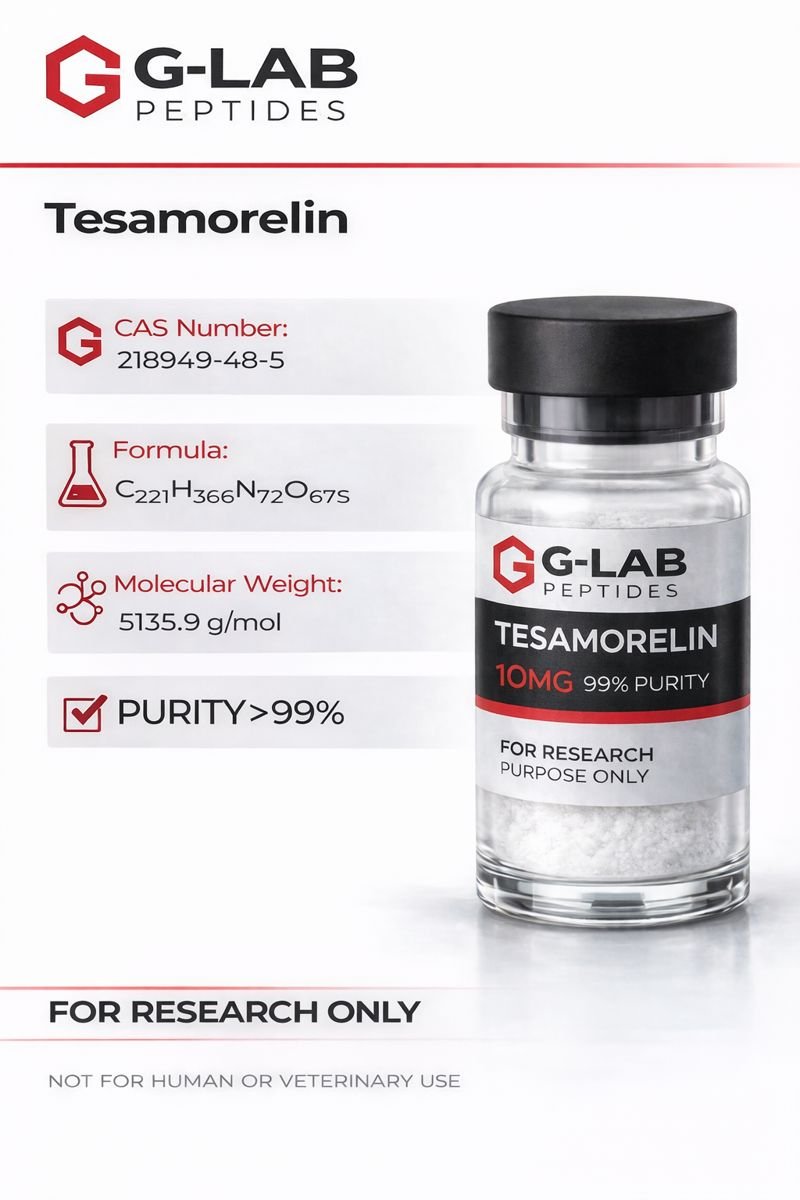
Tesamorelin
Price range: $86.90 through $115.00
| Quantity | Discount | Price |
|---|---|---|
| 5 - 8 | 5% | $82.56 |
| 9+ | 10% | $78.21 |
Free shipping on orders over $200!
- Satisfaction Guaranteed
- No Hassle Refunds
- Secure Payments
Tesamorelin
Tesamorelin is a synthetic growth hormone–releasing hormone (GHRH) analog (also called growth hormone–releasing factor, GHRF) designed to activate GHRH receptors on pituitary somatotroph cells, increasing pulsatile endogenous growth hormone (GH) secretion and downstream IGF-1 signaling. In research and clinical pharmacology literature, tesamorelin has been most studied in HIV-associated lipodystrophy (visceral adipose tissue reduction) and more recently in HIV-associated NAFLD models/trials as a mechanistic strategy to target ectopic fat and related metabolic pathways.
Specifications
Synonyms: Tesamorelin acetate; GHRH(1–44) analog; GRF analog (clinical literature)
Class: GHRH receptor agonist / GH secretagogue (endogenous GH stimulation)
Peptide length: 44 amino acids (human GHRH sequence backbone)
Molecular formula (acetate salt): C221H366N72O67S • x C2H4O2 (x ≈ 7)
Molecular weight (free base): 5135.9 Da
Mechanism of Action: GHRH Receptor → Pulsatile GH → IGF-1 Axis
Receptor-level activity. In vitro, tesamorelin binds and stimulates human GHRH (GHRF) receptors with similar potency to endogenous GHRH/GRF.
Physiologic cascade. GHRH signaling at the pituitary increases GH synthesis and pulsatile release. GH then drives a broad set of anabolic/lipolytic effects through GH receptors on target tissues (including adipocytes and hepatocytes), with some effects mediated via IGF-1 produced in the liver and peripheral tissues.
Why researchers care. Because tesamorelin increases endogenous GH (rather than supplying exogenous GH), it has been used as a tool to probe how GH/IGF-1 signaling influences visceral fat biology, lipid handling, inflammatory markers, and ectopic fat deposition, particularly in settings where abdominal adiposity is a major metabolic driver.
Visceral Adipose Tissue (VAT) and Body-Fat Distribution Research
Randomized clinical trials in HIV-associated abdominal adiposity
A pivotal placebo-controlled trial reported that daily tesamorelin over 26 weeks reduced visceral fat and improved aspects of lipid profiles in HIV-infected adults with central fat accumulation, supporting tesamorelin as a selective VAT-targeting strategy in this population.
VAT response as a “metabolic responder” signal
Follow-up analyses suggest that individuals achieving meaningful VAT reduction show more favorable changes in triglycerides and adiponectin and may preserve glucose homeostasis better than nonresponders—supporting VAT reduction as a mechanistic driver for downstream metabolic improvements in this context.
Interpretation for research use: Tesamorelin is frequently used as a model compound to explore (1) depot-specific fat remodeling, and (2) how lowering VAT can modulate circulating lipids and adipokines in chronic inflammatory/metabolic states.
Liver Fat (NAFLD) and Fibrosis-Progression Research in HIV
Liver fat reduction signals (MRI/MRS-based outcomes)
A randomized clinical study in HIV-infected participants with abdominal fat accumulation reported reductions in VAT with accompanying modest liver-fat reductions over 6 months, supporting a VAT–liver fat link in this population.
HIV-associated NAFLD: reduced liver fat and less fibrosis progression
A larger randomized placebo-controlled trial in individuals with HIV and NAFLD reported that tesamorelin decreased liver fat content and reduced progression of fibrosis over the study period, positioning tesamorelin as a mechanistic strategy targeting ectopic fat in HIV-associated steatotic liver disease.
Mechanistic “omics” and hepatic signaling
Transcriptomic work connected tesamorelin-associated liver fat reduction with shifts in hepatic gene-expression signatures related to metabolic/inflammatory pathways, giving researchers another angle to study how GH-axis modulation intersects with steatosis biology.
Inflammation, Adipokines, and Fibrinolytic Marker Research
Beyond fat distribution endpoints, tesamorelin has been evaluated for effects on systemic markers:
Studies in HIV patients with abdominal adiposity suggest tesamorelin may produce modest beneficial shifts in adiponectin and certain fibrinolytic markers, often correlating with the degree of VAT reduction—supporting the idea that VAT is metabolically active and may influence inflammatory/hemostatic tone.
Interpretation for research use: These findings are commonly used to design mechanistic studies linking adipose remodeling to inflammatory and endothelial risk pathways—while recognizing that clinical significance and long-term outcomes require cautious interpretation.
Safety/Interpretation Signals Commonly Discussed in the Literature
Because tesamorelin increases endogenous GH and raises IGF-1, literature and labeling emphasize monitoring and careful interpretation around growth-factor biology, glucose tolerance, and fluid-retention signals (e.g., edema/arthralgia). In clinical labeling, long-term cardiovascular outcomes are noted as not established.
Research Use Only — Important Notice
This Tesamorelin 10 mg product is supplied exclusively for laboratory research purposes.
Not for human or veterinary use
Not for diagnostic, therapeutic, or cosmetic applications
Intended only for in vitro research and/or use in appropriately controlled experimental models by qualified professionals
All descriptions above summarize findings from published clinical and mechanistic research and are provided for educational and informational purposes only. They must not be interpreted as medical claims, clinical guidance, or instructions for self-administration.
References
Falutz J. et al.
Metabolic effects of a growth hormone–releasing factor in patients with HIV.
New England Journal of Medicine, 2007;357:2359–2370.
https://www.nejm.org/doi/full/10.1056/NEJMoa072375Stanley T.L. et al.
Effect of tesamorelin on visceral fat and liver fat in HIV-infected patients with abdominal fat accumulation.
JAMA, 2014;312(4):380–389.
https://jamanetwork.com/journals/jama/fullarticle/1889139Stanley T.L. et al.
Effects of tesamorelin on nonalcoholic fatty liver disease in people living with HIV.
The Lancet HIV, 2019;6(12):e821–e830.
https://www.sciencedirect.com/science/article/pii/S2352301819302326Fourman L.T. et al.
Tesamorelin reduces liver fat and fibrosis progression in HIV-associated NAFLD.
JCI Insight, 2020;5(18):e140134.
https://insight.jci.org/articles/view/140134Stanley T.L. et al.
Visceral adiposity reduction is associated with improved metabolic profile during tesamorelin therapy.
Clinical Infectious Diseases, 2012;54(11):1642–1651.
https://academic.oup.com/cid/article/54/11/1642/322418Koutkia P. et al.
Growth hormone–releasing hormone analogues and body composition changes in HIV-associated lipodystrophy.
Journal of Clinical Endocrinology & Metabolism, 2004;89(6):2868–2875.
https://academic.oup.com/jcem/article/89/6/2868/2844184
Related products
SS-31
Price range: $65.00 through $210.00Select options This product has multiple variants. The options may be chosen on the product page

GHK-Cu
Price range: $58.90 through $81.90Select options This product has multiple variants. The options may be chosen on the product page
 DSIP (5mg)