
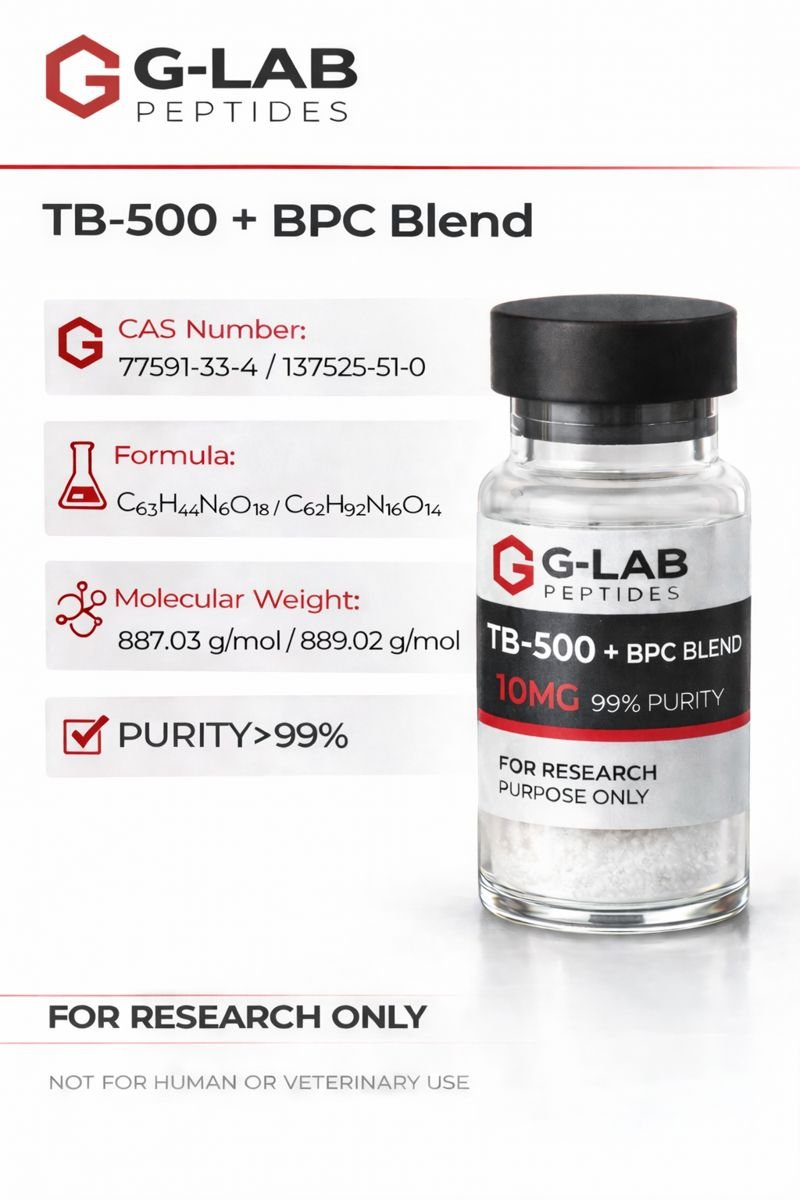
TB-500 + BPC blend (10mg)
$98.90
| Quantity | Discount | Price |
|---|---|---|
| 5 - 8 | 5% | $93.96 |
| 9+ | 10% | $89.01 |
Free shipping on orders over $200!
- Satisfaction Guaranteed
- No Hassle Refunds
- Secure Payments
TB-500 + BPC Blend (10 mg)
TB-500 + BPC Blend (10 mg) is a combined research-only peptide formulation typically containing:
TB-500 – a synthetic fragment of thymosin beta-4 (Tβ4), a 43–amino acid actin-binding peptide involved in cell migration, angiogenesis and tissue repair. PMC+2Nature+2
BPC-157 – a stable gastric pentadecapeptide (sequence GEPPPGKPADDAGLV) originally isolated from a protein in human gastric juice and widely studied as a cytoprotective and pro-healing peptide in preclinical models. PubMed+2Frontiers+2
The blend is used experimentally to probe soft-tissue regeneration, angiogenesis, microvascular protection, and organ-protection pathways in animal and in vitro models. Popular use of this combination in bodybuilding and “recovery stacks” (often marketed as the “Wolverine stack”) is based almost entirely on preclinical data on the individual peptides, not on robust studies of the fixed combination itself. The Washington Post+1
Important: To date, there is little to no peer-reviewed data specifically on a TB-500 + BPC fixed blend; the evidence base comes from separate TB-4/TB-500 studies and separate BPC-157 studies.
Specifications
Synonyms (formulation level): TB-500 + BPC-157 blend 10 mg, TB-500/BPC “recovery blend”, TB-4 fragment + BPC-157 combo
Constituents (typical research formulation):
TB-500 (synthetic Tβ4 fragment) – amount per vial defined by batch COA
BPC-157 (GEPPPGKPADDAGLV) – amount per vial defined by batch COA
Total peptide content: 10 mg (e.g., 5 mg + 5 mg, or other ratio as specified by manufacturer)
Class: Experimental tissue-repair / angiogenesis / organ-protection research peptide blend
Molecular formula / weight: Mixture (not applicable at blend level; each peptide has its own defined sequence and mass). PMC+1
Mechanism of Action and Complementary Pathways
Although the TB-500 + BPC combination has not been systematically characterized, the proposed rationale is that the two peptides act on overlapping but non-identical repair pathways.
TB-500 (Thymosin beta-4 fragment)
Studies on Tβ4 and related fragments (TB-500) indicate:
Actin regulation and cell migration:
Tβ4 is a G-actin sequestering peptide that regulates cytoskeletal organization, cell motility and tissue remodeling. ScienceDirect+1Angiogenesis & wound healing:
Tβ4 increases angiogenesis, keratinocyte and endothelial migration, and collagen deposition in wound models, accelerating repair of full-thickness skin wounds. PubMed+2Jidonline+2Cardiac repair and organ protection:
In myocardial infarction models, Tβ4 reduces infarct size, improves ventricular function and promotes cardiomyocyte survival and coronary re-growth. MDPI+3PMC+3PubMed+3Inflammation & fibrosis:
Tβ4 and Tβ4-sulfoxide modulate inflammatory cell recruitment and fibrosis, with potential roles in immune regulation and tissue remodeling. Nature+1
TB-500, as a synthetic Tβ4 fragment, is marketed and studied as a shorter, more stable surrogate intended to capture key Tβ4 actions on actin dynamics, cell migration and angiogenesis, although direct head-to-head mechanistic comparisons are limited. Wada Ama+2Apex Peptide Supply+2
BPC-157 (Stable gastric pentadecapeptide)
BPC-157 shows a different but complementary profile:
Cytoprotection and organ-protection:
BPC-157 maintains gastric integrity, protects mucosa against diverse noxious agents, and extends this “stomach cytoprotection” to systemic organ-protection (skin, liver, pancreas, heart, brain) in animal models. PubMed+2PMC+2NO system & microcirculation:
BPC-157 modulates the nitric-oxide system, counteracts both thrombosis and bleeding depending on context, and promotes circumvention (“bypassing”) of vessel occlusions via collateral microcirculation, improving outcomes in ischemia/reperfusion models. Frontiers+2PubMed+2Angiogenesis and wound healing:
It accelerates healing of skin wounds, tendon, muscle and anastomoses with improved vascular organization and granulation tissue. MDPI+3PubMed+3ScienceDirect+3
Conceptually, TB-500 contributes actin-driven cell migration and angiogenesis, while BPC-157 contributes cytoprotection, NO-dependent microvascular normalization and multi-organ repair, making the blend an attractive experimental tool to study multi-pathway tissue regeneration.
Musculoskeletal, Tendon and Soft-Tissue Regeneration Research
Thymosin beta-4 / TB-500 component
Skin and soft-tissue wounds:
Tβ4 accelerates closure of full-thickness dermal wounds, increases collagen deposition and angiogenesis, and promotes keratinocyte migration. PubMed+2Jidonline+2Cardiac and skeletal muscle:
Tβ4 has been shown to support cardiomyocyte survival, limit adverse remodeling after MI, and improve cardiac function. PubMed+3PMC+3Physiology Journals+3
BPC-157 component
Tendon and ligament healing:
BPC-157 accelerates healing of transected rat Achilles tendon and stimulates tendocyte growth in vitro, even under conditions that would normally lead to poor spontaneous repair. PubMed+2ScienceDirect+2Muscle injuries:
In quadriceps transection and other muscle-injury models, systemic BPC-157 markedly improves muscle continuity, contractile recovery and histologic architecture compared to controls. SpringerLink+1Myotendinous junction / sports-medicine context:
Reviews in orthopaedic sports medicine summarize preclinical evidence that BPC-157 improves outcomes in muscle, tendon, ligament and bone models, but stress that human data are minimal and uncontrolled. PMC
Rationale for the blend in musculoskeletal research
Because TB-500 (Tβ4 fragment) supports cell migration and angiogenesis, and BPC-157 supports microvascular stability, NO balance and multi-tissue healing, TB-500 + BPC blends are often used in experiments to explore:
Coordinated healing of muscle–tendon units
Interactions between actin dynamics, angiogenesis and NO-driven microcirculation
Recovery from high-load or trauma-induced soft-tissue injury in animal models
However, no robust comparative trials have yet established that the fixed combination is superior to either peptide alone.
Wound Healing, GI and Organ-Protection Research
TB-4 / TB-500 axis
Tβ4 research extends beyond musculoskeletal tissues:
Promotes corneal repair, epithelial migration and reduced inflammation in ocular models. IOVS+1
Shows organ-protective signals in heart and possibly other organs through anti-apoptotic, pro-angiogenic and anti-fibrotic actions. MDPI+3PMC+3Nature+3
BPC-157 axis
BPC-157 has a well-developed organ-protection literature:
GI tract:
Protects against NSAID-induced lesions, alcohol injury, colitis, ischemia/reperfusion damage and anastomotic breakdown, while improving adaptation and healing in damaged intestine. Karger Publishers+3GutnLiver+3WJGnet+3Skin and laser wounds:
Improves healing after CO₂ laser injury and multiple cutaneous wound models, both macro- and microscopically. ScienceDirect+1Systemic organ-protection:
Evidence supports protective effects in liver, pancreas, heart and brain, consistent with an extension of the original “stomach cytoprotection” concept to multi-organ protection. WJGnet+3PubMed+3PMC+3
Use of the blend
In combined TB-500 + BPC formulations, researchers may test whether:
Addition of actin-mediated cell migration (TB-500) to NO-modulating organ-protection (BPC-157) further enhances wound and organ recovery
Multi-compartment injuries (e.g., combined muscle–tendon–vascular damage) respond differently to single-agent vs combination peptide exposure
Again, such hypotheses are largely conceptual; published, peer-reviewed data on the fixed blend itself remain extremely limited.
Safety, Regulatory Status and “Stacking” Concerns
Non-approval and doping status
Neither TB-500 nor BPC-157 is approved as a drug by the U.S. FDA, EMA or other major regulatory agencies. Regulatory filings explicitly note that thymosin β4 and TB-500 have never been approved for therapeutic use. Therapeutic Goods Administration (TGA)+1
The World Anti-Doping Agency (WADA) lists thymosin-β4 and its derivatives (including TB-500) under the peptide hormone/growth factor category (S2), and BPC-157 under S0 “non-approved substances”, making them prohibited in sport. NPC Hello+5Wada Ama+5Wada Ama+5
Unregulated market and health risks
Investigations by regulators and journalists show that TB-500 and BPC-157 are commonly sold online as “research chemicals” with highly variable purity and labeling, and are used off-label by wellness clinics and individuals despite lack of safety data. AP News+5Wada Ama+5Ortho and Wellness+5
USADA and other agencies warn of serious potential risks, including immune reactions, cardiovascular events, contamination and unknown long-term effects. The Washington Post+3NPC Hello+3NPC Hello+3
Combination (“Wolverine stack”) specifically
Media and anti-doping reports highlight that stacking TB-500 and BPC-157 together is increasingly promoted to athletes and the general public under nicknames like “Wolverine stack”, with claims of extreme healing and recovery. AP News+3The Washington Post+3AP News+3
Experts caution that combining multiple unapproved peptides may increase risk due to unknown interactions, dose stacking, and cumulative toxicity. The Washington Post+2AP News+2
Therefore, TB-500 + BPC Blend (10 mg) must be treated strictly as an experimental research formulation, not as a proven or safe therapy for humans.
Other Experimental Applications
The TB-500 + BPC combination may be used in exploratory research to:
Compare single-peptide vs combination exposure in models of tendon rupture, muscle tears, bone injury, or multi-organ ischemia.
Study systems-biology responses (transcriptomics, proteomics, metabolomics) to concurrent activation of actin-regulated migration (TB-500) and NO-driven microcirculation and cytoprotection (BPC-157).
Investigate the impact of dual pro-angiogenic / organ-protective signaling in complex healing models (e.g., polytrauma, combined vascular and soft-tissue injury).
At present, such applications remain largely hypothetical and preclinical.
Research Use Only – Important Notice
This TB-500 + BPC Blend (10 mg) product is supplied exclusively for laboratory research purposes.
Not for human or veterinary use
Not for diagnostic, therapeutic, performance-enhancing, or cosmetic applications
Intended only for in vitro experiments and/or appropriately controlled animal studies by qualified professionals
All descriptions above summarize findings from preclinical and mechanistic studies of TB-4/TB-500 and BPC-157 separately, plus regulatory and anti-doping information.
They must not be interpreted as medical claims, dosage guidance, or endorsement of any clinical or self-administration use.
References
Malinda KM. et al. Thymosin β4 accelerates wound healing. J Invest Dermatol. 1999. PubMed+1
Xing Y. et al. Progress on the function and application of thymosin β4. Int J Mol Sci. 2021. PMC+2PMC+2
Crockford D. Development of thymosin beta 4 for treatment of patients with acute myocardial infarction. Expert Opin Biol Ther. 2007. PubMed+2Physiology Journals+2
Evans MA. et al. Thymosin β4-sulfoxide attenuates inflammatory cell infiltration and fibrosis. Nat Commun. 2013. Nature
Zhang G. et al. Protective effect of thymosin β4 on central nervous system tissues. Ther Adv Neurol Disord. 2020. SAGE Journals
Staresinic M. et al. Gastric pentadecapeptide BPC 157 accelerates healing of transected rat Achilles tendon and stimulates tendocyte growth. J Orthop Res. 2003. PubMed+2Wiley Online Library+2
Chang CH. et al. Promoting effect of pentadecapeptide BPC 157 on tendon fibroblast outgrowth, survival and migration. J Appl Physiol. 2011. Physiology Journals
Seiwerth S. et al. Stable gastric pentadecapeptide BPC 157 and wound healing. Front Pharmacol. 2021. PubMed+2Frontiers+2
Sikiric P. et al. Stable gastric pentadecapeptide BPC 157 and implementation of the stomach cytoprotection/organoprotection concept. Gut Liver. 2020; and related reviews. WJGnet+4GutnLiver+4PubMed+4
Gwyer D. et al. Gastric pentadecapeptide BPC 157 and muscle, tendon and ligament healing. Cell Tissue Res. 2019. SpringerLink+1
Vasireddi N. et al. Emerging use of BPC-157 in orthopaedic sports medicine: a systematic review. 2025. PMC
WADA. Prohibited List (includes thymosin-β4, TB-500 and other peptides). 2025 edition. Wada Ama+2Wada Ama+2
USADA / TGA and related regulators. Advisories and FOI on TB-500, Tβ4 and BPC-157 as unapproved substances. Wada Ama+4Therapeutic Goods Administration (TGA)+4NPC Hello+4
Investigative reports on stacked peptide use (BPC-157 + TB-500 “Wolverine stack”) and associated risks. AP News+3The Washington Post+3
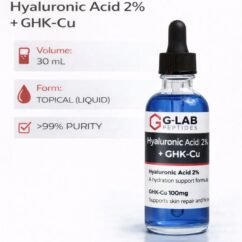 Hyaluronic Acid 2% + GHK-Cu (Serum)