
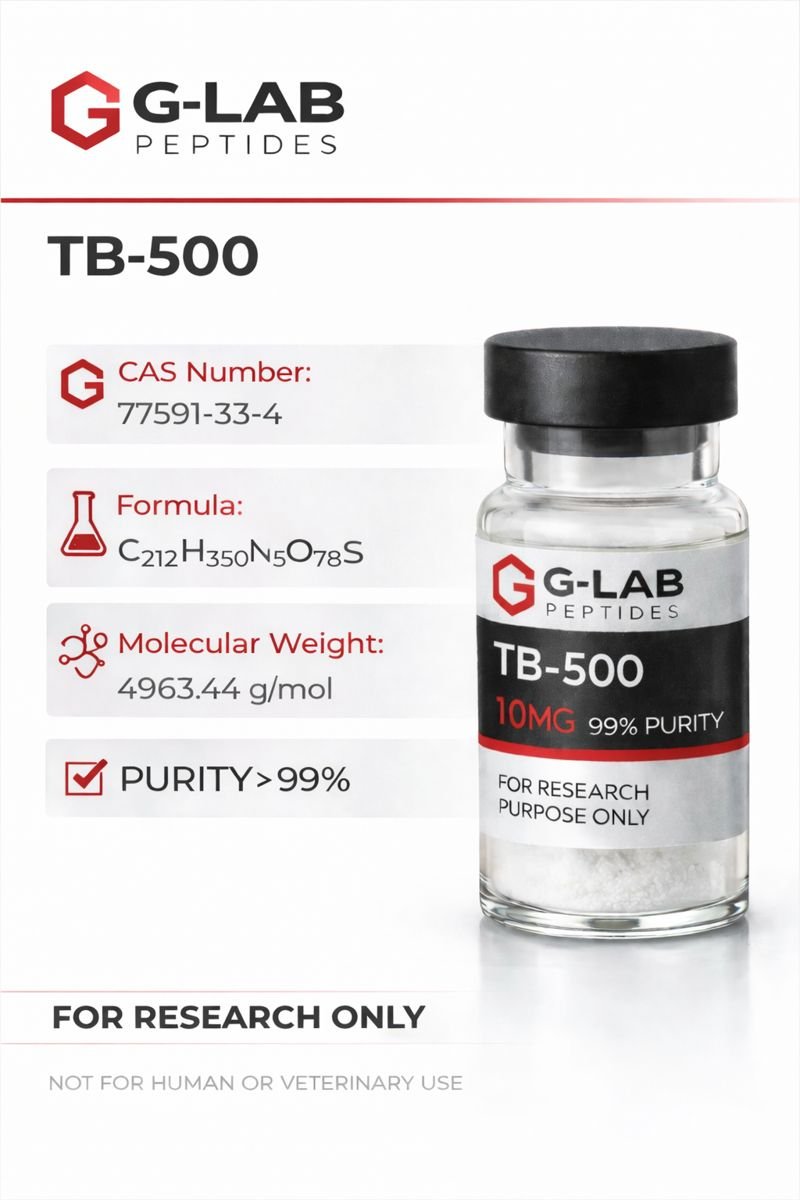
TB-500 (10mg)
$85.00
Out of stock
Free shipping on orders over $200!
- Satisfaction Guaranteed
- No Hassle Refunds
- Secure Payments
TB-500 Peptide (Thymosin β4 Fragment)
TB-500 is a synthetic peptide based on the active domain of thymosin β4 (Tβ4), a 43–amino-acid actin-binding protein highly expressed in platelets, wound fluid, and many mammalian tissues. TB-500 was designed to mimic key biological activities of Tβ4, particularly those related to cell migration, angiogenesis, cytoskeletal remodeling, and tissue repair.The Company of Biologists+3GlpBio+3TargetMol+3
Through its interaction with G-actin and downstream signaling pathways, TB-500 is widely used as a research tool in models of wound healing, cardiac repair, corneal injury, inflammation, fibrosis, and organ protection.
Specifications
Synonyms: TB-500, Thymosin β4 fragment, Thymosin beta-4 mimetic, Timbetasin
Sequence (full-length TB-500): Ac-Ser-Asp-Lys-Pro-Asp-Met-Ala-Glu-Ile-Glu-Lys-Phe-Asp-Lys-Ser-Lys-Leu-Lys-Lys-Thr-Glu-Thr-Gln-Glu-Lys-Asn-Pro-Leu-Pro-Ser-Lys-Glu-Thr-Ile-Glu-Gln-Glu-Lys-Gln-Ala-Gly-Glu-SerBioLongevity Labs+1
Molecular formula: C₂₁₂H₃₅₀N₅₆O₇₈SBioLongevity Labs+1
Molecular weight: ~4963 g/molBioLongevity Labs+1
Class: Thymosin β4–derived peptide / Actin-sequestering, tissue-repair modulator
Mechanism of Action and Actin–Cytoskeleton Remodeling
Thymosin β4 is regarded as the major G-actin sequestering peptide in mammalian cells, binding monomeric actin and regulating its polymerization into F-actin. TB-500, modeled on the LKKTETQ active site, is used experimentally to probe similar biology.Peptide Sciences+3PubMed+3FASEB Journal+3
Through this mechanism, TB-500 / Tβ4 have been shown in experimental models to:
Enhance cell migration (keratinocytes, fibroblasts, endothelial cells)
Promote angiogenesis (endothelial sprouting, tubule formation, aortic ring outgrowth)FASEB Journal+1
Support extracellular matrix deposition and collagen organization in healing tissueNature+1
Modulate Rac/F-actin pathways, impacting cell motility and cytoskeletal dynamicsNature+1
Collectively, these effects position TB-500 as a versatile research tool for dissecting how actin dynamics control tissue regeneration, vascularization, and structural repair.
TB-500, Wound Healing and Tissue Regeneration
Thymosin β4 and TB-500 have been extensively evaluated in cutaneous and soft-tissue injury models:
In murine full-thickness skin wounds, Tβ4 treatment accelerated re-epithelialization, increased collagen deposition, and enhanced wound contraction compared with controls.ScienceDirect+1
Tβ4/TB-500 exposure promotes fibroblast migration, granulation tissue formation, and improved histologic organization of healing skin.ejdent.org+1
A 2021/2025 body of work highlights Tβ4 as a key pro-regenerative peptide, with roles in diabetic ulcers, dermal burns, and chronic wounds, often reducing inflammation while promoting repair.MDPI+2SpringerLink+2
These findings support the experimental use of TB-500 in models of tissue regeneration, chronic non-healing wounds, and impaired repair due to metabolic disease or aging.
Cardiovascular and Ischemia–Reperfusion Research
Cardiac studies using Tβ4 (and related fragments) have suggested multiple cardioprotective and pro-regenerative actions:
In mouse myocardial infarction (MI) models, Tβ4 administration reduced cardiac rupture, limited infarct expansion, and improved left ventricular function.PMC+2Physiology Journals+2
Mechanistic work indicates reduced cardiomyocyte apoptosis, enhanced angiogenesis in peri-infarct regions, and activation of epicardial-derived progenitor cells, partially re-engaging embryonic repair programs.gladstone.org+2Frontiers+2
Other studies argue that endogenous Tβ4 may be dispensable for normal heart development and adult function, underscoring that exogenous peptide effects should be interpreted cautiously and remain investigational.PMC+1
TB-500 is therefore used as a tool compound in cardiac research to model pro-angiogenic and pro-survival signaling after ischemic injury, not as an established therapy.
Ocular Surface, Corneal Injury and Epithelial Repair
A major translational focus for Tβ4 derivatives has been the corneal surface:
In alkali-burn models, topical Tβ4 significantly accelerated corneal re-epithelialization, reduced stromal inflammatory cell infiltration, and improved overall corneal clarity.PMC+1
Subsequent reviews highlight Tβ4 as both pro-healing and anti-inflammatory on the ocular surface, modulating NF-κB, apoptosis and cell migration.Taylor & Francis Online+1
Ophthalmic solutions containing Tβ4 (e.g., RGN-259) have reached Phase 2/3 clinical trials for dry eye disease and neurotrophic keratopathy, with reports of improved epithelial defect closure and symptom relief, and good short-term safety profiles.ClinicalTrials.gov+3Dove Medical Press+3Nature+3
TB-500, as a Tβ4-derived peptide, is used experimentally to probe similar corneal wound-healing and anti-inflammatory mechanisms in ocular research models.
Inflammation, Fibrosis and Sepsis Models
Beyond structural repair, Tβ4/TB-500 have shown immunomodulatory actions:
In corneal and epithelial models, Tβ4 decreased NF-κB activation, IL-8 transcription, and downstream inflammatory signaling.PMC+1
In rodent models of severe systemic inflammation and sepsis, Tβ4 administration improved survival, reduced reactive oxygen species (ROS), upregulated anti-oxidative enzymes, and decreased pro-inflammatory mediators.PMC+1
Additional work suggests Tβ4 can limit fibrosis and oxidative stress in various organ-injury models, including cardiac and pulmonary systems.Wiley Online Library+1
These data support the use of TB-500 as an experimental probe for pro-resolving, anti-fibrotic, and antioxidant pathways at the interface of immunity and tissue repair.
Other Experimental Applications
TB-500 (via the Tβ4 biology) has also been investigated in:
Hair follicle and dermal appendage biology, where Tβ4 appears to influence follicle development and cyclingScienceDirect
Neonatal cardiac regeneration, extending the window of intrinsic regenerative capacity in early-life heartsFrontiers
Combination strategies (e.g., with selenium or antibiotics) to enhance healing outcomes and modulate inflammation in chronic or infected wounds.SpringerLink+1
These diverse applications highlight TB-500’s utility as a multi-pathway research tool rather than a single-target agent.
Research Use Only – Important Notice
This TB-500 (10 mg) product is supplied exclusively for laboratory research purposes.
Not for human or veterinary use
Not for diagnostic, therapeutic, or cosmetic applications
Intended only for in vitro work and/or use in appropriately controlled experimental animal models by qualified professionals
All descriptions above summarize findings from preclinical and mechanistic studies on thymosin β4 and related peptides and are provided for educational and informational purposes only. They must not be interpreted as medical claims or guidance for any form of self-administration or clinical use.
References
Philp, D. et al. The actin-binding site on thymosin β4 promotes angiogenesis, endothelial cell migration, and tubule formation. FASEB J. 2003.
https://faseb.onlinelibrary.wiley.com/doi/10.1096/fj.03-0121fje FASEB JournalGoldstein, A.L. et al. Thymosin β4: actin-sequestering protein moonlights to repair injured tissues. Trends Mol Med. 2005.
https://www.sciencedirect.com/science/article/abs/pii/S1471491405001668 ScienceDirectBelsky, J.B. et al. Thymosin β4 regulation of actin in sepsis and its protective role against organ injury. J Intensive Care Med. 2018.
https://pmc.ncbi.nlm.nih.gov/articles/PMC6556887/ PMCMalinda, K.M. et al. Thymosin β4 accelerates wound healing. J Invest Dermatol. 1999.
https://www.sciencedirect.com/science/article/pii/S0022202X15405950 ScienceDirectPeng, H. et al. Thymosin β4 prevents cardiac rupture and improves cardiac function after myocardial infarction in mice. Am J Physiol Heart Circ Physiol. 2014.
https://pmc.ncbi.nlm.nih.gov/articles/PMC4187393/ PMCShrivastava, S. et al. Thymosin β4 and cardiac repair. Ann N Y Acad Sci. 2010.
https://gladstone.org/sites/default/files/u/dsrivastava/Articles/Shrivastava-AnnNYAcadSci-2010.pdf gladstone.orgSosne, G. et al. Thymosin β4 promotes corneal wound healing and decreases inflammation in vivo following alkali injury. Exp Eye Res. 2002.
https://pmc.ncbi.nlm.nih.gov/articles/PMC2701135/ PMCKim, C.E. et al. RGN-259 (thymosin β4) improves clinically important dry eye disease signs and symptoms. Sci Rep. 2018.
https://www.nature.com/articles/s41598-018-28861-5 NatureXing, Y. et al. Progress on the function and application of thymosin β4 in tissue repair and regeneration. Front Endocrinol. 2021.
https://www.frontiersin.org/articles/10.3389/fendo.2021.767785/full FrontiersQiu, P. et al. Thymosin β4 inhibits TNF-α–induced NF-κB activation and IL-8 expression in epithelial cells. J Biol Chem. 2011.
https://pmc.ncbi.nlm.nih.gov/articles/PMC3101037/ PMC
 DSIP (5mg)