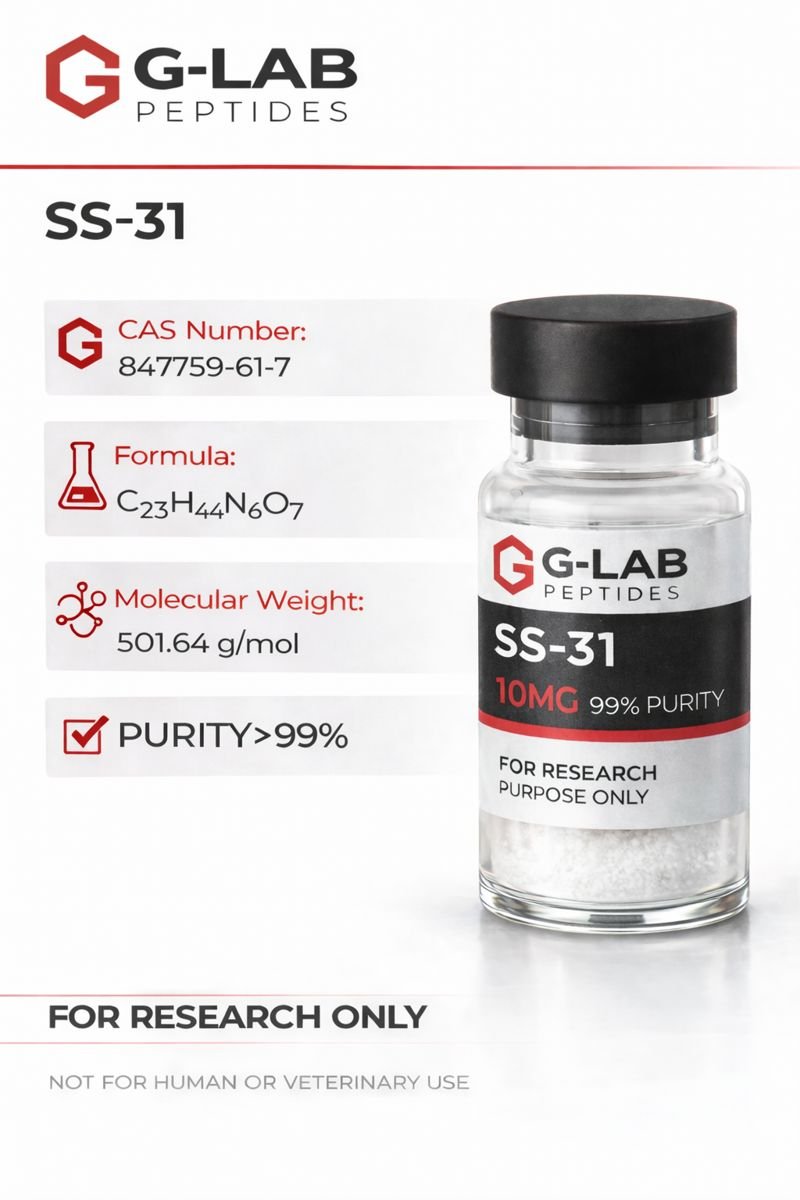
SS-31
Price range: $65.00 through $210.00
| Quantity | Discount | Price |
|---|---|---|
| 5 - 8 | 5% | $61.75 |
| 9+ | 10% | $58.50 |
Free shipping on orders over $200!
- Satisfaction Guaranteed
- No Hassle Refunds
- Secure Payments
SS-31 Peptide (10 mg)
SS-31 (also known as elamipretide, Bendavia®, or MTP-131) is a synthetic, mitochondria-targeted tetrapeptide designed to accumulate in the inner mitochondrial membrane and interact selectively with cardiolipin. By modulating cardiolipin–protein interactions, SS-31 has been widely used as a research tool to explore mitochondrial bioenergetics, oxidative stress, organ protection, and age-related cellular dysfunction in preclinical models. Alzheimer’s Drug Discovery Foundation+1
Specifications
Synonyms: SS-31, elamipretide, Bendavia®, MTP-131, Szeto–Schiller peptide 31
Sequence: D-Arg–2,6-dimethylTyr–Lys–Phe-NH₂ Frontiers+1
Molecular formula: C₃₂H₄₉N₉O₅ rnd.peptide.one
Molecular weight: ~639.8 g/mol (free peptide base) rnd.peptide.one+1
Class: Mitochondria-targeted aromatic–cationic tetrapeptide / cardiolipin-modulating antioxidant
Mechanism of Action and Mitochondrial Targeting
SS-31 belongs to the Szeto–Schiller family of aromatic–cationic peptides that carry a net positive charge and a lipophilic aromatic residue, enabling rapid cell entry and preferential accumulation in mitochondria. Stealth BioTherapeutics Inc.+1
Once inside the cell, SS-31 is driven by the mitochondrial membrane potential to the inner mitochondrial membrane, where it binds selectively to cardiolipin, a phospholipid unique to this compartment. This interaction is reported to: Alzheimer’s Drug Discovery Foundation+1
Preserve the organization of respiratory-chain supercomplexes and support efficient oxidative phosphorylation
Reduce mitochondrial reactive oxygen species (ROS) generation under stress
Maintain mitochondrial membrane potential and cristae structure
Limit opening of the mitochondrial permeability transition pore in injury models
Recent proteomic work has mapped a broader “interaction landscape” of SS-31 with mitochondrial proteins, reinforcing its role as a modulator of electron-transport–chain organization and redox homeostasis. PNAS
SS-31, Bioenergetics and Cardiac Aging
Mitochondrial dysfunction and proton leak are hallmarks of cardiac aging. In aged mouse hearts, an 8-week course of SS-31 treatment was reported to: eLife+1
Normalize age-associated increases in mitochondrial proton leak
Reduce mitochondrial ROS and protein oxidation
Shift myocardial thiol redox state toward a more reduced profile
Reverse diastolic dysfunction and improve exercise tolerance
These findings have made SS-31 a widely used compound to dissect how restoration of mitochondrial function can remodel the aged myocardial phenotype, without necessarily increasing mitochondrial content.
Cardiovascular and Ischemia–Reperfusion Research
SS-31 has been extensively evaluated in preclinical models of cardiac and vascular injury:
Myocardial ischemia–reperfusion: In rat models, mitochondria-targeted SS-peptides including SS-31 decreased infarct size and improved post-ischemic ventricular function, consistent with preserved mitochondrial structure and reduced oxidative tissue damage. ScienceDirect+1
Barth syndrome and cardiolipin deficiency: In tafazzin-deficient (TazKD) mice, SS-31 treatment improved mitochondrial respiratory efficiency, reorganized respiratory supercomplexes, and partially restored abnormal mitochondrial morphology in the heart. Nature
Clinically, elamipretide has been investigated in mitochondrial cardiomyopathy and Barth syndrome, where open-label extensions of the TAZPOWER trial have suggested improvements in cardiac stroke volume and functional parameters, although pivotal trials have yielded mixed results and evaluation is ongoing. Barth Syndrome Foundation+2Taylor & Francis Online+2
Kidney Injury and Renal Mitochondrial Stress
Mitochondria are central to tubular and glomerular cell survival; SS-31 has been used as a nephroprotective probe in several experimental settings:
In murine models of acute tubular injury and glomerular damage, the mitochondria-active tetrapeptide SS-31 reduced oxidative tissue damage, attenuated proteinuria, and preserved renal function. Frontiers+1
In diabetic and ischemia–reperfusion kidney models, SS-31 ameliorated mitochondrial dysfunction, decreased apoptosis of tubular epithelial cells, and reduced histologic markers of renal injury. PMC+2Physiological Reviews+2
Collectively, these data support the use of SS-31 as a research tool for dissecting mitochondria-dependent mechanisms in acute and chronic kidney injury.
Neuroprotection, Inflammation and CNS Models
Because neurons are highly dependent on mitochondrial ATP and vulnerable to ROS, SS-31 has been investigated in multiple neurobiological models:
A systematic review of elamipretide in neurodegeneration summarized preclinical studies in which SS-31 protected dopaminergic neurons in Parkinsonian mouse models, reduced amyloid-β accumulation in Alzheimer’s disease models, and improved mitochondrial function in cognitive-deficit paradigms. Frontiers
In neuronal and spinal cord cell models, SS-31 and its derivatives reduced mitochondrial ROS, improved ATP synthesis, and limited glutamate- or rotenone-induced apoptosis, as measured by mitochondrial potential assays and caspase activation. MDPI+1
These studies position SS-31 as a useful experimental compound for probing the interface between mitochondrial bioenergetics, neuroinflammation, and neuronal survival.
Other Experimental Applications
Metabolic and endocrine models
SS-31 has been used to explore mitochondrial contributions to β-cell survival, insulin secretion, and oxidative stress in islet transplantation and metabolic disease models, where it has been reported to reduce mitochondrial depolarization and apoptosis in islet cells and improve post-transplant function in rodents. OUP Academic+1
Peripheral ischemia–reperfusion and tissue injury
In hind-limb ischemia–reperfusion models, SS-31 administration before or after ischemia mitigated tissue damage and improved recovery, highlighting its potential for studying mitochondrial protection in skeletal muscle and vascular injury. ResearchGate+1
Drug delivery and nanocarriers
Recent work has conjugated SS-31 to liposomal carriers to create mitochondria-targeted nanoparticles. SS-31-decorated liposomes showed enhanced mitochondrial localization, reduced oxidative damage, and greater anti-apoptotic effects in endothelial and muscle cells exposed to oxidative stress in vitro. Karger Publishers
Together, these applications underscore SS-31’s value as a versatile tool compound in mitochondrial biology across diverse tissues and pathophysiologic contexts.
Research Use Only – Important Notice
This SS-31 (10 mg) product is supplied exclusively for laboratory research purposes.
Not for human or veterinary use
Not for diagnostic, therapeutic, or cosmetic applications
Intended only for in vitro experiments and/or use in appropriately controlled experimental animal models by qualified professionals
All descriptions above summarize findings from preclinical and mechanistic studies and are provided for educational and informational purposes only. They must not be interpreted as medical claims, clinical guidance, or recommendations for any form of self-administration or clinical use.
References
Chavez JD et al. Mitochondrial protein interaction landscape of SS-31. Proc Natl Acad Sci USA. 2020;117(26):15363-15373. Available at: https://www.pnas.org/doi/10.1073/pnas.2002250117 PNAS
Szeto HH. First-in-class cardiolipin-protective compound as a therapeutic agent to restore mitochondrial bioenergetics. Br J Pharmacol. 2014;171(8):2029-2050. Available at: https://bpspubs.onlinelibrary.wiley.com/doi/10.1111/bph.12461 BPS Publications+1
Li M et al. Discovery of novel SS-31 (D-Arg-dimethylTyr-Lys-Phe-NH₂) derivatives as potent agents to ameliorate inflammation and increase mitochondrial ATP synthesis. RSC Adv. 2024. Available at: https://pubs.rsc.org/en/content/articlelanding/2024/ra/d4ra05517a PMC+1
Chiao YA et al. Late-life restoration of mitochondrial function reverses cardiac dysfunction in old mice. eLife. 2020;9:e55513. Available at: https://elifesciences.org/articles/55513 eLife
Wyss JC et al. Differential effects of the mitochondria-active tetrapeptide SS-31 and its peptidase-targeted prodrugs in experimental acute kidney injury. Front Pharmacol. 2019;10:1209. Available at: https://www.frontiersin.org/articles/10.3389/fphar.2019.01209/full Frontiers+1
Sweetwyne MT et al. The mitochondrial-targeted peptide, SS-31, improves mitochondrial energetics and reverses age-related kidney damage. Kidney Int. 2017;91(5):1126-1141. Available at: https://www.kidney-international.org/article/S0085-2538(16)30652-4/fulltext Kidney International+1
Hou Y et al. Mitochondria-targeted peptide SS-31 attenuates renal injury and mitochondrial dysfunction in diabetic nephropathy. Am J Physiol Renal Physiol. 2016;310(6):F547-F559. Available at: https://journals.physiology.org/doi/10.1152/ajprenal.00574.2014 Physiological Reviews+1
Nhu NT et al. Neuroprotective effects of a small mitochondrially targeted peptide, elamipretide (SS-31), in neurodegenerative disease models: a systematic review. Front Integr Neurosci. 2022;15:747901. Available at: https://www.frontiersin.org/articles/10.3389/fnint.2021.747901/full Frontiers
Calkins MJ et al. Mitochondria-targeted antioxidant SS-31 prevents amyloid-β toxicity in neuronal cultures. Pharmaceuticals (Basel). 2012;5(10):1103-1129. Available at: https://www.mdpi.com/1424-8247/5/10/1103 MDPI
Russo S et al. SS-31 treatment ameliorates cardiac mitochondrial abnormalities and mitophagy defects in tafazzin-deficient mice. Sci Rep. 2024. Available at: https://www.nature.com/articles/s41598-024-64368-y Nature
Ravenscraft B et al. Mitochondrial cardiolipin-targeted tetrapeptide SS-31 protects spinal cord neurons from mitochondrial dysfunction and excitotoxic injury. Int J Mol Sci. 2025;26(7):3327. Available at: https://www.mdpi.com/1422-0067/26/7/3327 MDPI
Mitchell W et al. Membrane interactions of mitochondria-targeted Szeto–Schiller peptides and effects on surface electrostatics. bioRxiv. 2019. Available at: https://www.biorxiv.org/content/10.1101/735001v1.full-text bioRxiv
Related products
MOTS-c
Price range: $76.90 through $155.00Select options This product has multiple variants. The options may be chosen on the product page
Tesamorelin
Price range: $86.90 through $115.00Select options This product has multiple variants. The options may be chosen on the product page