
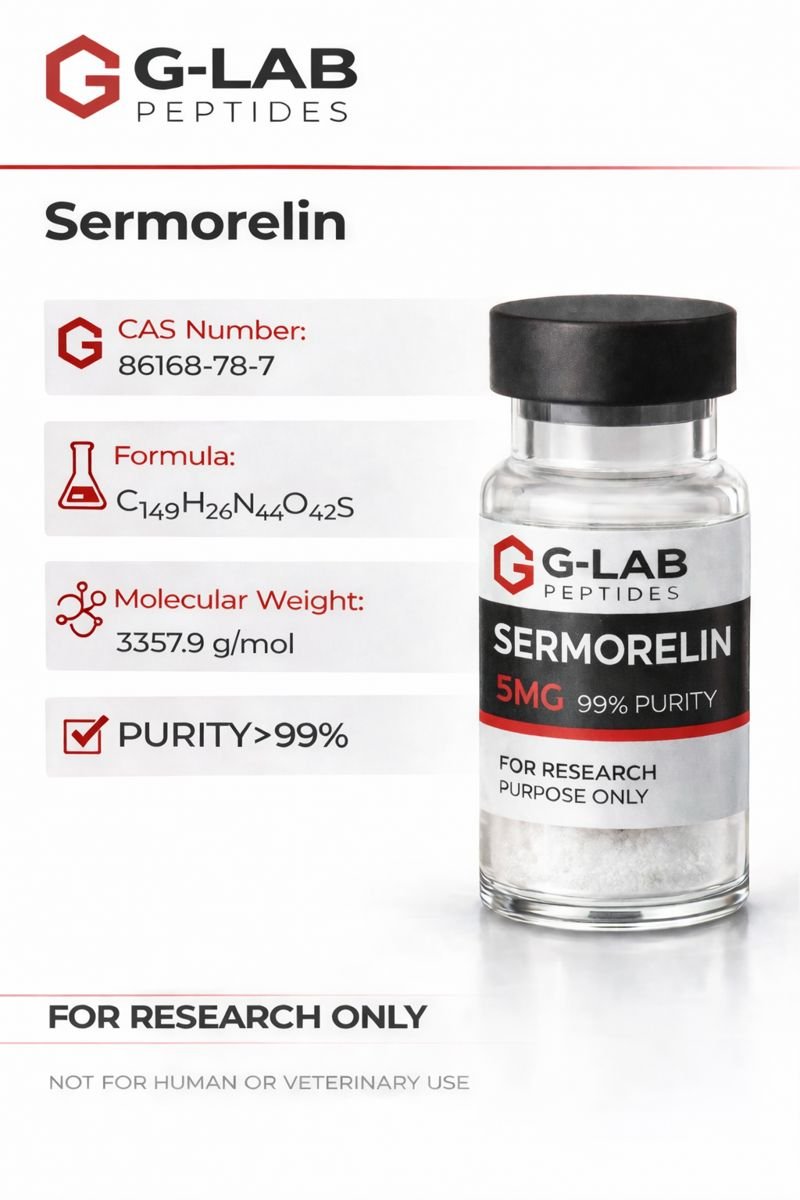
Sermorelin
Price range: $50.90 through $89.90
| Quantity | Discount | Price |
|---|---|---|
| 5 - 8 | 5% | $48.36 |
| 9+ | 10% | $45.81 |
Free shipping on orders over $200!
- Satisfaction Guaranteed
- No Hassle Refunds
- Secure Payments
Sermorelin
Sermorelin acetate (GHRH1-29) is a synthetic fragment of endogenous growth hormone–releasing hormone (GHRH) designed to bind and activate GHRH receptors in the anterior pituitary. Although shorter than the full 44–amino-acid human GHRH peptide, GHRH1-29 retains full biological activity in stimulating pulsatile growth hormone (GH) secretion in experimental models.
Specifications
Synonyms: GHRH(1-29), Sermorelin Acetate, GRF 1-29
Molecular Formula: C₁₄₉H₂₅₂N₄₄O₄₂S
Molecular Weight: 3357.9 g/mol
Class: GHRH analog / Pituitary GH Secretagogue
Mechanism of Action: GHRH Receptor Activation & GH Pulsatility
Research demonstrates that Sermorelin binds the GHRH receptor (GHRHR) on pituitary somatotropes, triggering:
cAMP accumulation via Gs protein coupling
Activation of PKA and CREB
Increased GH gene transcription
Enhanced pulsatile GH release rather than continuous stimulation
Studies also show that GHRH1-29 preserves physiologic negative feedback from IGF-1, maintaining a regulated secretory pattern similar to endogenous GH signaling.
Experimental studies have reported that Sermorelin:
Increases amplitude of GH pulses
Enhances GH responsiveness to endogenous stimuli
Supports pituitary somatotroph proliferation in some animal models
Avoids receptor desensitization typical of non-GHRH secretagogues
Growth Hormone, IGF-1, and Metabolic Research
Preclinical and controlled human research on GHRH analogs, including Sermorelin, describe several physiological actions:
1. IGF-1 Modulation
Sermorelin-stimulated GH release increases hepatic IGF-1 production, which participates in:
Protein synthesis
Muscle recovery
Tissue repair
Anticatabolic signaling pathways
A randomized trial in adults demonstrated dose-dependent increases in serum GH and IGF-1 following Sermorelin infusion.
2. Sleep-Related GH Secretion
GH secretion peaks during slow-wave sleep. Rodent studies show that GHRH analogs enhance the intensity and duration of deep sleep phases, aligning Sermorelin activity with natural circadian physiology.
3. Neuroendocrine and Cognitive Research
Central GHRH signaling has been linked to:
Memory consolidation
Stress-axis modulation
Neuroprotective activation of hippocampal circuits
Sermorelin itself is not confirmed to cross the blood-brain barrier efficiently, but peripheral GHRH receptor stimulation indirectly influences neuroendocrine pathways.
4. Body Composition & Repair
GH/IGF-1 increases induced by GHRH peptides have been associated in research contexts with:
Enhanced collagen turnover
Accelerated wound repair in animal models
Improved nitrogen retention
These findings apply to mechanistic research use and are not medical claims.
Experimental & Comparative Research
Sermorelin vs. Full-Length GHRH
Studies show GHRH(1-29):
Maintains full pituitary activity
Has shorter half-life than endogenous GHRH
Is less mitogenic than synthetic longer GHRH super-analogs
Preserves physiologic GH feedback loops
Sermorelin in Pediatric GH Studies
Historically, Sermorelin was used as a diagnostic GH secretagogue to evaluate pituitary GH reserve, demonstrating predictable and reproducible GH stimulation patterns.
Research Use Only – Important Notice
This Sermorelin 5 mg product is supplied strictly for laboratory research purposes.
Not for human or veterinary use
Not for diagnostic, therapeutic, or medical application
For in vitro studies or controlled experimental models only
Information above summarizes mechanistic and preclinical findings for educational purposes only
References
1. Walker RF et al. Growth hormone–releasing hormone analogues: structure, function, and pharmacology. Endocr Rev. 1991.
https://pubmed.ncbi.nlm.nih.gov/1722164/
2. Thorner MO et al. Stimulation of growth hormone secretion by GRF 1-29 in normal men. J Clin Invest. 1983.
https://pubmed.ncbi.nlm.nih.gov/6605479/
3. Chapman IM et al. Pharmacokinetics and endocrine effects of GHRH1-29 in adults. Clin Endocrinol. 1996.
https://pubmed.ncbi.nlm.nih.gov/8737052/
4. Obál F Jr & Krueger JM. GHRH and sleep physiology. Sleep Medicine Reviews. 2001.
https://pubmed.ncbi.nlm.nih.gov/12531152/
5. Veldhuis JD et al. GHRH control of GH pulse dynamics. Am J Physiol. 1991.
https://pubmed.ncbi.nlm.nih.gov/1872388/
6. Sonntag WE et al. GH/IGF-1 axis and tissue repair in aging animal models. J Gerontol A Biol Sci Med Sci. 2000.
https://pubmed.ncbi.nlm.nih.gov/10819307/
Related products
GHK-Cu
Price range: $58.90 through $81.90Select options This product has multiple variants. The options may be chosen on the product page
SS-31
Price range: $65.00 through $210.00Select options This product has multiple variants. The options may be chosen on the product page