Semax (10mg)
$46.99
| Quantity | Discount | Price |
|---|---|---|
| 5 - 8 | 5% | $44.64 |
| 9+ | 10% | $42.29 |
Free shipping on orders over $200!
- Satisfaction Guaranteed
- No Hassle Refunds
- Secure Payments
Semax Peptide (10 mg)
Semax (Met-Glu-His-Phe-Pro-Gly-Pro) is a synthetic analogue of the ACTH(4–10) fragment engineered to remove hormonal activity while preserving and enhancing its neuroactive properties. It is widely used in experimental neurobiology to investigate cognition, synaptic plasticity, neuroprotection, inflammatory signaling, and cerebrovascular regulation. Semax has demonstrated potent neuromodulatory effects in animal and human research settings, including modulation of BDNF pathways, antioxidant gene expression, and dopaminergic signaling.
Semax is stable, rapidly absorbed intranasally in research models, and capable of exerting central nervous system activity without crossing-reactivity to classical ACTH/MC2R hormonal pathways.
Specifications
Synonyms: ACTH(4–10) analogue; Met-Glu-His-Phe-Pro-Gly-Pro; Semax peptide
Sequence: MEHFPGP
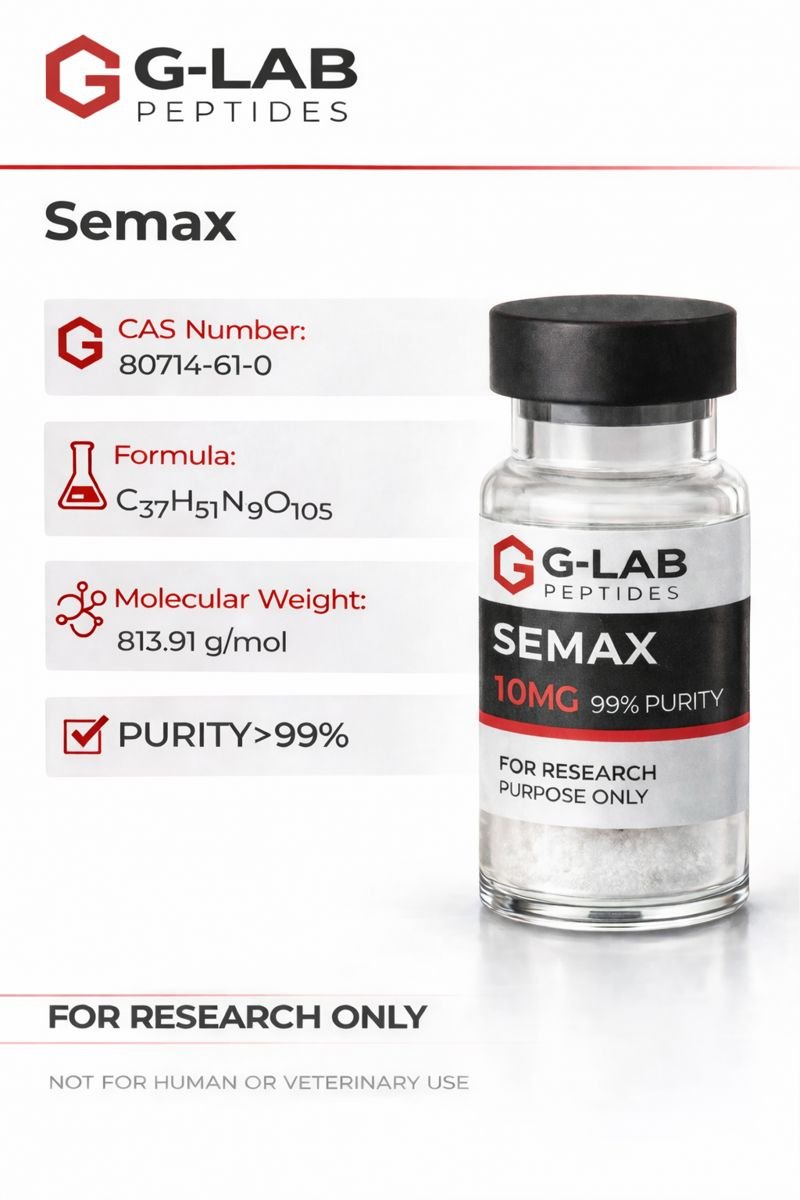
Molecular formula: C₃₇H₅₁N₉O₁₀
Molecular weight: 799.86 g/mol
Class: Synthetic heptapeptide / neuroactive ACTH fragment analogue / nootropic research peptide
Mechanism of Action and Neurotrophic Signaling
Semax modulates multiple neurobiological pathways, most notably BDNF (brain-derived neurotrophic factor) and its downstream cascades:
1. BDNF Upregulation and TrkB Signaling
Experimental work has shown that Semax significantly increases BDNF mRNA expression in the hippocampus and frontal cortex, enhancing synaptic plasticity and long-term potentiation.
This is associated with activation of MAPK/ERK, PI3K/Akt, and CaMKII signaling networks.
2. Antioxidant and Stress-Response Gene Regulation
Transcriptomic studies demonstrate that Semax upregulates genes involved in:
Antioxidant defense (SOD, catalase)
Anti-inflammatory modulation
Neuronal survival during hypoxic/ischemic stress
Administration in rat models led to rapid induction of neuroprotective gene clusters following cerebral ischemia.
3. Modulation of Dopaminergic and Serotonergic Systems
Semax enhances dopaminergic transmission in the nucleus accumbens and frontal cortex, contributing to its experimental cognitive and behavioral effects.
4. Neurovascular and Cerebroprotective Effects
Semax can improve cerebral microcirculation under ischemic conditions, reduce endothelial inflammation, and prevent free-radical damage in experimental stroke models.
Semax in Cognitive Research and Memory Models
Learning and Memory Enhancement
Animal studies show Semax improves:
Spatial learning
Memory consolidation
Attention and task performance
This has been attributed to its modulation of neurotrophic factors and monoaminergic neurotransmission.
Attention and Executive Function
Human neuropsychological studies in controlled settings found improved attention stability, reduced mental fatigue, and enhanced resistance to cognitive overload following Semax administration.
These findings support its use as a research tool for studying cognition, neuroplasticity, and functional brain activation under stress.
Semax in Ischemia, Neurotrauma, and Inflammation Models
Cerebral Ischemia and Stroke Research
In rodent ischemia models, Semax administration:
Reduced infarct volume
Decreased pro-inflammatory cytokines (TNF-α, IL-1β)
Preserved neuronal viability
Normalized blood–brain barrier permeability
Oxidative Stress and Neuronal Protection
Semax increased expression of anti-apoptotic and antioxidant genes, limiting free-radical injury after experimental hypoxia.
Immune and Stress Response
Transcriptomic studies identified strong modulation of genes associated with:
Immune cell activation
Cytokine production
Glutamatergic signaling
Other Experimental Applications
1. Pain and Analgesia Research
Semax influences nociceptive thresholds and may modulate pain transmission through interactions with melanocortin and neurotrophin signaling circuits.
2. Neurodevelopment and Plasticity
Semax has been used to study neurogenesis and synaptic remodeling, especially in models where BDNF regulation is central.
3. Stress Adaptation and Behavioral Resilience
Research indicates improved behavioral responses under acute or chronic stress, likely linked to dopaminergic and BDNF-mediated plasticity.
Research Use Only – Important Notice
This Semax (10 mg) product is supplied exclusively for laboratory research purposes.
Not for human or veterinary use
Not for diagnostic, therapeutic, or clinical application
Intended solely for in vitro and controlled in vivo experimental systems
Must be handled only by qualified laboratory professionals
All descriptions provided summarize findings from preclinical and early-stage human research and must not be interpreted as medical or clinical claims of safety or efficacy.
References
Inozemtseva AA et al. Semax modulates expression of genes related to neurotransmission and neurotrophic pathways. Front Pharmacol.
https://www.frontiersin.org/articles/10.3389/fphar.2021.637995/fullNavolotskaya EV et al. Peptide Semax: Mechanisms of neuroprotection and neurotrophic regulation. Neurosci Behav Physiol.
https://pubmed.ncbi.nlm.nih.gov/16465412/Andreeva LA et al. Transcriptomic response to Semax after cerebral ischemia in rats. Mol Biol Reports.
https://pubmed.ncbi.nlm.nih.gov/32914367/Ashmarin IP et al. Semax and cognitive performance under high mental load. Hum Physiol.
https://pubmed.ncbi.nlm.nih.gov/10852105/Volkova TV et al. Semax-induced BDNF upregulation in hippocampal structures. Bull Exp Biol Med.
https://pubmed.ncbi.nlm.nih.gov/15339073/Andreeva LA et al. Gene networks modulated by Semax during ischemic injury. Mol Biol (Mosk).
https://pubmed.ncbi.nlm.nih.gov/32852230/Ashmarin IP et al. Analgesic properties of Semax in animal models. Bull Exp Biol Med.
https://pubmed.ncbi.nlm.nih.gov/12564714/Kolomin T et al. Neuroprotective effects of Semax in oxidative stress models. Front Neurosci.
https://www.frontiersin.org/articles/10.3389/fnins.2020.00059/full