
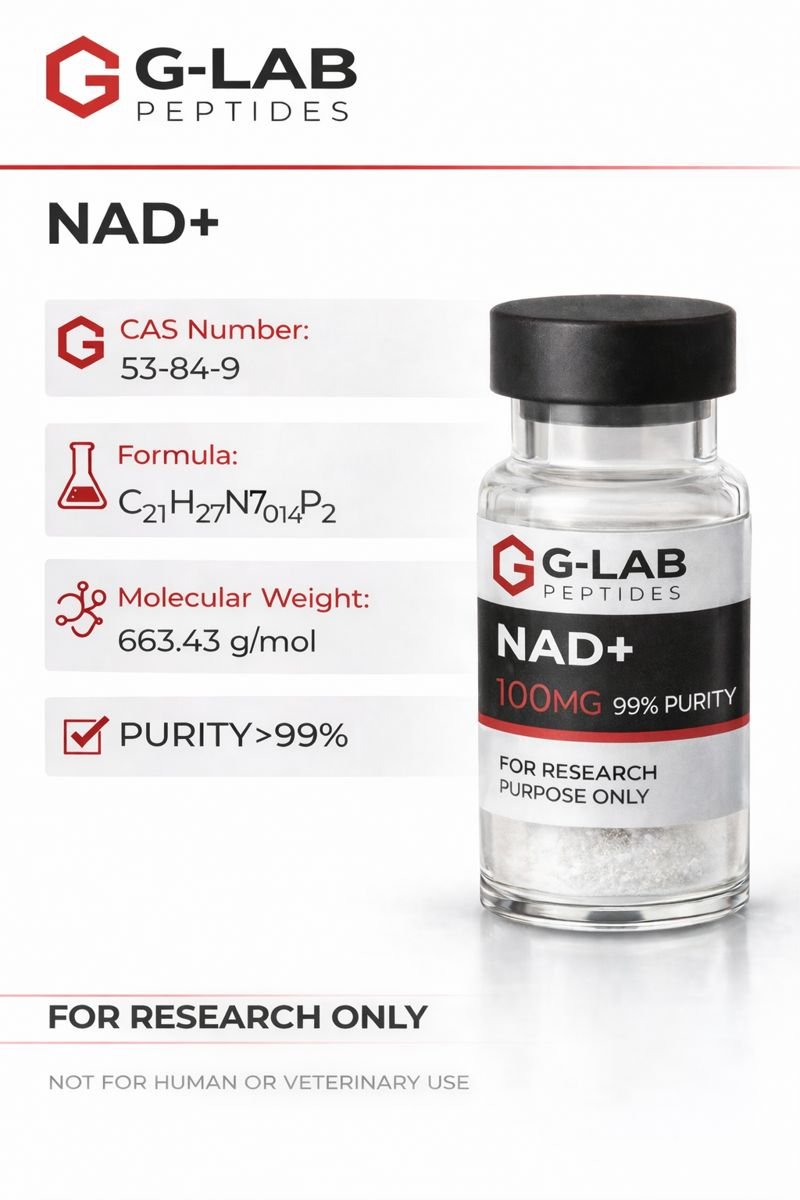
NAD+ (1000mg)
$108.90
| Quantity | Discount | Price |
|---|---|---|
| 5 - 8 | 5% | $103.46 |
| 9+ | 10% | $98.01 |
Free shipping on orders over $200!
- Satisfaction Guaranteed
- No Hassle Refunds
- Secure Payments
NAD+ (Nicotinamide Adenine Dinucleotide, Oxidized Form)
Nicotinamide adenine dinucleotide (NAD⁺) is a ubiquitous pyridine nucleotide that functions both as a central redox cofactor and as a substrate for signaling enzymes. It is essential for oxidative metabolism, glycolysis, the TCA cycle, and mitochondrial respiration, while also fueling NAD⁺-consuming enzymes such as sirtuins, PARPs, CD38/CD157 and SARM1.Taylor & Francis Online+3PMC+3Nature+3
By linking cellular energy status to gene expression, DNA repair, stress resistance, immune regulation and aging pathways, NAD⁺ has become a key focus in research on metabolism, neurodegeneration, cardiovascular disease, inflammation and longevity.PMC+2Wiley Online Library+2
Specifications
Synonyms: NAD⁺, oxidized nicotinamide adenine dinucleotide, β-NAD⁺
Molecular formula: C₂₁H₂₇N₇O₁₄P₂Taylor & Francis Online
Molecular weight: ~663.4 g/molTaylor & Francis Online
Class: Pyridine nucleotide / redox cofactor / signaling metabolite
Research category: Bioenergetics, redox biology, DNA repair, immunometabolism, aging research
Mechanism of Action and NAD⁺ Signaling
Redox Cofactor and Energy Metabolism
NAD⁺/NADH form a central redox pair that shuttles electrons in:
Glycolysis
Pyruvate dehydrogenase complex
Tricarboxylic acid (TCA) cycle
Fatty-acid β-oxidation
Mitochondrial respiratory chain (complex I–III)PMC+2ScienceDirect+2
Through these reactions, NAD⁺ supports ATP production and governs the balance between glycolysis and oxidative phosphorylation, influencing metabolic flexibility and mitochondrial dynamics (fusion, fission and mitophagy).PMC+2ScienceDirect+2
NAD⁺ as a Substrate for Enzymatic Signaling
Beyond redox, NAD⁺ is cleaved or consumed by several enzyme families:
Sirtuins (SIRT1–7): NAD⁺-dependent deacylases that regulate chromatin structure, mitochondrial biogenesis, oxidative stress responses and metabolic reprogramming.
PARPs (poly(ADP-ribose) polymerases): DNA-damage sensors that use NAD⁺ to build ADP-ribose polymers on target proteins, coupling genomic stress to repair and cell-death decisions.
CD38 / CD157: Ectoenzymes that convert NAD⁺ into calcium-mobilizing messengers (cADPR, ADPR), thereby influencing immune activation, calcium signaling and inflammaging.MDPI+3PMC+3PMC+3
As a consequence, intracellular NAD⁺ levels act as a rheostat that tunes multiple pathways: mitochondrial fitness, DNA repair, inflammatory responses, senescence and cell survival.
NAD⁺, Cellular Energetics and Metabolic Homeostasis
NAD⁺ is now recognized as a master regulator of energy homeostasis:
In metabolic tissues (liver, adipose, skeletal muscle), declining NAD⁺ is linked to insulin resistance, lipid accumulation, mitochondrial dysfunction and oxidative stress.Nature+2PMC+2
Experimental restoration of NAD⁺ (genetic or nutrient precursors) improves mitochondrial respiration, fatty-acid oxidation, glucose tolerance and exercise capacity in multiple animal models of obesity and metabolic syndrome.PMC+2PMC+2
In cardiac tissue, NAD⁺ metabolism influences contractile function, ischemia–reperfusion tolerance, and age-related cardiomyopathy, partly via crosstalk between PARPs, sirtuins and mitochondrial quality control.AHA Journals+1
These findings make NAD⁺ and its metabolic network valuable targets for cardiometabolic and mitochondrial research.
NAD⁺, DNA Damage, Sirtuins and Aging
Accumulating data implicate NAD⁺ in senescence regulation and organismal aging:
DNA damage activates PARPs, rapidly consuming NAD⁺ in the nucleus. Persistent PARP activation in aged tissues drives NAD⁺ depletion, reduced SIRT1 activity, impaired mitophagy and mitochondrial decline.Wiley Online Library+2SpringerLink+2
Restoring NAD⁺ levels in aged or stressed cells has been shown to enhance SIRT1/3/6 signaling, improve mitochondrial function, reduce oxidative damage and modulate inflammatory gene expression.PMC+2Wiley Online Library+2
Reviews on NAD⁺ and aging emphasize that NAMPT-mediated salvage, sirtuins, PARPs and CD38 form an integrated network controlling lifespan-relevant pathways (metabolism, DNA repair, ECM remodeling, immune tone).Wiley Online Library+2Taylor & Francis Online+2
NAD⁺ is therefore extensively used in models of cellular senescence, longevity, neurodegeneration and age-related disease.
NAD⁺ in Neurobiology and Neurodegeneration
Neurons are highly dependent on mitochondrial NAD⁺ pools to sustain ATP production and maintain axonal integrity:
NAD⁺ participates in neuronal redox balance and supports resilience against excitotoxic, oxidative and proteotoxic stress.PMC+1
In models of Alzheimer’s, Parkinson’s and other neurodegenerative diseases, reduced NAD⁺ is associated with mitochondrial dysfunction, impaired autophagy, increased DNA damage and neuroinflammation.SpringerLink+1
Experimental restoration of NAD⁺ (via precursors or PARP/CD38 modulation) can enhance mitochondrial clearance, synaptic function and neuronal survival in preclinical systems, although translation to humans remains under active investigation.SpringerLink+2PMC+2
Because of this, NAD⁺ is a central read-out and intervention target in brain-energy, cognition and neurodegeneration research.
NAD⁺ in Immunometabolism and Inflammation
Recent work highlights NAD⁺ as a key regulator of immune cell activation and inflammatory tone:
NAD⁺ levels shape macrophage and T-cell phenotype, influencing the balance between pro-inflammatory and regulatory states through sirtuins, PARPs and CD38.PMC+1
During infections and sepsis, inflammatory signaling can perturb NAD⁺ pathways, altering both energy metabolism and antiviral responses. Dysregulated NAD⁺ metabolism has been reported in viral infections such as COVID-19.Frontiers+1
NAD⁺-boosting or NAD⁺-preserving strategies (e.g., salvage-pathway activation, PARP inhibition, CD38 inhibition) are being investigated as ways to modulate autoimmunity, inflammaging and tissue-destructive immune responses in preclinical models.PMC+2MDPI+2
These studies position NAD⁺ metabolism at the interface between energy metabolism and immune regulation.
NAD⁺ Precursors, Boosting Strategies and Clinical Research
Because NAD⁺ declines with age and in multiple disease states, various strategies are being studied to modulate its levels:
Nicotinamide riboside (NR) and nicotinamide mononucleotide (NMN) are the most widely tested oral NAD⁺ precursors in human trials, consistently raising blood NAD⁺ concentrations.PMC+2ScienceDirect+2
Clinical trials have explored their effects on insulin sensitivity, vascular function, muscle performance, liver fat and markers of aging, with generally good safety profiles but mixed efficacy outcomes.PMC+2ScienceDirect+2
Systems-based supplement formulations targeting multiple nodes of the salvage pathway have also been shown to significantly increase whole-blood NAD⁺ in randomized controlled settings.Nature+1
Direct NAD⁺ itself is primarily used as a research reagent; its pharmacokinetics and optimal delivery routes for clinical purposes remain under investigation.
Other Experimental Applications
NAD⁺ and its redox pair NADH are widely used in:
Live-cell imaging and metabolic flux analysis (e.g., fluorescence lifetime imaging of NAD(P)H to monitor metabolic state).FEBS Journal+1
In vitro enzyme assays involving dehydrogenases and oxidoreductases.
Studies dissecting compartment-specific NAD⁺ pools, including mitochondrial uptake via carriers such as SLC25A51/MCART1.science.org+1
These applications make NAD⁺ a core small molecule in biochemistry, cell biology and systems metabolism.
Research Use Only – Important Notice
This NAD⁺ (100 mg) product is supplied exclusively for laboratory research purposes.
Not for human or veterinary use
Not for diagnostic, therapeutic, or cosmetic applications
Intended only for in vitro experiments and/or appropriately controlled animal studies conducted by qualified professionals
All descriptions above summarize findings from preclinical and mechanistic studies (plus limited human supplementation trials) and are provided for informational and educational purposes only. They must not be interpreted as medical claims or guidance for any form of self-administration or clinical use.
References
Amjad, S. et al. Role of NAD⁺ in Regulating Cellular and Metabolic Signaling. Int J Mol Sci. 2021.
https://pmc.ncbi.nlm.nih.gov/articles/PMC7973386/ PMCXie, N. et al. NAD⁺ Metabolism: Pathophysiologic Mechanisms and Therapeutic Potential. Signal Transduct Target Ther. 2020.
https://www.nature.com/articles/s41392-020-00311-7 NatureCantó, C., Menzies, K.J., Auwerx, J. NAD⁺ Metabolism and the Control of Energy Homeostasis. J Cell Biol. 2015.
https://pmc.ncbi.nlm.nih.gov/articles/PMC4487780/ PMCYang, Y., Sauve, A.A. NAD⁺ Metabolism: Bioenergetics, Signaling and Manipulation for Therapy. Antioxid Redox Signal. 2016.
https://pmc.ncbi.nlm.nih.gov/articles/PMC5521000/ PMCNikiforov, A. et al. The Human NAD Metabolome: Functions, Metabolism and Regulation. Crit Rev Biochem Mol Biol. 2015.
https://www.tandfonline.com/doi/full/10.3109/10409238.2015.1028612 Taylor & Francis OnlineChini, C.C.S. et al. NAD Metabolism: Role in Senescence Regulation and Aging. Aging Cell. 2024.
https://onlinelibrary.wiley.com/doi/10.1111/acel.13920 Wiley Online LibraryAbdellatif, M. et al. NAD⁺ Metabolism in Cardiac Health, Aging and Disease. Circulation. 2021.
https://www.ahajournals.org/doi/10.1161/CIRCULATIONAHA.121.056589 AHA JournalsWu, J. et al. Targeting NAD⁺ Metabolism to Modulate Autoimmunity and Inflammation. Trends Immunol. 2024.
https://pmc.ncbi.nlm.nih.gov/articles/PMC10954088/ PMCChen, C. et al. NAD⁺ Metabolism and Immune Regulation. Antioxidants. 2023.
https://www.mdpi.com/2076-3921/12/6/1230 MDPIFreeberg, K.A. et al. Dietary Supplementation With NAD⁺-Boosting Compounds in Humans. Nutrients. 2023.
https://pmc.ncbi.nlm.nih.gov/articles/PMC10692436/ PMCSong, Q. et al. Safety and Anti-Aging Effects of Nicotinamide Mononucleotide Supplementation. Clin Nutr. 2023.
https://www.sciencedirect.com/science/article/pii/S2161831323013595 ScienceDirectHenderson, J.D. et al. A Systems Approach to Increase NAD⁺ in Humans. NPJ Aging. 2024.
https://www.nature.com/articles/s41514-023-00134-0 Nature
Related products
SS-31
Price range: $65.00 through $210.00Select options This product has multiple variants. The options may be chosen on the product page
GHK-Cu
Price range: $58.90 through $81.90Select options This product has multiple variants. The options may be chosen on the product page
Tesamorelin
Price range: $86.90 through $115.00Select options This product has multiple variants. The options may be chosen on the product page
 KPV (10mg)