
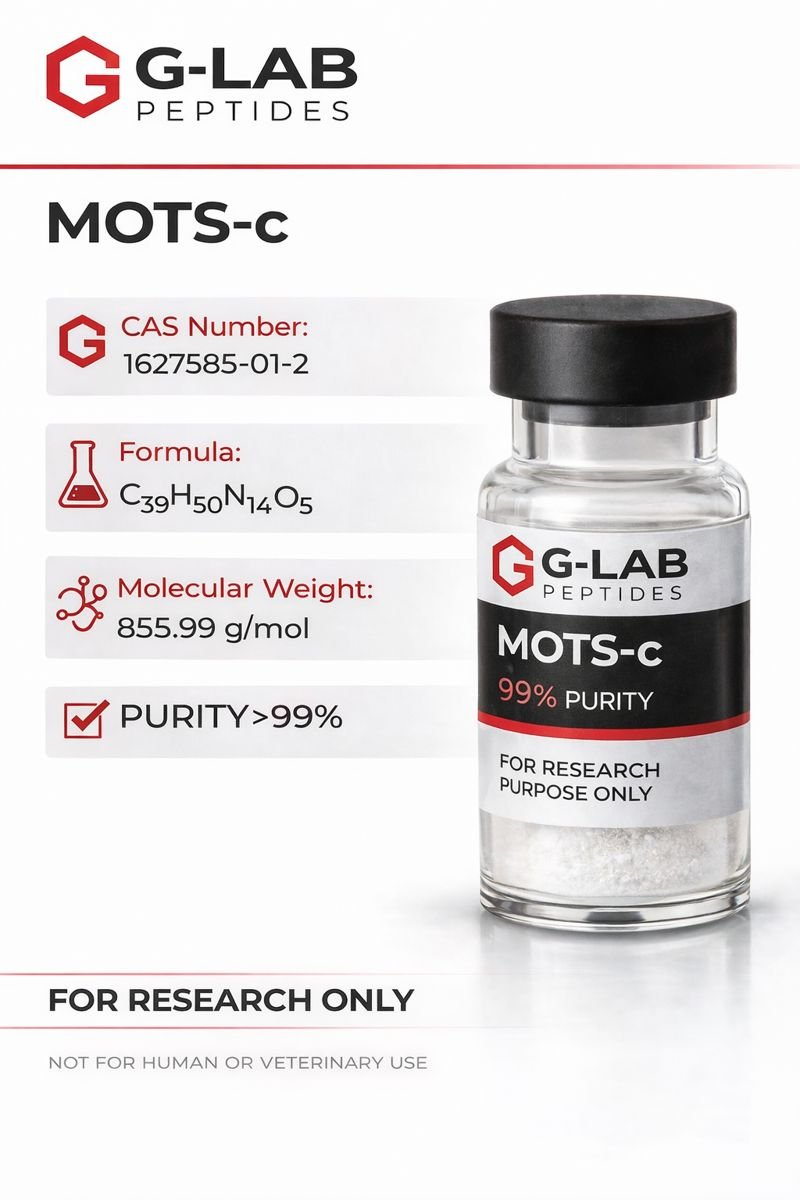
MOTS-c
Price range: $76.90 through $155.00
| Quantity | Discount | Price |
|---|---|---|
| 5 - 8 | 5% | $73.06 |
| 9+ | 10% | $69.21 |
Free shipping on orders over $200!
- Satisfaction Guaranteed
- No Hassle Refunds
- Secure Payments
MOTS-c Peptide
Mitochondrial-Derived Peptide Regulating Metabolic Homeostasis and Cellular Stress Responses
MOTS-c (Mitochondrial Open Reading Frame of the 12S rRNA-c) is a mitochondrial-encoded bioactive peptide consisting of 16 amino acids, classified as a member of the mitochondrial-derived peptide (MDP) family. Unlike nuclear-encoded peptides, MOTS-c is transcribed from mitochondrial DNA and plays a critical role in metabolic regulation, cellular stress adaptation, insulin sensitivity, and mitochondrial–nuclear communication.
MOTS-c functions as a signaling molecule that links mitochondrial metabolic status to nuclear gene expression, allowing cells to adapt to energetic and oxidative stress conditions.
Specifications
Synonyms: MOTS-c, Mitochondrial Open Reading Frame of the 12S rRNA-c
Amino acid sequence: MRWQEMGYIFYPRKLR
Length: 16 amino acids
Molecular weight: ~2.1 kDa
Class: Mitochondrial-derived regulatory peptide (MDP)
Mechanism of Action and Cellular Signaling
MOTS-c acts primarily as a metabolic stress-responsive peptide. Under conditions such as glucose restriction, oxidative stress, or mitochondrial dysfunction, MOTS-c translocates from the cytoplasm into the nucleus, where it directly influences gene expression.
Experimental studies demonstrate that MOTS-c:
Activates AMP-activated protein kinase (AMPK) signaling
Modulates folate-dependent one-carbon metabolism
Regulates nuclear transcription programs involved in energy balance
Enhances cellular resistance to metabolic stress
Once internalized, MOTS-c inhibits the folate cycle at the level of 5-methyltetrahydrofolate, leading to accumulation of AICAR-like metabolites and subsequent AMPK activation. This positions MOTS-c as an endogenous mitochondrial regulator of AMPK-dependent pathways.
MOTS-c and Metabolic Homeostasis
MOTS-c has been extensively studied in the context of glucose metabolism and insulin sensitivity:
In mouse models, systemic MOTS-c administration improved glucose tolerance and insulin responsiveness
MOTS-c prevented diet-induced obesity and reduced adiposity despite high-fat feeding
Enhanced glucose uptake in skeletal muscle via AMPK-dependent mechanisms
Human observational studies have shown that circulating MOTS-c levels decline with aging, insulin resistance, and metabolic syndrome, suggesting a role in age-related metabolic dysfunction.
MOTS-c, Exercise Physiology and Skeletal Muscle
MOTS-c has been proposed as an exercise-responsive mitochondrial signal:
Exercise increases endogenous MOTS-c expression in skeletal muscle
MOTS-c enhances muscle glucose utilization and fatty acid oxidation
Improves endurance capacity in animal models independent of training
These findings support the concept that MOTS-c functions as a mitochondrial-encoded “exercise mimetic” signal, coordinating energy demand with nuclear metabolic adaptation.
Cellular Protection, Stress Resistance and Aging Research
Beyond metabolism, MOTS-c has demonstrated cytoprotective properties:
Increases resistance to oxidative stress
Protects cells from mitochondrial dysfunction-induced apoptosis
Maintains mitochondrial membrane potential under stress conditions
Age-related decline in MOTS-c expression has been associated with reduced metabolic flexibility and increased susceptibility to cellular stress, positioning MOTS-c as a target of interest in aging and longevity research.
MOTS-c and Inflammatory Regulation
Preclinical models indicate that MOTS-c may modulate inflammatory signaling:
Reduces expression of pro-inflammatory cytokines (TNF-α, IL-6)
Improves metabolic inflammation associated with obesity
Links mitochondrial function with immune-metabolic regulation
These effects are thought to be secondary to improved mitochondrial efficiency and AMPK-mediated suppression of inflammatory pathways.
Other Experimental Applications
Mitochondrial-nuclear communication studies
Insulin resistance and metabolic disease models
Exercise physiology and endurance signaling
Aging and cellular stress adaptation research
MOTS-c is considered a foundational research peptide for understanding how mitochondria actively regulate whole-cell and organism-level metabolism.
Research Use Only – Important Notice
This MOTS-c (10 mg) product is supplied exclusively for laboratory research purposes.
Not for human or veterinary use
Not for diagnostic, therapeutic, or cosmetic applications
Intended for in vitro studies and controlled experimental animal models only
All information presented reflects preclinical and mechanistic research findings
No statements herein should be interpreted as medical claims or guidance for self-administration.
References
Lee C. et al. MOTS-c: A mitochondrial-encoded peptide that regulates insulin sensitivity and metabolic homeostasis. Cell Metabolism 2015;21(3):443–454.
https://www.sciencedirect.com/science/article/pii/S1550413115000720Kim K.H. et al. MOTS-c: A novel mitochondrial-derived peptide regulating muscle glucose metabolism and exercise capacity. Journal of Cachexia, Sarcopenia and Muscle 2018.
https://onlinelibrary.wiley.com/doi/10.1002/jcsm.12345Reynolds J.C. et al. Mitochondrial-derived peptides and their roles in metabolism and aging. Trends in Endocrinology & Metabolism 2021;32(10):814–825.
https://www.sciencedirect.com/science/article/pii/S1043276021001443Zarse K. et al. MOTS-c improves metabolic homeostasis and promotes stress resistance. Aging Cell 2019;18(4):e12938.
https://onlinelibrary.wiley.com/doi/10.1111/acel.12938Lu H. et al. Circulating MOTS-c levels are associated with aging and insulin resistance in humans. Endocrine Journal 2020;67(4):345–352.
https://www.jstage.jst.go.jp/article/endocrj/67/4/67_EJ19-0462/_article
Related products
GHK-Cu
Price range: $58.90 through $81.90Select options This product has multiple variants. The options may be chosen on the product page
SS-31
Price range: $65.00 through $210.00Select options This product has multiple variants. The options may be chosen on the product page
Tesamorelin
Price range: $86.90 through $115.00Select options This product has multiple variants. The options may be chosen on the product page
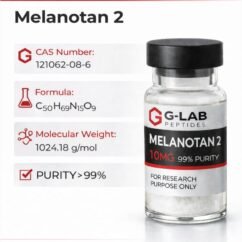 Melanotan 2 (10mg)
  IGF DES (2mg)