
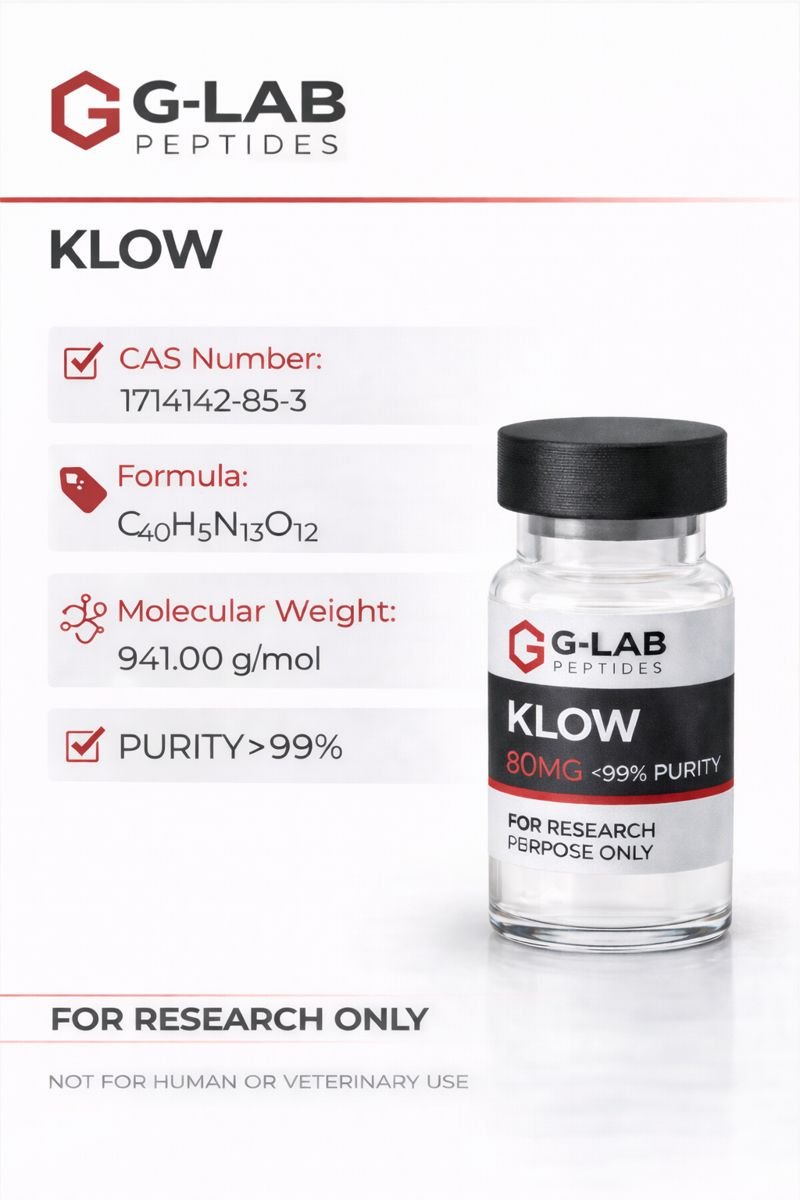
KLOW 80mg
$145.00
Out of stock
Free shipping on orders over $200!
- Satisfaction Guaranteed
- No Hassle Refunds
- Secure Payments
KLOW — Peptide Blend
(GHK-Cu 50mg + BPC-157 10mg + TB-500 10mg + KPV 10mg)
Skin Repair, Inflammation Modulation & Tissue-Regeneration Signaling
KLOW is a multi-peptide research blend formulated to investigate skin regeneration, inflammation modulation, and extracellular matrix (ECM) remodeling.
The blend combines GHK-Cu, BPC-157, TB-500, and KPV—four bioactive peptides widely studied for their complementary roles in cell migration, angiogenesis, immune balance, and tissue repair signaling.
Composition
GHK-Cu (Copper Tripeptide-1)
BPC-157 (Body Protection Compound)
TB-500 (Thymosin Beta-4 fragment)
KPV (Lys–Pro–Val)
Mechanistic Overview
GHK-Cu — ECM Remodeling & Skin Signaling
GHK-Cu is a naturally occurring human tripeptide involved in collagen synthesis, elastin organization, and antioxidant defense. Experimental studies show modulation of gene expression related to skin regeneration and firmness.
BPC-157 — Cytoprotection & Tissue Repair
BPC-157 is a gastric-derived peptide investigated for cytoprotective, angiogenic, and anti-inflammatory signaling. It is frequently used in research models of soft-tissue healing, endothelial integrity, and fibroblast migration.
TB-500 — Cell Migration & Angiogenesis
TB-500, a synthetic fragment of thymosin beta-4, is studied for its role in actin regulation, cell motility, and angiogenic pathways, making it a key peptide in wound-healing and tissue-regeneration models.
KPV — Anti-Inflammatory & Immune-Modulating Peptide
KPV (Lys–Pro–Val) is a tripeptide derived from α-melanocyte–stimulating hormone (α-MSH).
Research demonstrates that KPV can modulate NF-κB signaling, reduce pro-inflammatory cytokine expression, and support immune balance in epithelial and skin models—without melanocortin receptor activation.
KPV is commonly studied for:
Inflammation downregulation
Skin barrier support
Redness and irritation signaling pathways
Gut–skin immune axis research
Synergistic Research Rationale
The KLOW blend integrates four complementary biological axes:
Structural repair & collagen remodeling → GHK-Cu
Cytoprotection & vascular support → BPC-157
Cell migration & angiogenesis → TB-500
Inflammation control & immune balance → KPV
This synergy allows investigation of skin recovery, post-inflammatory repair, and tissue-regeneration signaling in complex experimental models.
Primary Experimental Applications
Skin regeneration and dermal remodeling research
Inflammatory skin-condition models
Wound-healing and angiogenesis studies
ECM turnover and collagen organization
Barrier repair and post-inflammatory signaling
Research Use Only — Important Notice
This KLOW peptide blend is supplied exclusively for laboratory research purposes.
Not for human or veterinary use
Not for diagnostic, therapeutic, or cosmetic applications
Intended only for in vitro research and/or use in appropriately controlled experimental models by qualified professionals
All descriptions above summarize findings from preclinical and mechanistic research and are provided for educational and informational purposes only.
References
Pickart L., Margolina A.
Regenerative and protective actions of the GHK-Cu peptide in the skin.
International Journal of Molecular Sciences, 2018;19(7):1987.
https://www.mdpi.com/1422-0067/19/7/1987Sikiric P. et al.
Stable gastric pentadecapeptide BPC-157 and tissue repair mechanisms.
Current Pharmaceutical Design, 2011;17(16):1612–1632.
https://pubmed.ncbi.nlm.nih.gov/21524264/Goldstein A.L., Kleinman H.K.
Thymosin beta-4: actin-sequestering peptide with roles in wound healing and angiogenesis.
Trends in Molecular Medicine, 2003;9(12):512–518.
https://pubmed.ncbi.nlm.nih.gov/14604823/Malinda K.M. et al.
Thymosin beta-4 accelerates wound healing and promotes angiogenesis.
FASEB Journal, 1999;13(6):755–765.
https://faseb.onlinelibrary.wiley.com/doi/10.1096/fasebj.13.6.755Catania A. et al.
The neuropeptide α-MSH in host defense.
Scientific World Journal, 2010;10:1841–1856.
https://www.ncbi.nlm.nih.gov/pmc/articles/PMC5774629/Kannengiesser K. et al.
Anti-inflammatory properties of the α-MSH-derived tripeptide KPV.
Journal of Investigative Dermatology, 2008;128(9):2211–2218.
https://pubmed.ncbi.nlm.nih.gov/18432278/