
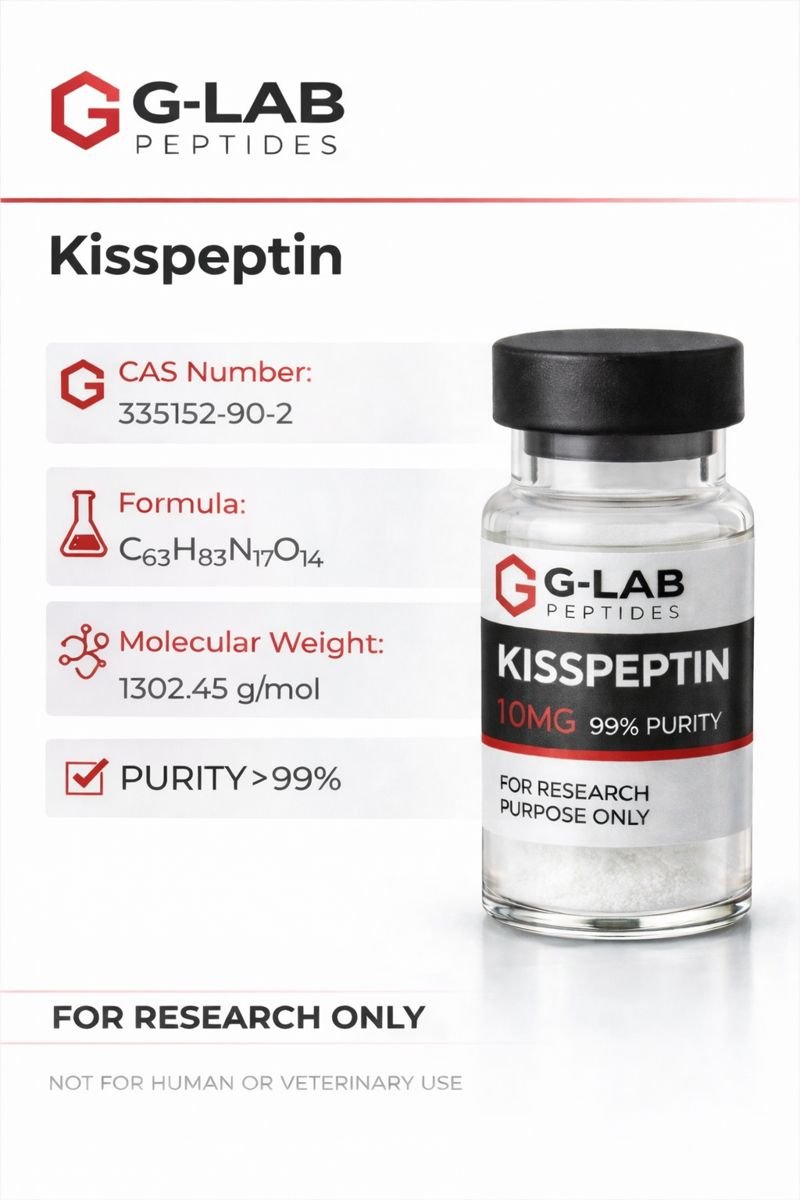
Kisspeptin (10mg)
$59.89
| Quantity | Discount | Price |
|---|---|---|
| 5 - 8 | 5% | $56.90 |
| 9+ | 10% | $53.90 |
Free shipping on orders over $200!
- Satisfaction Guaranteed
- No Hassle Refunds
- Secure Payments
Kisspeptin Peptide (10 mg)
Kisspeptin refers to a family of neuropeptides derived from the KISS1 gene, originally identified as metastasis-suppressor peptides. In experimental physiology, Kisspeptin is best known for its central role in regulating GnRH (gonadotropin-releasing hormone) neurons, thereby influencing reproductive axis signaling, neuroendocrine regulation, and behavioral responses.
Kisspeptin and its receptor GPR54/KISS1R have become essential tools in neuroendocrine research for studying puberty onset, fertility pathways, hypothalamic circuitry, metabolic–reproductive coupling, and the neurobiology of sexual motivation.
Specifications
Synonyms: Kisspeptin-10, Metastin fragment, KP-10, KISS1-derived decapeptide
Sequence: Tyr-Asn-Trp-Asn-Ser-Phe-Gly-Leu-Arg-Phe-NH₂
Molecular formula: C₆₂H₈₉N₁₉O₁₂
Molecular weight: 1302.5 g/mol
Class: Neuropeptide hormone analog / GPR54 agonist
Mechanism of Action and Neuroendocrine Signaling
1. Activation of KISS1R (GPR54) and Stimulation of GnRH Neurons
Kisspeptin binds with high affinity to the KISS1R receptor expressed on GnRH neurons in the hypothalamus.
Experimental administration robustly increases GnRH secretion, leading to downstream rises in LH and FSH release in multiple animal models and controlled human research.
2. Regulation of Puberty and Reproductive Axis Development
Kisspeptin is considered a master upstream regulator of puberty.
Mice lacking KISS1R show complete failure of sexual maturation, while exogenous Kisspeptin restores GnRH-driven reproductive function in certain models.
3. Modulation of Sexual Behavior and Neurocircuitry
Functional MRI experiments in humans show that Kisspeptin activates brain regions related to:
limbic emotional processing
sexual cue responsiveness
motivation and reward
These findings have made Kisspeptin an important research tool in neurobehavioral and psychosexual studies.
4. Metabolic–Reproductive Integration
Kisspeptin neurons interact with leptin, insulin, and energy-balance signals, linking metabolic status to reproductive capability.
Starvation, obesity, or altered insulin signaling downregulate Kisspeptin pathways, illustrating its integrative role.
Experimental Applications in Reproductive Physiology
1. LH and FSH Stimulation in Animals and Humans
Acute Kisspeptin infusion increases circulating LH within minutes, with secondary FSH elevation depending on species and experimental conditions.
This has been consistently demonstrated in rodents, primates, and controlled human studies.
2. Follicular Development, Ovulation, and Gonadal Function
Kisspeptin is involved in:
preovulatory GnRH/LH surge
ovarian follicle maturation
spermatogenesis and testicular steroidogenesis
These effects make Kisspeptin a valuable research probe for fertility and gonadal physiology.
3. Pregnancy and Placental Research
KISS1 is highly expressed in trophoblast cells.
Experimental findings suggest roles in:
placental invasion
vascular remodeling
monitoring of pregnancy health biomarkers
Neurobehavioral and Emotional Regulation Research
1. Mood, Reward, and Emotional Processing
Human neuroimaging studies report that Kisspeptin enhances:
positive emotional processing
sexual attraction signaling
limbic system activation
It also appears to buffer negative mood responses, suggesting a role in neural circuits linking reproduction and emotion.
2. Stress and Anxiety Pathways
Animal studies indicate that Kisspeptin interacts with the hypothalamic–pituitary–adrenal axis, potentially modulating stress responses and behavioral arousal.
Cancer and Metastasis Research
KISS1 was originally identified as a metastasis-suppressor gene in melanoma.
Experimental Kisspeptin analogs demonstrate inhibitory effects on:
tumor cell migration
metastatic potential
matrix metalloproteinase activity
Though mechanistically interesting, these findings are preclinical only.
Other Experimental Applications
Seasonal breeding models (sheep, hamsters) to study photoperiodic reproductive control
Neuropeptide mapping for hypothalamic circuitry research
Reproductive toxicology models looking at endocrine disruption
Research Use Only – Important Notice
This Kisspeptin (10 mg) product is supplied strictly for laboratory research.
Not for human or veterinary use
Not for therapeutic, diagnostic, or clinical administration
For in vitro studies or controlled in vivo animal research only
All descriptions reflect preclinical or controlled human experimental findings and must not be interpreted as medical claims
References
Seminara SB et al. The GPR54 gene as a key regulator of puberty and reproduction. N Engl J Med.
https://pubmed.ncbi.nlm.nih.gov/12646665/Comninos AN et al. Kisspeptin modulates sexual and emotional brain processing in humans. J Clin Invest.
https://pubmed.ncbi.nlm.nih.gov/27571232/Smith JT. Kisspeptin signaling and metabolic regulation of reproduction. Endocrinology.
https://pubmed.ncbi.nlm.nih.gov/19074571/Bilban M et al. KISS1 in human placental development and preeclampsia research. Proc Natl Acad Sci USA.
https://pubmed.ncbi.nlm.nih.gov/17227847/Clarkson J, Herbison AE. Ovarian function and GnRH surge regulation by Kisspeptin neurons. Endocrinology.
https://pubmed.ncbi.nlm.nih.gov/16857741/Lee JH et al. KISS1 as a metastasis suppressor gene. Nature.
https://pubmed.ncbi.nlm.nih.gov/8906780/Dhillo WS et al. Kisspeptin stimulates LH secretion in humans. J Clin Endocrinol Metab.
https://pubmed.ncbi.nlm.nih.gov/15956092/
Related products

Tesamorelin
Price range: $86.90 through $115.00Select options This product has multiple variants. The options may be chosen on the product pageMOTS-c
Price range: $76.90 through $155.00Select options This product has multiple variants. The options may be chosen on the product page
 Hyaluronic Acid 2% + GHK-Cu (Serum)