
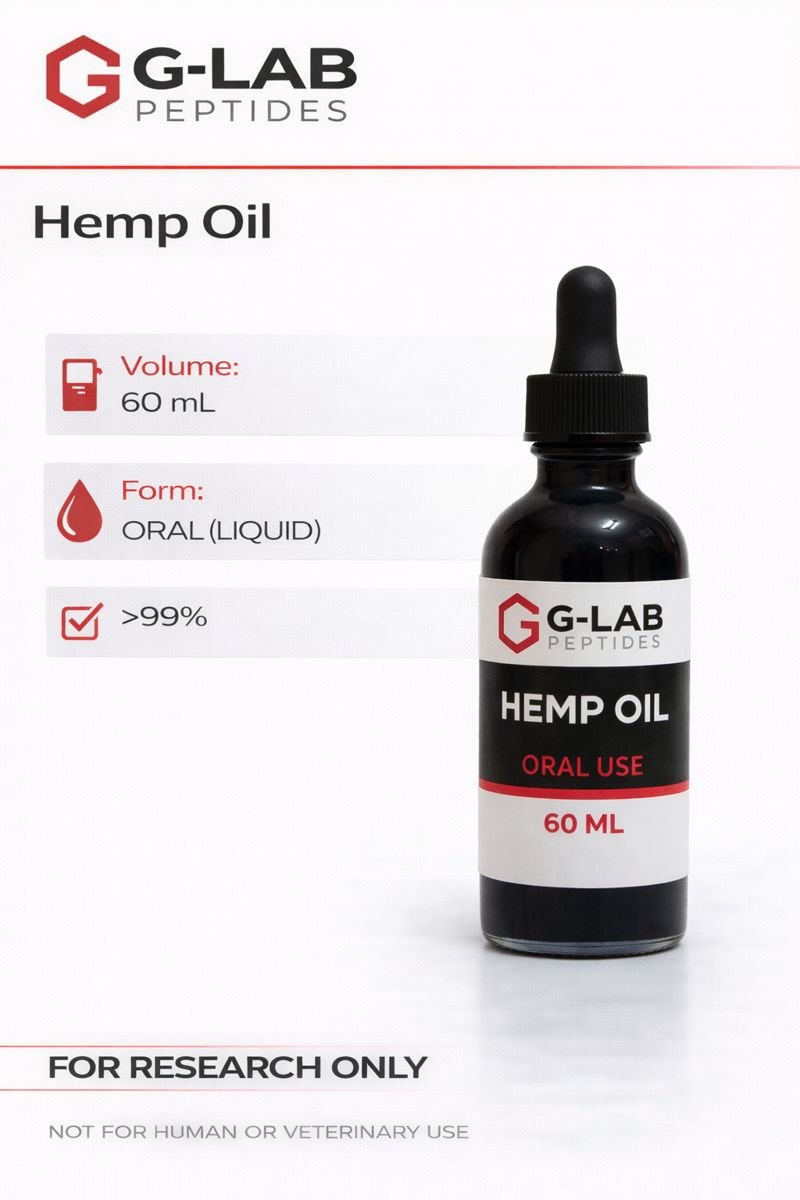
Hemp Oil (60ml)
$24.90
| Quantity | Discount | Price |
|---|---|---|
| 5 - 8 | 5% | $23.65 |
| 9+ | 10% | $22.41 |
Free shipping on orders over $200!
- Satisfaction Guaranteed
- No Hassle Refunds
- Secure Payments
Hemp Oil
Hemp Oil (from Cannabis sativa seeds) is a non-psychoactive lipid extract rich in polyunsaturated fatty acids (PUFAs) — particularly alpha-linolenic acid (ALA, omega-3), linoleic acid (LA, omega-6) and gamma-linolenic acid (GLA) — as well as phytosterols, tocopherols, terpenes, and antioxidant polyphenols. Because of its unique lipid composition and anti-inflammatory profile, Hemp Oil is widely used in research exploring metabolic regulation, lipid signaling, neuroprotection, skin barrier function, inflammation, oxidative stress, and cardiovascular biology.
Unlike cannabinoid-rich extracts, Hemp Oil naturally contains negligible THC and no psychoactive cannabinoids, making it a clean model for studying dietary lipids without endocannabinoid receptor confounders.
Specifications
Synonyms: Hemp Seed Oil, Cannabis sativa Seed Oil, HSO
Active Components: Omega-3 (ALA), Omega-6 (LA, GLA), tocopherols, sterols, terpenoids
Molecular Class: Polyunsaturated lipid complex
Research Category: Lipid metabolism / anti-inflammatory agents / cellular redox / dermatology / cardiovascular biology
Mechanisms of Action and Cellular Pathways
Research shows that Hemp Oil influences multiple biochemical and physiological pathways:
1. PUFA-Mediated Modulation of Inflammation
Hemp Oil contains ALA, LA, and GLA — fatty acids that influence inflammatory cascades by:
Reducing arachidonic-acid–derived pro-inflammatory mediators
Promoting synthesis of anti-inflammatory eicosanoids
Modulating NF-κB and COX pathways
Supporting membrane fluidity and cell signaling
GLA in particular has documented effects on decreasing IL-6, TNF-α, and CRP in inflammatory models.
2. Antioxidant and Redox Pathway Regulation
Tocopherols, phenolics, and terpenes in Hemp Oil:
Scavenge reactive oxygen species (ROS)
Improve mitochondrial oxidative stability
Reduce lipid peroxidation
Protect against UV- and pollution-induced oxidative damage
These antioxidant effects support research in aging, metabolic stress, and skin biology.
3. Lipid Metabolism, Adipocyte Biology and Cardiovascular Research
Studies show Hemp Oil impacts lipid pathways by:
Reducing LDL and total cholesterol
Increasing HDL in certain models
Improving TAG (triglyceride) turnover
Supporting healthy adipocyte differentiation
Enhancing endothelial function
Its omega-6:omega-3 ratio (~3:1), considered physiologically favorable, makes Hemp Oil a valuable model for dietary lipid research.
4. Skin Barrier, Dermal Repair and Atopic Biology
Hemp Oil’s PUFA-rich profile supports:
Epidermal barrier restoration
Increased ceramide production
Reduced transepidermal water loss (TEWL)
Decreased inflammatory markers in dermatitis models
Clinical studies show improvements in hydration, elasticity, and itch severity in subjects with atopic dermatitis.
5. Neuroprotective and Cognitive Pathways
Although Hemp Oil does not contain CBD or THC, its fatty acids and polyphenols influence brain health by:
Supporting neuronal membrane composition
Enhancing DHA synthesis pathways
Reducing neuroinflammation
Improving synaptic plasticity markers in animal models
These pathways make Hemp Oil relevant for studies on cognitive aging and neuroinflammatory disorders.
Hemp Oil in Metabolic Homeostasis and Energy Regulation
Key findings from preclinical and human studies:
Omega-3 and omega-6 PUFAs in hemp seed oil improve insulin sensitivity
Anti-inflammatory effects support healthier adipokine signaling
Antioxidants reduce metabolic oxidative stress
Modulation of hepatic lipid metabolism assists in NAFLD-related research
Hemp Oil is not a pharmacologic weight-loss agent, but its biochemical composition makes it a strong candidate for research in cardiometabolic support.
Dermatological and Topical Applications in Research
Due to its lipid profile, Hemp Oil is used to study:
Natural emollient effects
Repair of damaged or dehydrated skin
Improvement of eczema and psoriasis symptoms
Anti-aging pathways involving oxidative stress
Topically, Hemp Oil enhances skin softness, barrier integrity, and resilience to irritation.
Other Experimental Applications
Food science: lipid oxidation stability, PUFA bioavailability
Endothelial biology: vascular compliance, nitric-oxide pathways
Immunology: cytokine modulation, mast-cell responses
Skin microbiome research
Cosmetic science: formulation stability, dermal penetration
Research Use Only – Important Notice
This Hemp Oil material is provided exclusively for research and laboratory applications.
Not for diagnostic or therapeutic use
Not intended for ingestion unless part of an approved nutritional research protocol
Not intended to diagnose, treat, or prevent disease
All descriptions summarize results from preclinical and clinical research models and are not medical claims
References
1. Callaway J. Hempseed as a nutritional resource: An overview of its lipid and antioxidant profile. Euphytica, 2004.
https://link.springer.com/article/10.1007/s10681-004-4811-6
2. Leonard B. et al. Anti-inflammatory properties of gamma-linolenic acid and omega-6 PUFAs. Progress in Lipid Research, 2004.
https://pubmed.ncbi.nlm.nih.gov/15234544/
3. Schwab U. et al. PUFA consumption and cardiovascular risk markers in humans. American Journal of Clinical Nutrition, 2006.
https://academic.oup.com/ajcn/article/83/6/1243/4649464
4. Ali A. et al. Hempseed oil improves skin hydration and reduces atopic dermatitis severity. Journal of Dermatological Treatment, 2005.
https://pubmed.ncbi.nlm.nih.gov/15748174/
5. Katsiari M. et al. Antioxidant capacity and oxidative-stress modulation by hempseed components. Food Chemistry, 2017.
https://www.sciencedirect.com/science/article/pii/S0308814616313704
6. Burdock G. et al. Safety assessment of hempseed ingredients and nutritional components. Regulatory Toxicology and Pharmacology, 2006.
https://pubmed.ncbi.nlm.nih.gov/16844203/
7. Van Esterik T. et al. Neuroprotective potential of polyunsaturated fatty acids from seed oils. Nutritional Neuroscience, 2021.
https://pubmed.ncbi.nlm.nih.gov/31866466/
Related products
Tesamorelin
Price range: $86.90 through $115.00Select options This product has multiple variants. The options may be chosen on the product page
 IGF-1 LR3 (1mg)