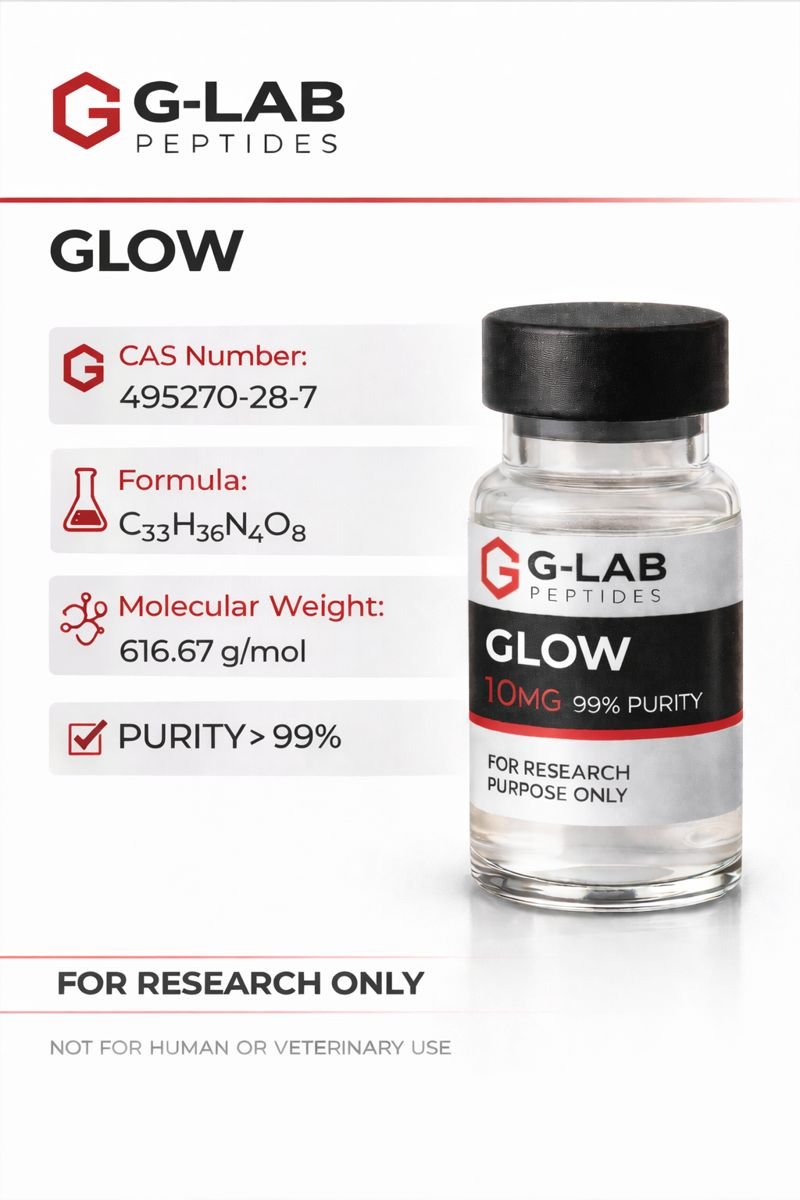
GLOW (GHK-Cu 50mg + BPC-157 10mg + TB-500 10mg)
$125.00
| Quantity | Discount | Price |
|---|---|---|
| 5 - 8 | 5% | $118.75 |
| 9+ | 10% | $112.50 |
Free shipping on orders over $200!
- Satisfaction Guaranteed
- No Hassle Refunds
- Secure Payments
GLOW – Regenerative Peptide Blend
GHK-Cu (50 mg) + BPC-157 (10 mg) + TB-500 (10 mg)
Multi-Pathway Tissue Repair, Anti-Inflammatory and Regenerative Research Formula
GLOW is a research-grade peptide blend designed to explore synergistic tissue regeneration, extracellular matrix remodeling, angiogenesis, and systemic recovery signaling.
By combining GHK-Cu, BPC-157, and TB-500, GLOW targets complementary biological pathways involved in wound healing, connective-tissue repair, inflammation control, and cellular migration.
This blend is widely applicable in experimental models of musculoskeletal injury, skin and soft-tissue repair, vascular recovery, and systemic inflammatory stress.
Composition
GHK-Cu (Copper Tripeptide-1) — 50 mg
BPC-157 (Body Protection Compound-157) — 10 mg
TB-500 (Thymosin Beta-4 fragment) — 10 mg
Specifications
Product type: Multi-peptide regenerative blend
Class: Tissue repair / angiogenic / cytoprotective research compound
Primary research domains:
Wound healing
Tendon, ligament, and muscle repair
Skin regeneration and collagen remodeling
Inflammation and oxidative stress modulation
Angiogenesis and endothelial repair
Mechanistic Overview – Why This Blend Works
GLOW is engineered to address all major phases of tissue repair:
Inflammation control
Cell migration and angiogenesis
Matrix remodeling and collagen synthesis
Long-term tissue integrity and regeneration
Each peptide contributes a distinct, non-redundant mechanism, resulting in true biological synergy, not overlap.
Component 1 – GHK-Cu (Copper Tripeptide-1)
Gene Modulation, Collagen Remodeling & Anti-Inflammatory Signaling
GHK-Cu is a naturally occurring human tripeptide that binds copper (II) ions and acts as a master regulator of regenerative gene expression.
Key Research Effects
Upregulates genes involved in collagen I & III synthesis
Activates fibroblasts, keratinocytes, and endothelial cells
Enhances angiogenesis and wound closure
Suppresses NF-κB–mediated inflammation
Reduces oxidative stress via SOD activation
Transcriptomic studies show GHK-Cu can positively regulate thousands of genes associated with tissue repair while downregulating pro-fibrotic and inflammatory pathways.
Component 2 – BPC-157 (Body Protection Compound-157)
Cytoprotection, Vascular Repair & Inflammation Control
BPC-157 is a stable gastric pentadecapeptide extensively studied for its organ-protective and reparative properties.
Key Research Effects
Accelerates tendon-to-bone healing
Enhances angiogenesis and microvascular integrity
Protects endothelial cells and nitric-oxide signaling
Reduces inflammatory cytokines (TNF-α, IL-6)
Promotes healing in muscle, ligament, gut, and nerve tissue
BPC-157 is notable for its ability to stabilize damaged tissue environments, making it an ideal foundation peptide in regenerative blends.
Component 3 – TB-500 (Thymosin Beta-4 Fragment)
Cell Migration, Actin Remodeling & Systemic Tissue Repair
TB-500 is a synthetic fragment of thymosin beta-4, a peptide involved in actin regulation and cell motility.
Key Research Effects
Promotes cell migration to injury sites
Enhances angiogenesis and capillary formation
Reduces fibrosis and scar tissue formation
Improves muscle fiber regeneration
Modulates inflammatory signaling
TB-500 plays a crucial role in the proliferative and remodeling phases of healing by guiding cells to damaged tissue.
Synergistic Action of the GLOW Blend
Why GHK-Cu + BPC-157 + TB-500 Together?
| Healing Phase | Dominant Peptide | Role |
|---|---|---|
| Inflammation control | BPC-157 + GHK-Cu | Cytoprotection, cytokine suppression |
| Cell migration | TB-500 | Actin remodeling, cellular movement |
| Angiogenesis | All three | Vascular growth & stability |
| Collagen remodeling | GHK-Cu | ECM synthesis and organization |
| Long-term tissue integrity | GHK-Cu + BPC-157 | Structural repair & resilience |
This coordinated activity allows GLOW to function as a full-spectrum regenerative research blend, rather than a single-pathway compound.
Experimental Applications
GLOW is commonly explored in research models involving:
Muscle tears and strain recovery
Tendon and ligament injury
Post-surgical tissue repair
Skin regeneration and wound healing
Chronic inflammation and oxidative stress
Vascular injury and endothelial dysfunction
Research Use Only – Important Notice
GLOW (GHK-Cu 50 mg + BPC-157 10 mg + TB-500 10 mg) is supplied exclusively for laboratory research purposes.
Not for human or veterinary use
Not for diagnostic, therapeutic, or cosmetic applications
Intended only for in vitro studies and/or controlled experimental animal models
All descriptions summarize preclinical and mechanistic research and do not constitute medical claims
References
Pickart L. et al. The human copper peptide GHK-Cu and tissue remodeling. J Biomater Sci Polym Ed.
https://pubmed.ncbi.nlm.nih.gov/23982867/Pickart L. et al. Gene expression and regenerative effects of GHK-Cu. Int J Mol Sci.
https://www.ncbi.nlm.nih.gov/pmc/articles/PMC6073405/Sikiric P. et al. BPC-157 and tissue healing: mechanisms and applications. Curr Pharm Des.
https://pubmed.ncbi.nlm.nih.gov/21548867/Sikiric P. et al. BPC-157 protects endothelium and promotes angiogenesis. J Physiol Pharmacol.
https://pubmed.ncbi.nlm.nih.gov/19336909/Goldstein AL, Kleinman HK. Thymosin beta-4: actin binding and tissue repair. Ann N Y Acad Sci.
https://pubmed.ncbi.nlm.nih.gov/12906302/Smart N. et al. Thymosin beta-4 induces angiogenesis and cardiac repair. Nature.
https://pubmed.ncbi.nlm.nih.gov/19597443/Zhang J. et al. TB-500 promotes cell migration and reduces fibrosis. Peptides.
https://pubmed.ncbi.nlm.nih.gov/19958875/
Related products

Sermorelin
Price range: $50.90 through $89.90Select options This product has multiple variants. The options may be chosen on the product pageGHK-Cu
Price range: $58.90 through $81.90Select options This product has multiple variants. The options may be chosen on the product pageSS-31
Price range: $65.00 through $210.00Select options This product has multiple variants. The options may be chosen on the product page