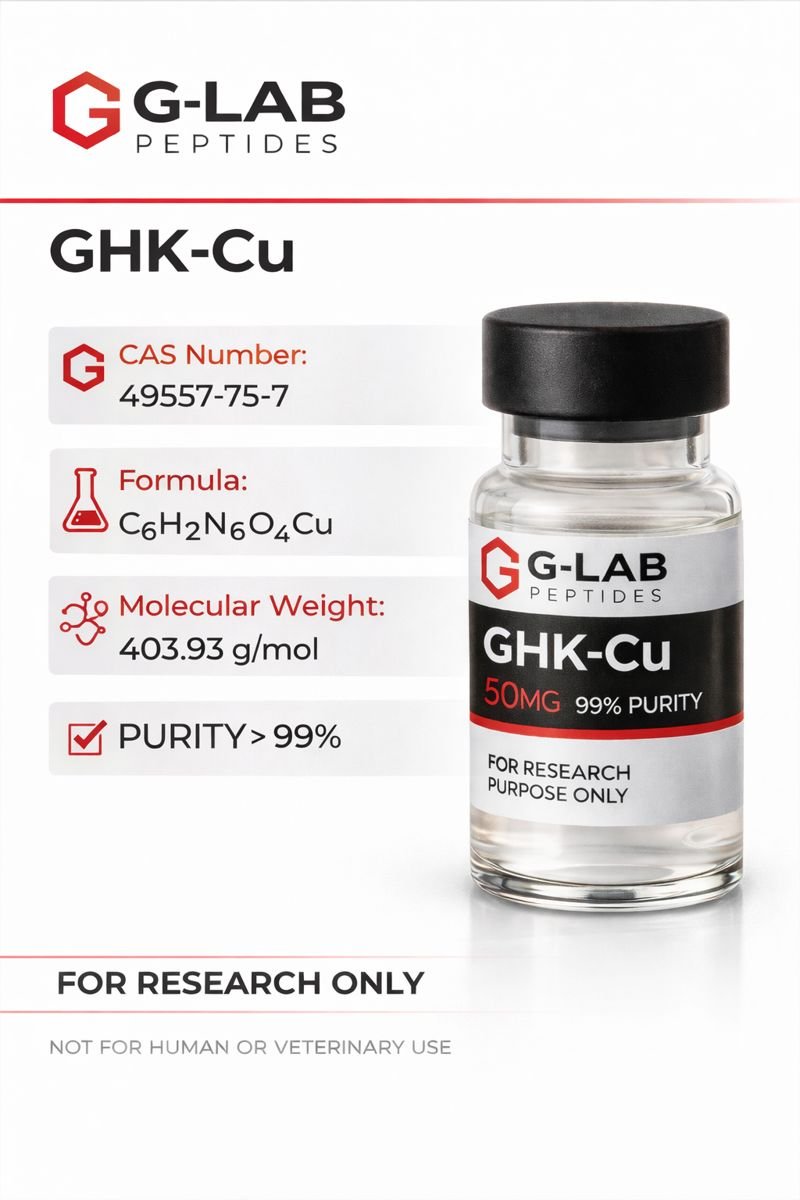
GHK-Cu
Price range: $58.90 through $81.90
| Quantity | Discount | Price |
|---|---|---|
| 5 - 8 | 5% | $55.96 |
| 9+ | 10% | $53.01 |
Free shipping on orders over $200!
- Satisfaction Guaranteed
- No Hassle Refunds
- Secure Payments
GHK-Cu
Copper Tripeptide-1 — Regenerative, Anti-Inflammatory, and Gene-Modulating Research Peptide
GHK-Cu (Copper Tripeptide-1) is a naturally occurring human plasma tripeptide (glycyl-L-histidyl-L-lysine) with a strong affinity for copper (II) ions. Identified in 1973 as a wound-healing modulator, GHK-Cu has since emerged as a key molecule in tissue regeneration, stem-cell activation, anti-inflammatory signaling, and epigenetic gene modulation.
In experimental settings, GHK-Cu has demonstrated the ability to:
Activate regenerative gene pathways
Enhance collagen synthesis and remodeling
Modulate inflammation via cytokine suppression
Improve cellular repair after oxidative stress
Support angiogenesis, fibroblast function, and extracellular-matrix turnover
Its broad transcriptomic influence—affecting over 4,000 genes in human cells—makes it a powerful research tool for investigating mechanisms of tissue repair, aging, and organ protection.
Specifications
Synonyms: Copper Tripeptide-1, GHK-Cu, Gly-His-Lys-Cu²⁺
Molecular formula: C₁₄H₂₄N₆O₄ · Cu
Molecular weight: 340.9 g/mol
Class: Regenerative copper-binding tripeptide
Primary research domains: Tissue repair, wound healing, anti-inflammatory signaling, fibrosis, angiogenesis, skin biology, hair-follicle regeneration, neuroprotection
Mechanism of Action — Copper Mobilization & Regenerative Signaling
1. High-Affinity Copper Binding
GHK serves as a high-affinity carrier for Cu²⁺, enabling controlled copper delivery to injured tissues.
Copper binding triggers:
Activation of lysyl oxidase, essential for collagen cross-linking
Modulation of HIF-1α and angiogenesis signaling
Stimulation of superoxide dismutase (SOD) and antioxidant responses
2. Gene Expression Modulation (Transcriptomic Remodeling)
A landmark systems-biology analysis revealed that GHK-Cu can upregulate 31% of human genes associated with tissue repair while downregulating inflammatory and fibrotic pathways.
Research shows activation of genes involved in:
Collagen I & III synthesis
Integrins, ECM remodeling enzymes
Nerve regeneration and axonal repair
Antioxidant defense
Anti-cancer and anti-senescence pathways
This makes GHK-Cu a valuable model compound for studying epigenetic regulation of healing processes.
3. Anti-Inflammatory and Anti-Fibrotic Pathways
In vitro and animal studies demonstrate GHK-Cu:
Reduces TNF-α, IL-1β, and inflammatory prostaglandins
Suppresses TGF-β–driven fibrosis
Inhibits NF-κB activation
Decreases oxidative stress markers
These mechanisms are key for research involving chronic inflammation, aging, and scar modulation.
4. Angiogenesis and Wound-Healing Research
GHK-Cu enhances:
Endothelial cell migration
Fibroblast proliferation
Keratinocyte function
Collagen matrix organization
Neovascularization of healing tissue
This profile makes it ideal for exploring skin, tendon, ligament, and vascular repair.
GHK-Cu in Skin, Hair, and Aging Research
Skin Biology & Collagen Remodeling
Multiple studies show increases in:
Collagen types I and III
Dermal glycosaminoglycan production
Elastin and integrin expression
Reduction in UV-induced damage
GHK-Cu is widely used as a research model for cutaneous regeneration and anti-aging signaling.
Hair Follicle & Stem-Cell Activity
GHK-Cu has shown:
Stimulation of dermal papilla cell proliferation
Upregulation of Wnt and BMP signaling
Enhanced follicular angiogenesis
Protection against DHT-induced damage in vitro
These findings support its role as a hair-growth research peptide.
GHK-Cu in Organ Protection, Lung and Nervous System Studies
Lung Injury and COPD Models
GHK-Cu has been shown to:
Reduce inflammatory infiltrates
Improve antioxidant enzyme activity
Reverse gene signatures associated with emphysema
Neuroprotective Effects
In rodent models:
Restores neuronal function after ischemic injury
Enhances synaptic repair signaling
Reduces oxidative mitochondrial damage
GHK-Cu is thus useful for studying neuroregeneration and oxidative-stress–related CNS disorders.
Other Experimental Applications
Researchers also utilize GHK-Cu in:
Fibrosis models (skin, liver, lung)
Anti-cancer gene expression studies
Metabolic stress response
Copper metabolism and transport
Senescence and longevity research
Its broad biochemical effects make GHK-Cu a uniquely versatile research compound.
Research Use Only – Important Notice
This GHK-Cu 50 mg product is supplied exclusively for laboratory research purposes.
Not for human or veterinary use
Not for diagnostic, therapeutic, or cosmetic applications
Intended only for controlled in vitro and in vivo experimental models
Descriptions above summarize findings from preclinical and mechanistic studies, not medical claims or usage guidelines
References
Pickart L, et al. The human tri-peptide GHK and tissue remodeling. J Biomater Sci Polym Ed.
https://pubmed.ncbi.nlm.nih.gov/23982867/Pickart L, Vasquez-Soltero JM, Margolina A. GHK-Cu may counteract the pathology of COPD and emphysema: a systems biology approach. Int J COPD.
https://www.ncbi.nlm.nih.gov/pmc/articles/PMC4717160/Maquart FX, et al. Stimulation of collagen synthesis by copper peptide in fibroblast cultures. Biochem Pharmacol.
https://pubmed.ncbi.nlm.nih.gov/2413941/Hong Y, et al. Protective effects of GHK-Cu peptide against UV-induced damage in human keratinocytes. Mol Med Rep.
https://pubmed.ncbi.nlm.nih.gov/24920351/Ahmed S, et al. GHK-Cu modulates inflammatory gene expression via NF-κB suppression. Inflammopharmacology.
https://pubmed.ncbi.nlm.nih.gov/30604088/Takahashi T, et al. GHK-Cu induces proliferation and angiogenesis in endothelial cells. J Dermatol Sci.
https://pubmed.ncbi.nlm.nih.gov/9530645/Zhang L, et al. Gene expression signature reversal by GHK in aging skin. Clin Cosmet Investig Dermatol.
https://pubmed.ncbi.nlm.nih.gov/33204021/
Related products
Tesamorelin
Price range: $86.90 through $115.00Select options This product has multiple variants. The options may be chosen on the product page