
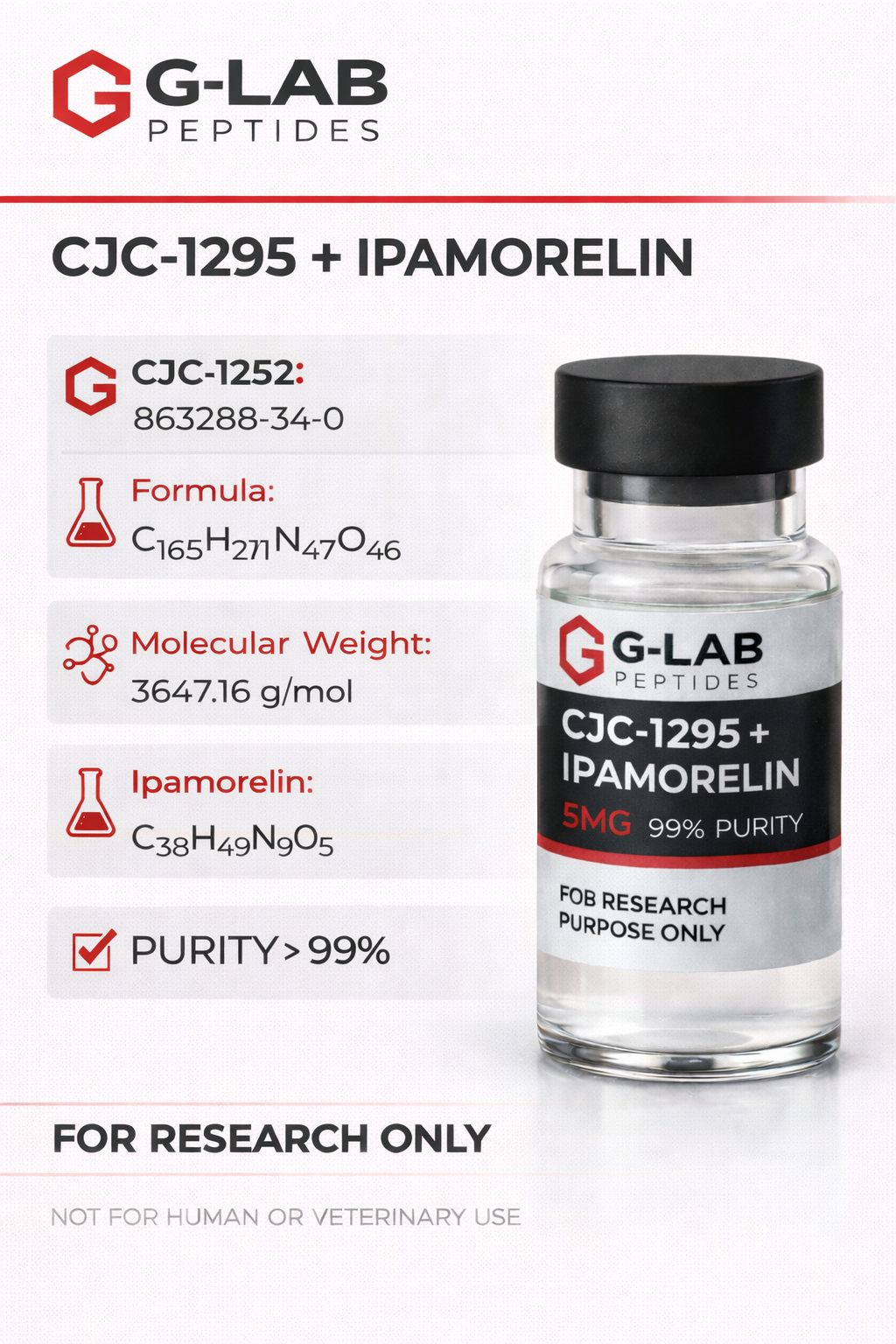
CJC-1295 + Ipamorelin (10mg)
$82.90
| Quantity | Discount | Price |
|---|---|---|
| 5 - 8 | 5% | $78.76 |
| 9+ | 10% | $74.61 |
Free shipping on orders over $200!
- Satisfaction Guaranteed
- No Hassle Refunds
- Secure Payments
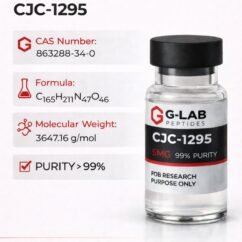
CJC-1295 + Ipamorelin (10 mg)
Synergistic GHRH Analog + GHSR Agonist Blend (GH/IGF-1 Axis Research)
The CJC-1295 + Ipamorelin combination is a research-only peptide blend that unites two complementary growth hormone secretagogues:
CJC-1295 – a long-acting analog of growth hormone–releasing hormone (GHRH), designed to enhance endogenous GH pulse amplitude and sustain elevated IGF-1 levels. OUP Academic+1
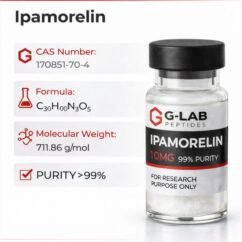
Ipamorelin – a highly selective agonist of the growth hormone secretagogue receptor (GHSR-1a), triggering GH release with minimal impact on ACTH, cortisol, or prolactin. PubMed+1
Together, they are widely used in experimental settings to interrogate the GH/IGF-1 axis, pulsatile GH secretion, body-composition regulation, musculoskeletal repair, and age-related endocrine decline.
Specifications
Components:
CJC-1295 (GHRH analog)
Ipamorelin (GHSR-1a agonist)
Class: Combination GH secretagogue (GHRH analog + GHRP)
Primary targets:
GHRH receptor on pituitary somatotrophs
GHSR-1a (ghrelin receptor) in pituitary and hypothalamus
Key research areas:
Growth hormone pulsatility and IGF-1 regulation
Body composition and metabolic homeostasis
Muscle, bone, and connective-tissue recovery
Endocrine aging models and GH deficiency paradigms
(Concentrations and formulation ratios may vary by research supplier and protocol.)
Mechanism of Action – Dual Pathway GH Stimulation
1. CJC-1295 Component – Long-Acting GHRH Analog
CJC-1295 is a modified analog of GHRH (1–29) engineered for prolonged half-life through covalent binding to endogenous serum albumin. ScienceDirect+1
Experimentally, CJC-1295 has been shown to:
Produce sustained, dose-dependent increases in GH and IGF-1 after subcutaneous administration in healthy adults. PubMed+1
Maintain pulsatile GH secretion, rather than flattening the physiological GH rhythm. PubMed
Show an extended effective half-life of ~6–10 days in humans via albumin binding. ScienceDirect+1
By acting directly on pituitary GHRH receptors, CJC-1295 essentially “primes” and amplifies the endogenous GH pulsatility axis.
2. Ipamorelin Component – Selective GHSR-1a (GHRP) Agonist
Ipamorelin is a pentapeptide (Aib-His-D-2-Nal-D-Phe-Lys-NH₂) identified as the first highly selective growth hormone secretagogue with minimal off-target endocrine activity. PubMed+1
Preclinical and clinical research shows that Ipamorelin:
Strongly stimulates GH release in a dose-dependent fashion in animal models and humans. PubMed+1
Has very limited or no stimulation of ACTH and cortisol even at doses >200× the ED₅₀ for GH release, unlike earlier GHRPs such as GHRP-6. SciSpace+1
Acts via GHSR-1a in the hypothalamus and pituitary, engaging PLC/IP₃–Ca²⁺ pathways and suppressing somatostatin tone. PubMed+1
This selective profile makes Ipamorelin a useful tool to investigate GH-specific physiology with fewer confounding endocrine signals.
3. Synergistic GH/IGF-1 Modulation – GHRH + GHRP Combination
Combining a GHRH analog (CJC-1295) with a GHRP / GHSR agonist (Ipamorelin) leverages two complementary mechanisms:
CJC-1295 amplifies the capacity and amplitude of GH pulses by stimulating GHRH receptors and maintaining a primed pituitary state. OUP Academic+1
Ipamorelin acts as a pulse trigger, acutely evoking GH bursts via GHSR-1a while lowering somatostatin tone. PubMed+1
Reviews and mechanistic analyses of growth hormone secretagogues note that co-administration of GHRH analogs and GHRPs produces greater GH output than either alone, particularly in states of impaired endogenous GH secretion. PMC+2Regulations.gov+2
The blend allows researchers to model:
Pulsatile vs. tonic GH stimulation
GH–IGF-1 feedback loops
Age- or obesity-related blunting of GH release and its partial restoration
CJC-1295 + Ipamorelin in Body Composition & Metabolic Research
Experimental and early clinical data on GHRH analogs and GHSR agonists support their use in models of:
Altered body composition: increased lean mass, changes in fat distribution (through GH-mediated lipolysis and altered substrate utilization). OUP Academic+2PubMed+2
Energy expenditure and substrate metabolism, via GH and IGF-1 effects on lipolysis, hepatic glucose production, and muscle glucose uptake. PMC+1
Obesity-associated blunted GH secretion, where GHRH + GHRP combinations have been investigated as tools to partially restore GH pulses in research settings. PMC
These studies do not establish approved clinical indications but highlight the blend’s relevance for mechanistic work in metabolic and endocrine physiology.
Musculoskeletal, Recovery and Tissue-Repair Models
Through activation of the GH/IGF-1 axis, CJC-1295 + Ipamorelin has been used in:
Muscle physiology research (hypertrophy, atrophy, and recovery after unloading or injury), leveraging GH’s role in stimulating hepatic and local IGF-1 production and downstream mTOR signaling. PMC+1
Bone and connective-tissue studies, where GH secretagogues have been reported to support bone mineral accrual and collagen turnover in preclinical models. BioScientifica
Post-surgical or immobilization models, exploring prevention of lean-mass loss and delayed recovery (primarily in animal studies or small human experimental protocols).
In these contexts, the CJC-1295 + Ipamorelin blend is used as a tool compound to dissect how pulsatile GH and IGF-1 influence tissue remodeling, repair kinetics, and structural integrity.
Neuroendocrine, Sleep and Aging-Related Research
Because GHSR-1a and GHRH receptors are expressed in the hypothalamus and other brain regions, combined GHRH + GHRP stimulation has been investigated in:
Circadian and sleep-related GH secretion – GH pulses are closely tied to slow-wave sleep; secretagogues help model this interaction in controlled settings. PubMed+1
Age-related decline of GH/IGF-1, using GHRH analogs (including CJC-1295) to explore whether long-acting stimulation can normalize growth in GHRH-deficient or aging animals. Physiology Journals+1
Neuroendocrine regulation of appetite and energy balance, given GHSR-1a’s role in ghrelin signaling and hypothalamic integration of metabolic cues. OUP Academic+1
These models provide insight into how endocrine aging, stress, and metabolic load alter GH physiology and how dual-pathway stimulation might experimentally compensate.
Other Experimental Applications
Researchers also use the CJC-1295 + Ipamorelin combination to study:
Serum proteomic changes under chronic GHRH analog exposure and downstream IGF-1 signaling. PubMed+1
Differences between short-acting vs. long-acting GH secretagogues, comparing pure GHRH analogs, GHRPs, and their combinations in terms of pulse pattern, feedback sensitivity, and binding kinetics. PMC+1
The blend is thus positioned as a flexible platform for probing complex endocrine network behavior rather than as a single-pathway stimulus.
Research Use Only – Important Notice
This CJC-1295 + Ipamorelin (10 mg) product is supplied exclusively for laboratory research purposes:
Not for human or veterinary use
Not for diagnostic, therapeutic, or cosmetic applications
Intended only for in vitro studies and/or use in appropriately controlled experimental animal models by qualified professionals
All descriptions above summarize findings from preclinical and mechanistic studies and must not be interpreted as medical claims or guidance for self-administration or clinical treatment
References
Teichman SL, et al. Prolonged stimulation of growth hormone (GH) and insulin-like growth factor I secretion by CJC-1295, a long-acting analog of GH-releasing hormone, in healthy adults. J Clin Endocrinol Metab. 2006;91(3):799–805.
Available at: https://pubmed.ncbi.nlm.nih.gov/16352683/ PubMedIonescu M, et al. Pulsatile secretion of growth hormone persists during continuous CJC-1295 administration in healthy adults. J Clin Endocrinol Metab. 2006;91(12):4792–4797.
Available at: https://pubmed.ncbi.nlm.nih.gov/17018654/ PubMedSackmann-Sala L, et al. Activation of the GH/IGF-1 axis by CJC-1295, a long-acting GHRH analog, results in serum protein profile changes in normal adult subjects. Growth Horm IGF Res. 2009;19(6):471–477.
Available at: https://pubmed.ncbi.nlm.nih.gov/19386527/ PubMedTeichman SL, et al. Once-daily administration of CJC-1295 normalizes growth in GHRH knockout mice. Am J Physiol Endocrinol Metab. 2006;291(5):E1120–E1129.
Available at: https://journals.physiology.org/doi/full/10.1152/ajpendo.00201.2006 Physiology JournalsRaun K, et al. Ipamorelin, the first selective growth hormone secretagogue. Eur J Endocrinol. 1998;139(5):552–561.
Available at: https://pubmed.ncbi.nlm.nih.gov/9849822/ PubMed+1Sigalos JT, Pastuszak AW. The safety and efficacy of growth hormone secretagogues. Curr Opin Endocrinol Diabetes Obes. 2017;24(3):159–165.
Available at: https://pmc.ncbi.nlm.nih.gov/articles/PMC5632578/ PMCLall S, et al. Independent stimulation of adiposity by GH secretagogues. Biochem Biophys Res Commun. 2001;280(1):132–138.
Available at: https://www.sciencedirect.com/science/article/pii/S0006291X00940658 ScienceDirectRaun K, et al. Pharmacology of the GH secretagogue ipamorelin in swine and humans. Eur J Endocrinol. 1998;139(5):552–560 (data figures).
PDF access: https://scispace.com/pdf/ipamorelin-the-first-selective-growth-hormone-secretagogue-1t1xkfpaeo.pdf SciSpaceTeichman SL, et al. CJC-1295 clinical development summary (FDA briefing document).
Available at: https://downloads.regulations.gov/FDA-2024-N-4777-0009/attachment_6.pdf Regulations.govBiotech Peptides (technical review). Pharmacological and metabolic insights into the Ipamorelin + CJC-1295 blend. 2025.
Available at: https://biotechpeptides.com/2025/09/02/pharmacological-and-metabolic-insights-into-the-ipamorelin-cjc-1295-blend/ Biotech Peptides
Related products
GHK-Cu
Price range: $58.90 through $81.90Select options This product has multiple variants. The options may be chosen on the product page
 IGF DES (2mg)