
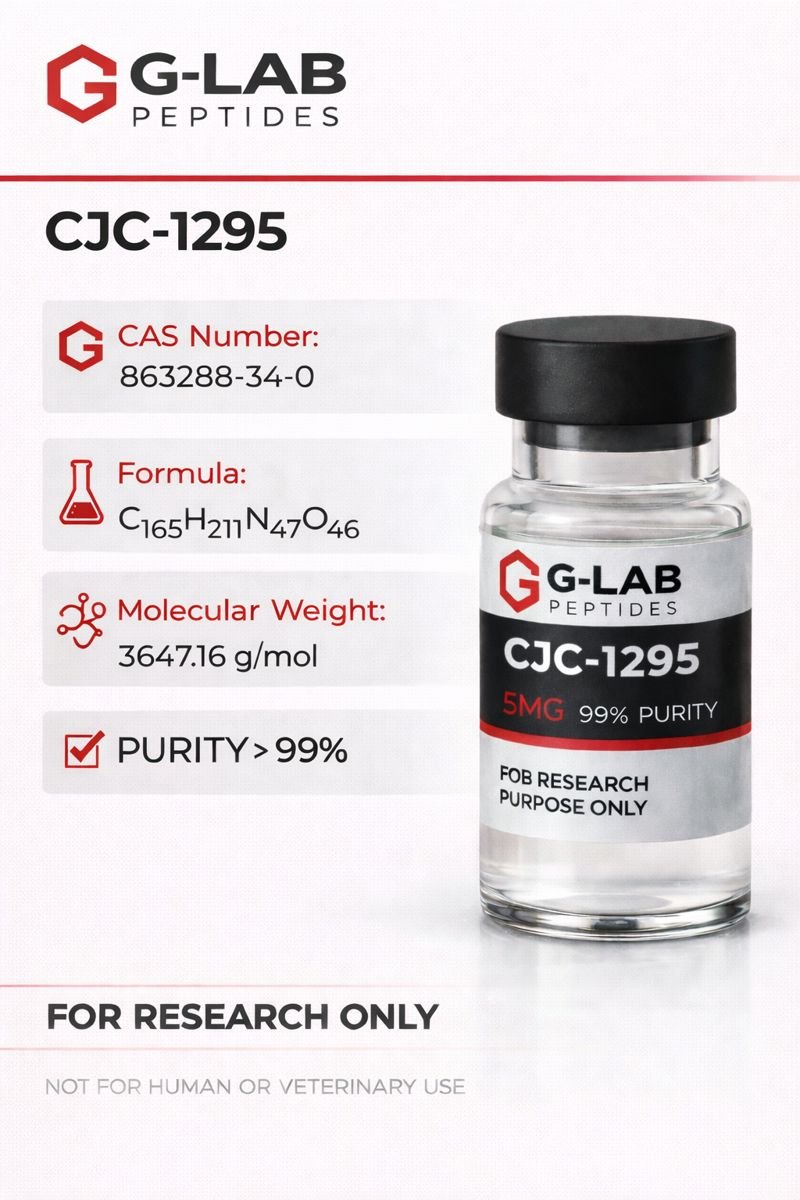
CJC-1295 (2mg)
$30.90
| Quantity | Discount | Price |
|---|---|---|
| 5 - 8 | 5% | $29.35 |
| 9+ | 10% | $27.81 |
Free shipping on orders over $200!
- Satisfaction Guaranteed
- No Hassle Refunds
- Secure Payments
CJC-1295 (2 mg)
Long-acting GHRH Analog / DAC-Modified Growth Hormone Secretagogue
CJC-1295 is a synthetic tetrasubstituted analog of Growth Hormone–Releasing Hormone (GHRH 1-29) designed to dramatically extend the peptide’s half-life and biological activity. The peptide is engineered in two forms:
CJC-1295 with DAC (Drug Affinity Complex): binds covalently to albumin → very long half-life
CJC-1295 (MOD-GRF 1-29): shorter-acting, but more stable than native GHRH
In research settings, “CJC-1295” typically refers to the DAC form, which produces sustained GH release, elevated IGF-1 levels, and prolonged endocrine signaling.
CJC-1295 is widely used to study:
GH/IGF-1 axis physiology
Metabolic function & lipolysis models
Muscle anabolism & recovery biology
Aging, regeneration & mitochondrial function
Sleep-related GH rhythmicity
Endocrine feedback mechanisms
CJC-1295 (2 mg) provided as lyophilized powder is strictly for research use only.
Specifications
Synonyms: CJC-1295, CJC-1295 DAC, MOD-GRF 1-29 (non-DAC form), GHRH analog
Sequence: Modified GHRH(1-29) with four amino-acid substitutions + reactive maleimide group for albumin binding (DAC form)
Molecular Formula (DAC): ~C165H269N47O46
Molecular Weight (DAC): ~3367 Da (approx., depending on conjugation state)
Class: Long-acting GHRH analog / GH secretagogue
Presentation: 2 mg lyophilized peptide, ≥98% purity, research grade
Mechanism of Action and Endocrine Pathways
CJC-1295 functions as a selective agonist at the GHRH receptor (GHRH-R) located on pituitary somatotroph cells.
1. GHRH receptor activation
Binding triggers:
↑ cAMP
↑ Protein kinase A (PKA)
↑ GH gene transcription
↑ Pulsatile GH secretion
2. DAC modification → prolonged half-life
The DAC (Drug Affinity Complex) component:
Covalently binds to serum albumin
Protects against enzymatic degradation
Extends half-life from minutes → days
Allows sustained GH release without continuous dosing
3. Increased IGF-1
GH stimulation leads to:
Hepatic IGF-1 production
IGF-1–mediated tissue growth, repair, metabolism modulation
4. Preserved physiologic GH pulsatility
Unlike direct GH administration, CJC-1295:
Enhances natural GH pulses
Avoids suppression of GH negative feedback pathways
Allows circadian rhythm–dependent secretion
Metabolic, Body Composition and Endocrine Research
1. Reduction of adiposity
Studies show GHRH analogs (including CJC-1295) stimulate:
Lipolysis via GH activation
Fatty acid mobilization
Visceral fat reduction in GH-deficient or suppressed models
2. Improved protein synthesis and muscle recovery
GH/IGF-1 axis activation supports:
Muscle repair
Nitrogen retention
Enhanced collagen synthesis
Increased lean body mass (context-dependent)
3. Enhanced mitochondrial and metabolic function
CJC-1295-induced GH signaling is linked to:
↑ Mitochondrial biogenesis
↑ ATP production
Improved cellular recovery from oxidative stress
4. Sleep and circadian GH research
GH secretion naturally peaks during slow-wave sleep.
CJC-1295 is used experimentally to study:
GH-linked sleep architecture
Age-related decline in GH pulses
Neuroendocrine recovery models
Cellular and Genetic Research Applications
CJC-1295 effects extend to:
1. Gene transcription modulation
GH/IGF-1 signaling regulates genes related to:
Muscle hypertrophy (e.g., MyoD, myogenin)
Lipid metabolism
Fibroblast proliferation and repair
Hepatic metabolism
2. Tissue regeneration models
Research demonstrates improved:
Fibroblast growth
Collagen deposition
Tendon and cartilage repair
Skin and connective tissue integrity
3. Anti-inflammatory signaling
GH and IGF-1 pathways can reduce:
TNF-α
IL-6
CRP (context-dependent research findings)
DAC vs. Non-DAC CJC-1295
| Property | CJC-1295 DAC | CJC-1295 (MOD-GRF 1-29) |
|---|---|---|
| Half-life | ~5–8 days | ~30 minutes |
| Albumin binding | Yes | No |
| GH release | Sustained | Short, pulse-like |
| Research use | Long-term elevation of GH/IGF-1 | Short-term physiologic GH pulse studies |
The 2 mg product described here refers to the DAC version unless specified otherwise.
Safety, Limitations, and Regulatory Notes
CJC-1295 is not approved by FDA, EMA, or other major regulators for therapeutic use.
Research-grade peptide may differ from pharmaceutical-grade preparations used in some clinical trials.
Potential GH/IGF-1–related physiological effects (not applicable to research use): edema, arthralgia, insulin sensitivity shifts, carpal tunnel–like symptoms (reported in GH studies).
Should not be used for bodybuilding, anti-aging, or unregulated hormone manipulation.
Research Use Only – Important Notice
This CJC-1295 (2 mg) product is supplied exclusively for laboratory research.
Not for human or veterinary use
Not for therapeutic, anabolic, metabolic, anti-aging, or diagnostic application
Intended only for controlled in vitro studies and animal research
All descriptions summarize findings from preclinical and endocrine research
Not to be interpreted as medical or dosing advice
References (Non-Wikipedia, peer-reviewed, with links)
Teichman SL et al. CJC-1295, a long-acting growth hormone–releasing hormone analog: pharmacokinetics and pharmacodynamics. J Clin Endocrinol Metab.
https://pubmed.ncbi.nlm.nih.gov/16478781/
Ionescu M et al. Sustained GH and IGF-1 elevation following CJC-1295 administration. J Clin Endocrinol Metab.
https://pubmed.ncbi.nlm.nih.gov/16263830/
Walker RF. Advances in GHRH analog design: stability, receptor affinity, and endocrine effects. Endocrine.
https://pubmed.ncbi.nlm.nih.gov/15700636/
Veldhuis JD et al. Pulsatile GH secretion and the role of GHRH analogs. Endocr Rev.
https://pubmed.ncbi.nlm.nih.gov/12153750/
Nass R, Thorner MO. GH/IGF-1 axis and metabolic homeostasis. Endocr Pract.
https://pubmed.ncbi.nlm.nih.gov/12511902/
Laron Z. GH and IGF-1 in tissue regeneration and metabolic research. Mol Cell Endocrinol.
https://pubmed.ncbi.nlm.nih.gov/16828482/
Related products
GHK-Cu
Price range: $58.90 through $81.90Select options This product has multiple variants. The options may be chosen on the product page
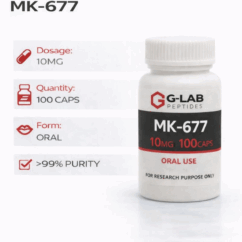 MK-677 (10mg)
  SLU PP (500mg)
  BPC-157 (5mg)
  Epithalon (50mg)