
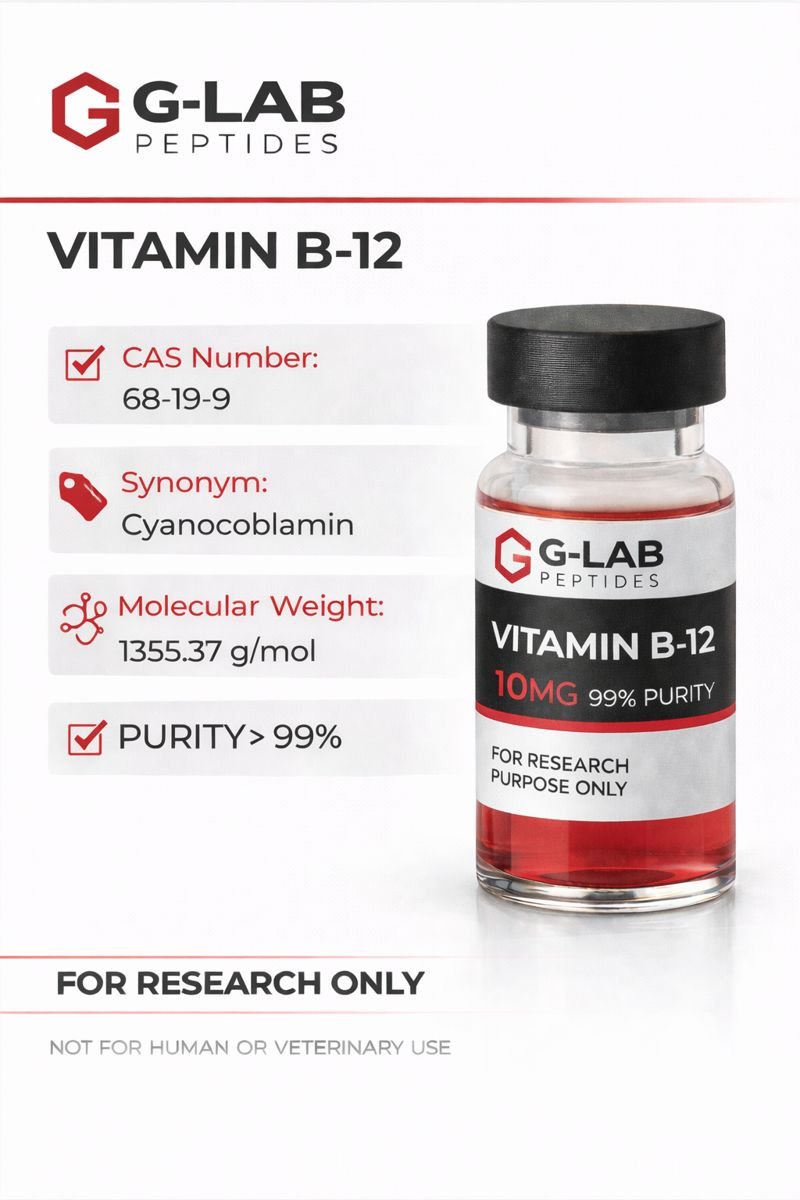
Vitamin B-12 (10mg)
$48.90
| Quantity | Discount | Price |
|---|---|---|
| 5 - 8 | 5% | $46.46 |
| 9+ | 10% | $44.01 |
Free shipping on orders over $200!
- Satisfaction Guaranteed
- No Hassle Refunds
- Secure Payments
Vitamin B-12 (Cobalamin)
Vitamin B-12 is an essential, water-soluble micronutrient required for DNA synthesis, erythropoiesis, mitochondrial energy production, one-carbon metabolism, fatty-acid oxidation, and neurological function. As a cofactor for key metabolic enzymes, B-12 serves as a critical regulator of cellular integrity, methylation pathways, and overall metabolic homeostasis.
Beyond its classical roles in hematology and neurology, contemporary research highlights the impact of B-12 status on adiposity, insulin sensitivity, hepatic lipid metabolism, inflammation, endothelial function, genomic stability, and musculoskeletal health, making it an important tool in metabolic and biochemical research.
Specifications
Synonyms: Vitamin B-12, Cobalamin, Cyanocobalamin, Hydroxocobalamin, Methylcobalamin, Adenosylcobalamin
Molecular class: Water-soluble vitamin / Metabolic cofactor
Research category: One-carbon metabolism / Mitochondrial function / Hematology / Neurological integrity
Mechanism of Action and Metabolic Pathways
Vitamin B-12 is required for two major enzymatic reactions, both central to metabolic and genomic stability:
1. Methionine Synthase (MS) — Methylation & DNA Synthesis
B-12 acts as a cofactor for methionine synthase, which converts homocysteine to methionine. This reaction is essential for:
DNA and RNA synthesis
Epigenetic methylation of DNA and histones
Phospholipid and neurotransmitter synthesis
Regulation of cell division and genomic stability
Disturbance in this pathway increases homocysteine, oxidative stress, and genomic damage — linking B-12 deficiency to metabolic syndrome, inflammation, and DNA instability.
2. Methylmalonyl-CoA Mutase (MCM) — Fatty-Acid and Energy Metabolism
B-12 participates in the conversion of methylmalonyl-CoA to succinyl-CoA in mitochondria, directly affecting:
β-oxidation of odd-chain fatty acids
TCA cycle energy flux
Myelin integrity
Lipid turnover and metabolic substrate utilization
Elevated methylmalonic acid (MMA) indicates impaired B-12–dependent mitochondrial metabolism.
Vitamin B-12 in Glucose Homeostasis, Lipid Metabolism & Metabolic Health
1. Lipid Metabolism and Adiposity Regulation
Human and animal studies demonstrate that low B-12 status is associated with:
Higher body-mass index (BMI)
Increased visceral adiposity
Dysregulated fatty-acid metabolism
Higher triglycerides and LDL
Lower adiponectin and higher inflammatory markers
Mechanistically, inadequate B-12 disrupts methylation and mitochondrial function, leading to impaired lipid oxidation, fat accumulation, and metabolic inflammation.
2. Insulin Resistance and Metabolic Syndrome
Epidemiological and clinical data link low B-12 levels with:
Greater insulin resistance
Higher fasting glucose
Elevated homocysteine (associated with endothelial dysfunction)
Features of metabolic syndrome
These effects appear mediated by oxidative stress, endothelial injury, and impaired mitochondrial fatty-acid metabolism.
Neurological Function and Myelin Integrity
B-12 is required for:
Myelin synthesis and repair
Neurotransmitter metabolism
Neuronal DNA synthesis
Deficiency leads to neuropathy, cognitive impairment, neuroinflammation, and degeneration of spinal cord pathways. Because of this, B-12 is used in research exploring neurodegeneration, myelin disorders, and age-associated cognitive decline.
Hematological Biology and Erythropoiesis
B-12 plays a critical role in the formation of properly matured red blood cells. Disruption of DNA synthesis in erythroid precursors leads to:
Megaloblastic anemia
Reduced oxygen-carrying capacity
Elevated inflammatory and oxidative markers
This makes B-12 supplementation a cornerstone of hematological restoration in deficiency states.
B-12 in Liver Biology and NAFLD Research
Recent clinical studies show that oral B-12 supplementation can improve metabolic markers in NAFLD (nonalcoholic fatty liver disease):
Reduction in homocysteine
Improvements in ALT/AST
Improved liver fat utilization
Modulation of one-carbon metabolism affecting hepatic lipid flux
As hepatic methylation dysregulation is central to NAFLD pathophysiology, B-12 is frequently used as a model nutrient in research related to liver metabolism.
Genomic Stability, Epigenetics & DNA Integrity
B-12 deficiency disrupts methylation cycles, resulting in:
Impaired DNA repair
Increased micronuclei formation
Increased genomic instability
Higher oxidative DNA damage
Dysregulated epigenetic signatures
Restoring B-12 levels has been shown to lower genotoxic biomarkers, supporting its importance in genomic maintenance and anti-aging research.
Muscle Mass, Bone Density & Aging
Large population-based studies indicate that adequate B-12 status correlates with:
Higher appendicular muscle mass
Stronger grip strength
Better physical performance
Improved bone mineral density
This suggests a potential role for B-12 in the prevention of sarcopenia, age-related muscle decline, and frailty.
Inflammation, Endothelial Function & Oxidative Stress
Low B-12 is associated with:
Higher CRP
Increased homocysteine
Impaired nitric oxide bioavailability
Endothelial dysfunction
Increased oxidative stress
This makes B-12 an important nutrient for studies exploring vascular biology, inflammation-mediated metabolic disorders, and cardiometabolic risk.
Supplementation, Absorption & Bioavailability
B-12 absorption depends on:
Gastric intrinsic factor
Intestinal uptake mechanisms
Dietary intake (primarily animal sources)
Individuals at high risk for deficiency:
Vegans and vegetarians
Older adults
Individuals with bariatric surgery
Patients with GI disorders (IBD, celiac disease, atrophic gastritis)
Long-term users of PPIs or metformin
High-dose oral B-12 or enhanced formulations (e.g., sucrosomial B-12) show superior absorption profiles and restoration of serum levels compared to standard formulations.
Research Use Only – Important Notice
This Vitamin B-12 product is intended exclusively for research or nutritional supplementation purposes.
Not for diagnostic, therapeutic, or clinical drug use.
Not intended to treat or cure any disease.
Descriptions above summarize findings from human and mechanistic research and must not be interpreted as medical guidance.
References (with direct scientific links)
- O’Leary F., Samman S. Vitamin B12 in Health and Disease: A Review. Nutrients 2010.
https://pmc.ncbi.nlm.nih.gov/articles/PMC3257642/
2. Mucha P., et al. Vitamin B12 Metabolism: A Network of Multi-Protein Interactions. IJMS 2024.
https://pmc.ncbi.nlm.nih.gov/articles/PMC11311337/
3. Halczuk K., et al. Vitamin B12 – Multifaceted In Vivo Functions and In Vitro Investigations. Nutrients 2023.
https://www.mdpi.com/2072-6643/15/12/2734
4. Talari HR., et al. Effects of Vitamin B12 Supplementation in NAFLD: A Randomized Controlled Trial. Scientific Reports 2022.
https://www.nature.com/articles/s41598-022-18195-8
5. Guetterman HM., et al. Vitamin B12 Status and Body Composition in Adults. Clin Nutrition 2025.
https://www.sciencedirect.com/science/article/pii/S2405457725003080
6. Zhu J., et al. Vitamin B12 and Metabolic Syndrome Risk. JAMA Network Open, 2023.
https://jamanetwork.com/journals/jamanetworkopen/fullarticle/2800209
7. Memon NM., et al. Bioavailability of Sucrosomial® B12 vs Conventional Oral Supplementation. Frontiers in Nutrition 2024.
https://www.frontiersin.org/articles/10.3389/fnut.2024.1493593/full
Related products
SS-31
Price range: $65.00 through $210.00Select options This product has multiple variants. The options may be chosen on the product page
 Oxytocin (5mg)
  Epithalon (50mg)