
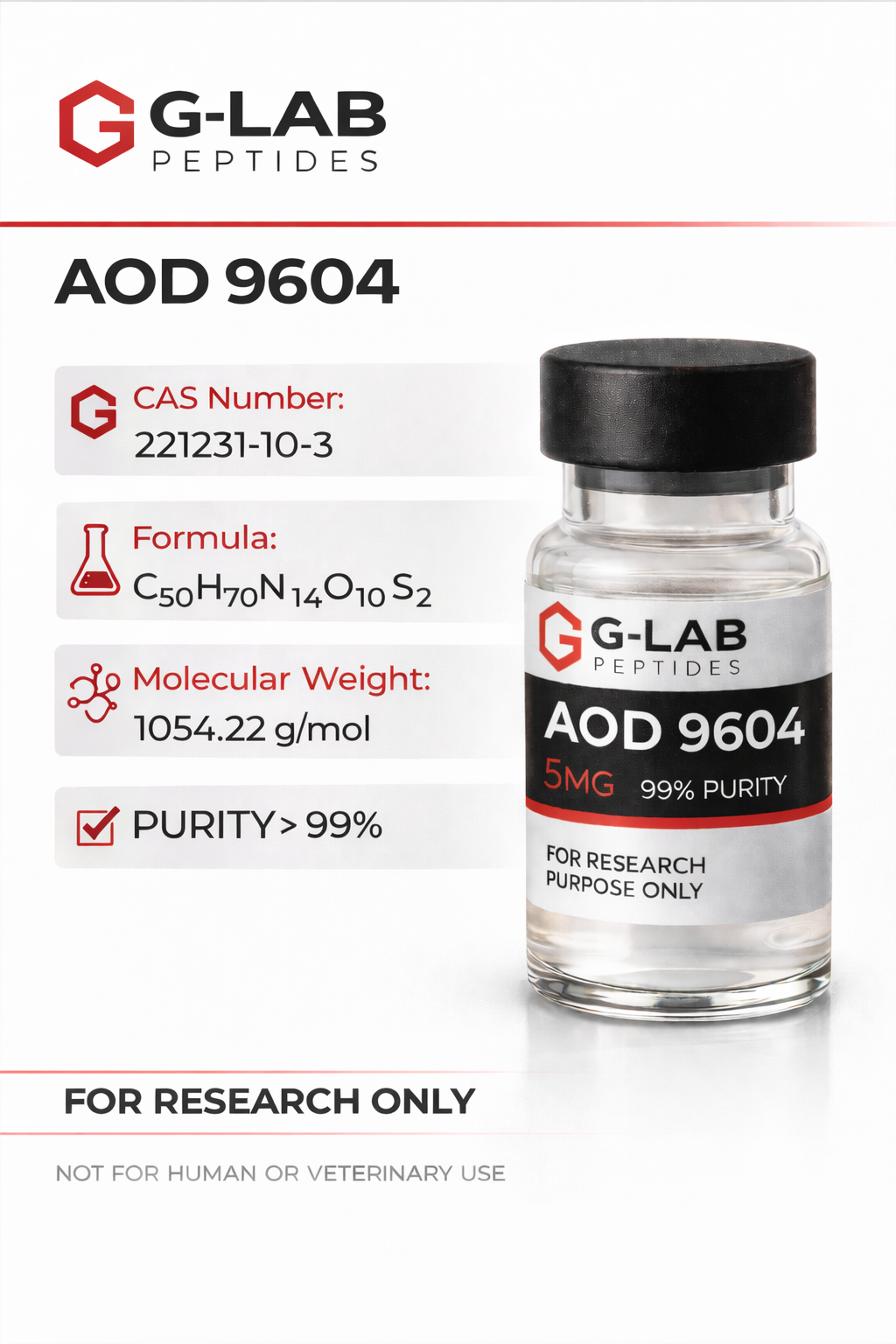
AOD 9604
Price range: $55.90 through $98.90
| Quantity | Discount | Price |
|---|---|---|
| 5 - 8 | 5% | $53.11 |
| 9+ | 10% | $50.31 |
Free shipping on orders over $200!
- Satisfaction Guaranteed
- No Hassle Refunds
- Secure Payments
AOD 9604 Peptide – 5 mg
AOD 9604 is a synthetic peptide derived from the C-terminal region of human growth hormone (hGH), corresponding to amino acids 176–191 with an N-terminal tyrosine substitution (Tyr-hGH 176–191). This fragment was originally designed to isolate the lipolytic (fat-metabolizing) actions of hGH while minimizing classical growth-promoting and IGF-1–mediated effects.
Preclinical and early clinical research indicates that AOD 9604 may influence lipid metabolism, energy expenditure, and cartilage repair, while displaying a safety profile distinct from full-length hGH.Development as an anti-obesity drug was eventually discontinued due to insufficient efficacy in long-term weight-loss trials; however, AOD 9604 remains of interest as a research tool in metabolic and musculoskeletal models.
Specifications
Synonyms:
AOD 9604, AOD-9604, hGH fragment 176–191, Tyr-hGH 176–191, Fragment 177–191, C-terminal hGH fragmentSequence:
Tyr-Leu-Arg-Ile-Val-Gln-Cys-Arg-Ser-Val-Glu-Gly-Ser-Cys-Gly-PheMolecular Formula:
C₇₈H₁₂₃N₂₃O₂₃S₂Paragon Sports Medicine+2PubChem+2Molecular Weight:
≈ 1815.1 g/molParagon Sports Medicine+2PubChem+2Class:
hGH-derived peptide fragment / metabolic & tissue-repair research peptide
AOD 9604 and Lipid Metabolism
Early mechanistic work suggested that AOD 9604 retains the lipolytic activity of hGH in adipose tissue without significantly stimulating IGF-1 pathways. In obese mouse models, chronic administration of hGH or AOD 9604 for 14 days reduced body weight and fat mass and increased lipolytic sensitivity. These effects were linked to interactions with the β₃-adrenergic receptor pathway; β₃-adrenergic receptor knockout mice were largely unresponsive to AOD 9604, indicating a β₃-AR–dependent mechanism.
In vitro and preclinical work on hGH fragments (including modified forms related to AOD 9604) has also reported increased lipid oxidation and reduced lipogenesis in adipocyte and metabolic test systems, supporting its use as a tool compound to study fat mobilization and energy balance.
AOD 9604 in Obesity and Metabolic Research
Short-Term Weight-Loss Trials
AOD 9604 was advanced into human trials as an oral anti-obesity candidate. In a 12-week randomized clinical trial, subjects receiving AOD 9604 (1 mg/day) lost on average about 2.6 kg, compared with approximately 0.8 kg in the placebo group, suggesting a modest treatment effect on body weight.
However, in a subsequent 24-week trial involving 536 obese participants, AOD 9604 did not achieve statistically robust, clinically meaningful weight-loss outcomes versus placebo, and the obesity-drug development program was discontinued around 2007.
These results mean that AOD 9604 is not approved as an anti-obesity medication, but the data remain relevant for researchers interested in metabolic modulation and fat-metabolism signaling rather than therapeutic use.
AOD 9604 and Cartilage / Joint Research
Interest in AOD 9604 later shifted toward cartilage repair and osteoarthritis models:
In a collagenase-induced knee osteoarthritis (OA) rabbit model, weekly intra-articular injections of AOD 9604 (0.25 mg), with or without hyaluronic acid (HA), enhanced cartilage regeneration compared with saline controls. The combination of AOD 9604 + HA produced more pronounced improvements in histologic cartilage scores than either agent alone.
A broader 2024 review on cartilage engineering peptides highlighted AOD 9604 as a candidate that, in preclinical models, may support cartilage matrix restoration when delivered intra-articularly in OA settings.
A recent overview article summarizing AOD 9604 research notes that in isolated chondrocyte cultures, AOD 9604 has been reported to promote proteoglycan and collagen production, and may influence differentiation of adipose-derived mesenchymal stem cells toward osteogenic lineages—suggesting a possible role as a tool to study cartilage and bone matrix biology.
Collectively, these findings position AOD 9604 as a peptide of interest in musculoskeletal and joint-health–focused research, distinct from its original obesity-centric development.
Safety, Tolerability, and Regulatory Perspective
Multiple non-clinical toxicology programs and clinical studies have evaluated the safety of AOD 9604:
A comprehensive non-clinical dossier reported no evidence of genotoxicity or major toxicological concerns across a range of pharmacokinetic and toxicity studies, supporting a favorable safety profile in standard preclinical models.
In a human safety and tolerability study, oral AOD 9604 (9, 27, and 54 mg) was administered to adults; investigators concluded that the peptide was well tolerated, with no safety-related concerns observed during the study period.
Despite this, efficacy limitations in long-term weight-loss trials meant that AOD 9604 was not developed as an approved drug. The compound is also listed on anti-doping monitoring programs, and its use in competitive sport is restricted or banned in many jurisdictions.
For research purposes, safety data are mainly relevant to dose-finding and study design in experimental models, not as endorsement of any clinical or self-administration use.
Other Experimental Applications
Beyond metabolic and joint-related research, AOD 9604 and closely related hGH fragments have been explored as tools to probe:
Exercise-like metabolic signaling, where hGH 176–191–type fragments may mimic some aspects of growth hormone’s effects on fat oxidation and energy expenditure, without activating full GH growth or IGF-1 axes.
Matrix biology and tissue regeneration, especially where proteoglycan, collagen, and extracellular matrix synthesis are endpoints of interest, such as in cartilage or bone models.
These uses remain experimental and mechanistic, providing insights into signaling pathways rather than serving as validated therapies.
Research Use Only – Important Notice
This AOD 9604 – 5 mg product is supplied exclusively for laboratory research.
Not for human or veterinary use
Not for diagnostic, therapeutic, cosmetic, or performance-enhancing applications
Intended only for in vitro work and/or use in appropriately controlled experimental animal models by qualified professionals
All information above summarizes preclinical and mechanistic research and is provided for educational and scientific purposes only. It must not be interpreted as medical advice or as a recommendation for any kind of self-administration or clinical use.
References
Heffernan MA et al. The effects of human GH and its lipolytic fragment (AOD9604) on lipid metabolism following chronic treatment in obese mice and beta(3)-AR knock-out mice. Endocrinology, 2001.
https://pubmed.ncbi.nlm.nih.gov/11713213 PubMed+1Misra M, Kelley DE. Obesity pharmacotherapy: current perspectives and future directions. Therap Adv Endocrinol Metab, 2013 – includes clinical trial summary for AOD 9604.
https://pmc.ncbi.nlm.nih.gov/articles/PMC3584306 PMCStier H, Vos E, Kenley D. Safety and tolerability of the hexadecapeptide AOD9604 in humans. Journal of Endocrinology and Metabolism, 2013.
https://www.jofem.org/index.php/jofem/article/view/157 Jofem+1Moréa MI et al. Safety and metabolism of AOD9604, a novel nutraceutical ingredient for improved metabolic health. J Endocrinol Metab, 2014.
https://lateral-pharma.com/wp-content/uploads/2016/12/Safety-Metabolism-of-AOD9604-a-Novel-Nutraceutical-Ingredient-for-Improved-Metabolic-Health-JEM-June-2014.pdf Lateral PharmaKwon DR, Park GY. Effect of intra-articular injection of AOD9604 with or without hyaluronic acid in rabbit osteoarthritis model. Ann Clin Lab Sci, 2015.
https://www.annclinlabsci.org/content/45/4/426.full annclinlabsci.org+1Liao HJ et al. Peptides for targeting chondrogenic induction and cartilage regeneration. Tissue Engineering / Regenerative Medicine review, 2024 – includes discussion of AOD9604 in OA models.
https://pmc.ncbi.nlm.nih.gov/articles/PMC11556548Oxford Science Review – Investigating the research potential of the peptide AOD-9604 (cartilage matrix and MSC observations).
https://oxsci.org/investigating-the-research-potential-of-the-peptide-aod%E2%80%919604 The Oxford Scientist+1
Related products
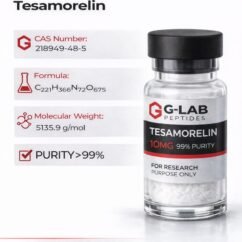
Tesamorelin
Price range: $86.90 through $115.00Select options This product has multiple variants. The options may be chosen on the product page
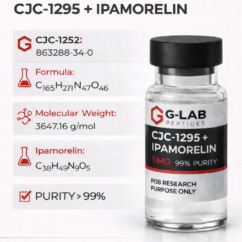 CJC-1295 + Ipamorelin (10mg)
  5-Amino Oral (50mg)
  Pinealon (10mg)