
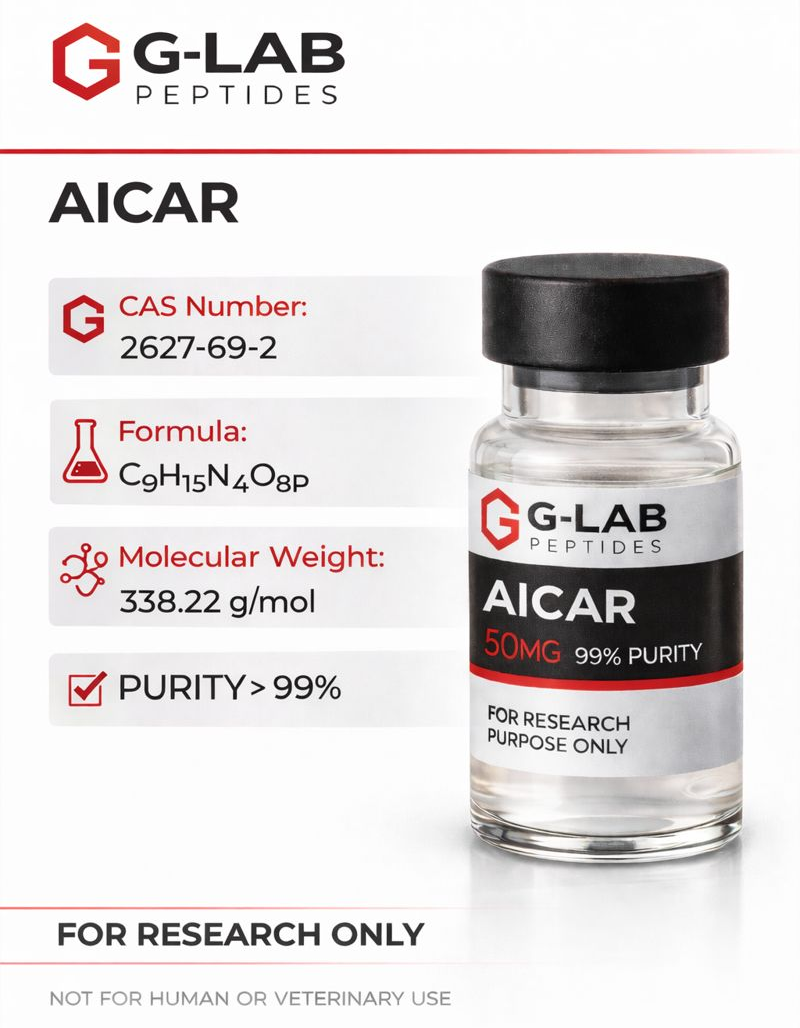
AICAR (50mg)
$71.90
| Quantity | Discount | Price |
|---|---|---|
| 5 - 8 | 5% | $68.31 |
| 9+ | 10% | $64.71 |
Free shipping on orders over $200!
- Satisfaction Guaranteed
- No Hassle Refunds
- Secure Payments
AICAR Peptide
AICAR (5-aminoimidazole-4-carboxamide ribonucleotide) is a synthetic analog of adenosine monophosphate (AMP) widely used as a pharmacological tool to activate AMP-activated protein kinase (AMPK) in cells and animal models. Once inside the cell, it is converted to the nucleotide ZMP, which can mimic several AMP-like signals and influence energy-sensing pathways, nucleotide metabolism, and cellular stress responses.
Specifications
Synonyms: AICAR, AICA ribotide, ZMP, 5-aminoimidazole-4-carboxamide ribonucleotide
Molecular formula: C₉H₁₅N₄O₈P
Molecular weight: 338.21 g/mol
Class: AMP analog / AMPK pathway modulator
Mechanism of Action and AMPK Signaling
Experimental work has shown that cell-permeable AICAR (or its riboside, AICAr) enters cells via adenosine transporters and is phosphorylated by adenosine kinase to AICAR/ZMP. This nucleotide can bind the γ-subunit of AMPK, favoring phosphorylation at Thr172 and stabilizing the active conformation of the kinase.Through this mechanism, AICAR has been used to:
Enhance glucose uptake and fatty-acid oxidation in skeletal muscle
Decrease lipogenesis in liver and adipose tissue
Shift cellular metabolism toward ATP-generating (catabolic) pathways while suppressing some anabolic processes
A systematic review also highlights that at high intracellular concentrations, AICAR/ZMP can affect other AMP-sensitive enzymes and nucleotide pathways, revealing AMPK-independent effects and underscoring the need for careful interpretation of AICAR-based experiments.
AICAR, Glucose Homeostasis and Insulin Sensitivity
AICAR has become a key tool for dissecting how AMPK influences glucose and lipid metabolism:
In preclinical models, AICAR has been reported to inhibit hepatic gluconeogenesis, reduce fatty-acid and cholesterol synthesis, and promote fatty-acid oxidation, consistent with AMPK’s role as an energy sensor.
In animal studies and short human infusion protocols, systemic AICAR administration has been associated with reduced hepatic glucose output and increased skeletal-muscle glucose disposal, although clinical use is limited by poor oral bioavailability and the need for continuous intravenous infusion.
More recent work has examined AICAR as a model for “exercise-like” AMPK activation in muscle:
Kjøbsted et al. showed that prior AICAR stimulation of mouse skeletal muscle increased subsequent insulin-stimulated glucose uptake in an AMPK-dependent manner. The effect was accompanied by enhanced phosphorylation of the Rab-GTPase regulator TBC1D4, which is involved in GLUT4 trafficking and is considered a key node linking AMPK and insulin signaling.
Jørgensen et al. later found that this AICAR-induced increase in muscle insulin sensitivity does not require serum factors and coincides with sustained AMPK signaling and elevated TBC1D4 Ser711 phosphorylation during recovery after AICAR exposure.
Collectively, these data support the use of AICAR as a research tool to explore how AMPK activation can acutely improve insulin action, particularly in skeletal muscle.
Cardiovascular and Ischemia–Reperfusion Research
Cardiac models have been extensively used to investigate AICAR’s impact on ischemia–reperfusion injury:
In an ex vivo mouse heart model of myocardial ischemia–reperfusion, Du et al. reported that AICAR-mediated AMPK activation improved left-ventricular function, reduced arrhythmia incidence and infarct size, and increased antioxidant capacity (higher superoxide dismutase activity and lower malondialdehyde levels). The peptide also modulated mitochondrial dynamics by altering phosphorylation of the fission regulator Drp1, favoring reduced mitochondrial fragmentation and lower inflammatory cytokine expression (TNF-α, IL-6, IL-1β).
A systematic review of AICAR notes that earlier animal and clinical studies in coronary artery bypass graft surgery suggested improved post-ischemic recovery and a possible reduction in early adverse cardiac events; however, later large trials (e.g., RED-CABG) did not confirm a clear clinical benefit, and AICAR is not approved as a cardioprotective drug.
These findings make AICAR a useful experimental probe for AMPK-dependent cardiometabolic pathways and mitochondrial quality control in ischemic heart research.
AICAR in Cancer Biology
Because AMPK can influence cell growth, metabolism, and mTOR signaling, AICAR has been evaluated in various tumor models:
In human osteosarcoma cell lines and xenograft models, Morishita et al. observed that AICAR treatment activated AMPK, inhibited proliferation, and induced mitochondrial apoptosis (TUNEL-positive cells, caspase activation). In tumor-bearing mice, AICAR administration significantly reduced tumor volume without major effects on body weight, indicating a potential antitumor action in this experimental setting.
A separate study in childhood acute lymphoblastic leukemia described that AICAR (acadesine) induced apoptosis and inhibited mTORC1 signaling in leukemic cells, while effects were less pronounced in non-malignant lymphocytes, suggesting some degree of differential sensitivity between malignant and normal cells.
The broader AMPK literature emphasizes that some AICAR effects on cancer cells may be AMPK-independent, and that the compound should be viewed as a research tool, not a validated anticancer therapy.
AICAR, Inflammation and Acute Organ Injury
AICAR-induced AMPK activation has also been studied in inflammatory and acute-injury models:
In a murine sepsis model (cecal ligation and puncture), Mulchandani et al. showed that AICAR activation of AMPK within the central nervous system was associated with reduced circulating organ-injury markers (e.g., AST), lower serum levels of TNF-α, IL-1β and IL-6, and markedly improved lung histology. AICAR-treated septic mice displayed less pulmonary edema, reduced inflammatory infiltrates, and fewer apoptotic (TUNEL-positive) cells in lung tissue.
In a chlorine-induced acute lung injury model, Ahmad et al. reported that AICAR decreased the severity of lung damage by phosphorylating AMPK, promoting autophagy, limiting mitochondrial injury and dampening inflammatory signaling.
A broader review on AMPK and host defense summarizes that AICAR and other AMPK activators can reduce the severity of sepsis-induced lung injury and modulate immune responses in multiple infection models, reinforcing AMPK’s role as a negative regulator of excessive inflammation.
These studies position AICAR as a tool compound to investigate AMPK-driven anti-inflammatory pathways, organ protection, and the interface between metabolism and immunity.
Other Experimental Applications
Energy metabolism and exercise mimetics: AICAR has been extensively used to model several aspects of endurance-type exercise at the cellular and tissue level. AMPK activation by AICAR can increase GLUT4 translocation, stimulate mitochondrial biogenesis, and alter fuel selection in ways that partially resemble contraction or training stimuli in skeletal muscle.
Nucleotide and biosynthetic pathways: High intracellular ZMP generated from AICAR can interfere with de novo purine synthesis and other AMP-sensitive enzymes, providing a way to study links between nucleotide metabolism, cell cycle regulation and energy sensing.
Research Use Only – Important Notice
This AICAR 50 mg product is supplied exclusively for laboratory research purposes.
Not for human or veterinary use
Not for diagnostic, therapeutic, or cosmetic applications
Intended only for in vitro work and/or use in appropriately controlled experimental animal models by qualified professionals
All descriptions above summarize findings from preclinical and mechanistic studies and are provided for educational and informational purposes only. They must not be interpreted as medical claims or guidance for any form of self-administration or clinical use.
References
Višnjić D. et al. AICAr, a widely used AMPK activator with important AMPK-independent effects: a systematic review. Cells 2021;10(5):1095.MDPI
Kjøbsted R. et al. Prior AICAR stimulation increases insulin sensitivity in mouse skeletal muscle in an AMPK-dependent manner. Diabetes 2015;64(6):2042–2055.PubMed
Jørgensen NO. et al. Serum is not necessary for prior pharmacological activation of AMPK to enhance muscle insulin sensitivity. Int J Mol Sci 2018;19(4):1201.MDPI
Du J. et al. AMPK activation alleviates myocardial ischemia-reperfusion injury by regulating Drp1-mediated mitochondrial dynamics. Front Pharmacol 2022;13:862204.Frontiers
Morishita M. et al. AICAR induces mitochondrial apoptosis in human osteosarcoma cells through an AMPK-dependent pathway. Int J Oncol 2017;50(1):23–30.Spandidos Publications
Sengupta TK. et al. Acadesine inhibits mTORC1 and induces apoptosis in childhood acute lymphoblastic leukemia cells. Int J Oncol (children’s leukemia model using AICAR/acadesine).SpringerLink
Mulchandani N. et al. Stimulation of brain AMP-activated protein kinase attenuates inflammation and acute lung injury in sepsis. Mol Med 2015;21:637–644.SpringerLink
Ahmad I. et al. AICAR decreases acute lung injury by phosphorylating AMPK and upregulating autophagy in chlorine-exposed models. Eur Respir J 2021.ERS Publications
Silwal P. et al. AMP-activated protein kinase and host defense against infection. Int J Mol Sci 2018;19(11):3495.Europe PMC
O’Neill HM. AMPK and exercise: glucose uptake and insulin sensitivity. Diabetes Metab J 2013;37(1):1–21.e-DMJ
Related products
MOTS-c
Price range: $76.90 through $155.00Select options This product has multiple variants. The options may be chosen on the product page
 MK-677 (10mg)