
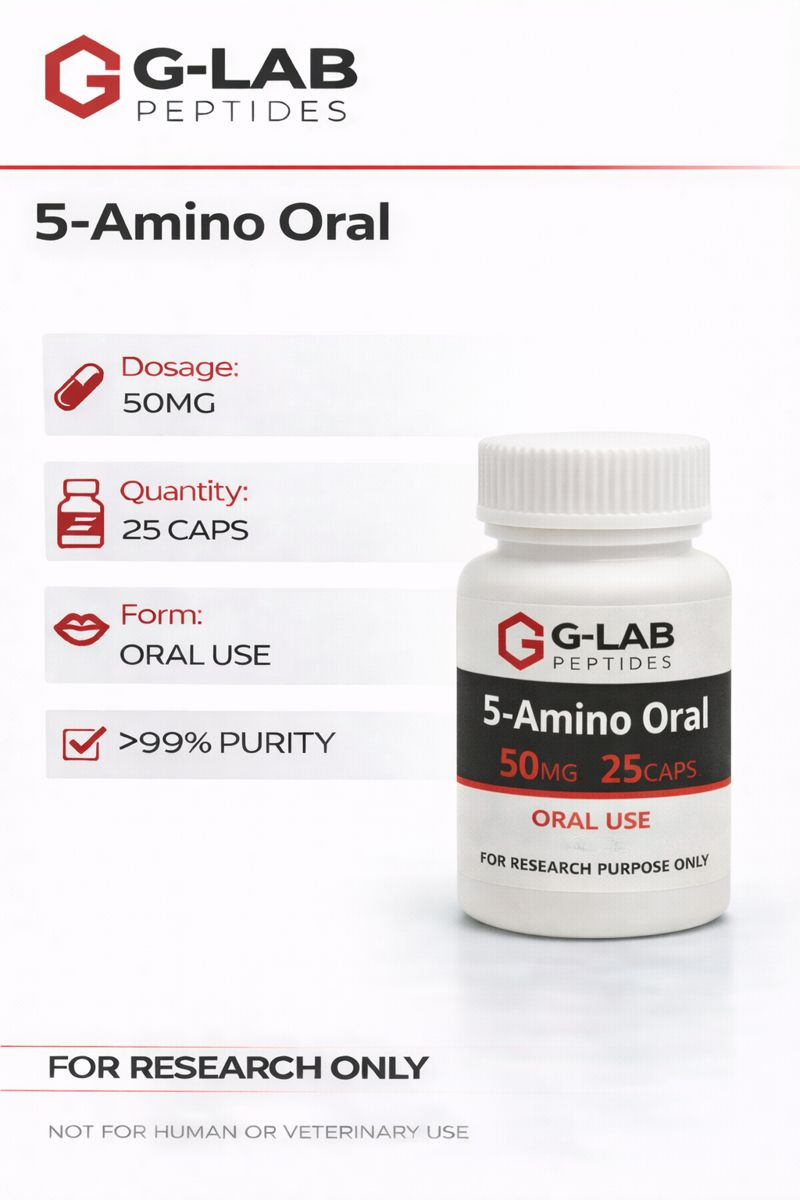
5-Amino Oral (50mg)
$129.90
| Quantity | Discount | Price |
|---|---|---|
| 5 - 8 | 5% | $123.41 |
| 9+ | 10% | $116.91 |
Free shipping on orders over $200!
- Satisfaction Guaranteed
- No Hassle Refunds
- Secure Payments
5-Amino Oral (50 mg)
5-Amino Oral (50 mg) is an oral-form research compound used to investigate systemic NNMT inhibition, methyl-donor dynamics, and whole-body metabolic regulation in animal and cellular models.
Because NNMT is widely distributed across liver, adipose tissue, kidneys, and certain cancers, oral delivery is used in preclinical environments to study bioavailability, systemic metabolic flux, and pharmacodynamic responses.
Mechanistic Properties in Oral Research Models
Experimental oral dosing models show:
Systemic reduction in 1-MNA levels (NNMT activity marker)
Altered nicotinamide → NAD⁺ conversion rates
Increased expression of mitochondrial oxidative genes
Possible effects on glucose and lipid handling in metabolic tissues
Modulation of inflammatory and methylation pathways
Oral NNMT-inhibition studies have been explored for insights into hepatic metabolism, adipocyte biology, methylation balance, and aging-related NAD⁺ decline.
Metabolic and Epigenetic Research Applications
Researchers use oral NNMT inhibitors to study:
Obesity and diet-induced metabolic dysfunction models
Aging-associated NAD⁺ depletion
Hepatic fat metabolism and mitochondrial oxidation
Epigenetic regulation via SAM-dependent methyltransferases
Cancer cell metabolic remodeling
These studies highlight NNMT’s role at the crossroads of epigenetics, metabolism, and energy homeostasis.
Research Use Only — Important Notice
Not for human consumption
For controlled laboratory research only
Not a therapeutic substance
All descriptions summarize preclinical findings only
References – Oral NNMT Inhibition
Kannt A et al. Discovery of potent small-molecule NNMT inhibitors and metabolic profiling in vivo.
https://pubmed.ncbi.nlm.nih.gov/31495893/Roberti A et al. NNMT and methylation metabolism in metabolic disease models.
https://pubmed.ncbi.nlm.nih.gov/31953484/Hong S et al. Systemic influence of NNMT inhibition on methylation and NAD⁺ pathways.
https://pubmed.ncbi.nlm.nih.gov/33896442/
📌 SLU-PP (500 mg)
(SLU-PP-332 / Estrogen-Related Receptor Agonist Research)
SLU-PP refers to a class of small-molecule experimental activators of estrogen-related receptors (ERRα/ERRγ)—key nuclear receptors involved in mitochondrial biogenesis, oxidative metabolism, and energy expenditure.
ERR pathways regulate:
Mitochondrial protein transcription
Fatty acid oxidation
Oxidative phosphorylation
ATP generation
Adaptive thermogenesis
Muscle metabolic remodeling
SLU-PP molecules (e.g., SLU-PP-332) have been used to probe mitochondrial activation and endurance-type metabolic profiles.
Specifications
Synonyms: SLU-PP, SLU-PP-332 analogs, ERR modulator
Class: Nuclear receptor agonist (ERRα/ERRγ)
Research Focus: Mitochondrial function, oxidative metabolism, metabolic disease modeling
Mechanism of Action — ERR Activation
Experimental ERR agonists such as SLU-PP have been found to:
Increase expression of PGC-1α–dependent mitochondrial genes
Enhance fatty acid oxidation and oxidative phosphorylation (OXPHOS)
Amplify mitochondrial respiratory capacity
Shift cellular metabolism toward endurance-like phenotypes
In vitro exposure increases transcription of genes encoding:
Electron transport chain components
Mitochondrial ribosomal proteins
β-oxidation enzymes
TCA cycle enzymes
These mechanisms make SLU-PP compounds valuable tools in mitochondrial and exercise-mimetic research.
Experimental Findings in Metabolic Research
SLU-PP–based ERR activation models show:
Increased mitochondrial DNA content
Greater oxygen consumption rate (OCR)
Improved mitochondrial coupling efficiency
Altered lipid metabolism and substrate utilization
Potential insight into diabetes, metabolic syndrome, and endurance-adaptation biology
Recent work demonstrated that ERR agonism enhances mitochondrial energy capacity in multiple tissue types, including skeletal muscle, liver, and cardiac cells.
Research Use Only — Important Notice
Not for human or veterinary use
Not for therapeutic, diagnostic, or cosmetic applications
For controlled in vitro or animal research environments only
References – SLU-PP (ERR Agonist Research)
Bi P et al. Activation of ERRγ enhances oxidative metabolism and mitochondrial gene programs.
https://pubmed.ncbi.nlm.nih.gov/26092696/Misra J et al. ERRα/γ regulate energy metabolism and mitochondrial biogenesis.
https://pubmed.ncbi.nlm.nih.gov/23211537/Luo J et al. ERR pathway control of metabolic remodeling in experimental models.
https://pubmed.ncbi.nlm.nih.gov/23582332/Pulinilkunnil T et al. Nuclear receptor ERRγ as a regulator of cardiac mitochondrial metabolism.
https://pubmed.ncbi.nlm.nih.gov/21709061/
Related products
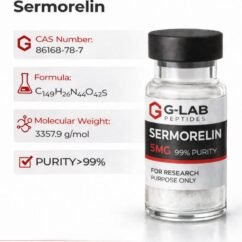
Sermorelin
Price range: $50.90 through $89.90Select options This product has multiple variants. The options may be chosen on the product page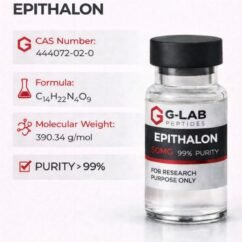
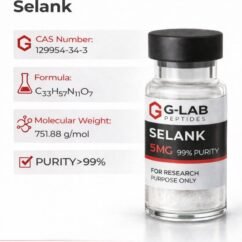 Selank (5mg)
 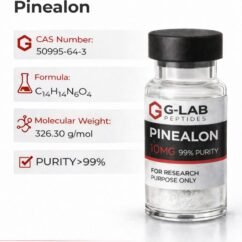 Pinealon (10mg)
 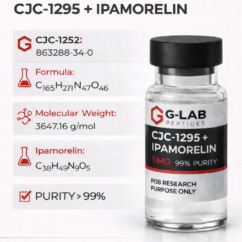 CJC-1295 + Ipamorelin (10mg)