
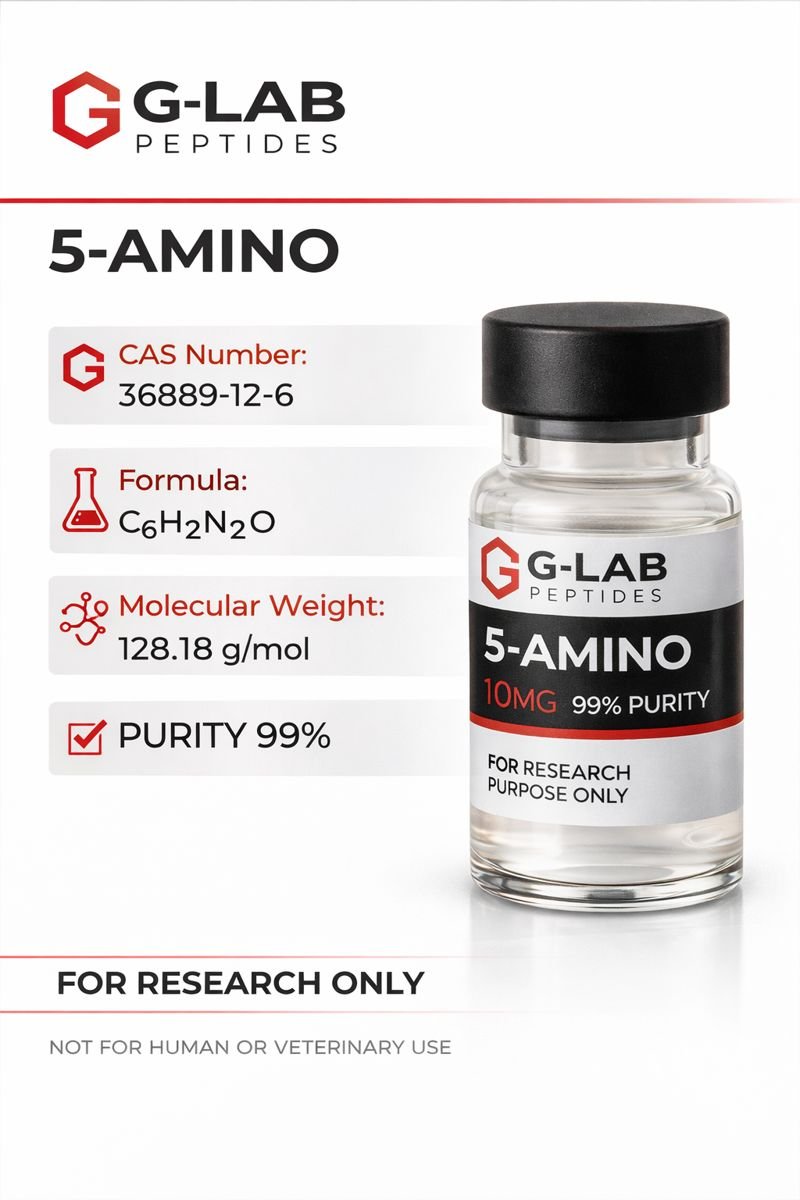
5-Amino (10mg)
$59.90
| Quantity | Discount | Price |
|---|---|---|
| 5 - 8 | 5% | $56.91 |
| 9+ | 10% | $53.91 |
Free shipping on orders over $200!
- Satisfaction Guaranteed
- No Hassle Refunds
- Secure Payments
5-Amino (10 mg)
5-Amino (10 mg) is supplied as a research-grade small molecule consistent with the class of 5-amino-1-methylquinolinium (5-amino-1MQ)–type nicotinamide N-methyltransferase (NNMT) inhibitors.
NNMT is a cytosolic enzyme that catalyzes the methylation of nicotinamide to 1-methylnicotinamide (1-MNA) using S-adenosylmethionine (SAM) as the methyl donor. This reaction connects NAD⁺ metabolism, methyl-donor balance, and epigenetic regulation. PMC+1
Selective NNMT inhibition with 5-amino-1MQ–like compounds has been shown in preclinical models to:
Reduce intracellular 1-MNA levels
Increase intracellular NAD⁺ and SAM
Shift adipocyte and hepatic metabolism toward higher energy expenditure
Influence gene expression programs sensitive to methylation state Wiley Online Library+3PMC+3ScienceDirect+3
Specifications
Synonyms (research context): 5-Amino-1MQ analog, NNMT inhibitor tool compound
Class: Small-molecule metabolic pathway modulator / NNMT inhibitor
Primary target: Nicotinamide N-methyltransferase (NNMT)
Model systems:
Differentiated adipocytes
Hepatocytes and liver models
Skeletal muscle and aging muscle models
Cancer and metabolic disease cell lines PMC+1
Mechanism of Action – NNMT Inhibition and Metabolic Rewiring
Structural and SAR (structure–activity relationship) work has identified 5-amino-1MQ as a potent NNMT inhibitor that binds in the nicotinamide-binding pocket of the enzyme. ScienceDirect+1
Experimental consequences of NNMT inhibition include:
Reduced 1-MNA production:
Lower levels of 1-MNA are a direct readout of decreased NNMT catalytic activity. ScienceDirect+1Increased NAD⁺ availability:
Nicotinamide is diverted away from methylation and back toward the NAD⁺ salvage pathway, supporting NAD⁺-dependent processes. ScienceDirect+1Altered SAM / SAH balance:
NNMT consumes SAM; its inhibition increases SAM and reduces S-adenosylhomocysteine (SAH), potentially affecting global methyltransferase activity and chromatin state. ScienceDirect+1Changes in transcriptional programs:
By combining NAD⁺ and methylation shifts, NNMT inhibition can remodel expression of genes involved in mitochondrial function, lipid storage, and oxidative metabolism. PMC+1
5-Amino, Adipocyte Biology and Energy Expenditure
In differentiated adipocyte models and diet-induced obesity (DIO) mice, NNMT inhibition with 5-amino-1MQ–type compounds has been reported to:
Reduce intracellular 1-MNA and increase NAD⁺ and SAM ScienceDirect
Suppress lipogenesis and decrease triglyceride accumulation in adipocytes ScienceDirect+1
Lead to smaller adipocyte size, lower white adipose tissue mass, and reduced body weight in obese mice, accompanied by increased energy expenditure Wiley Online Library+1
Remodel the gut microbiome toward a profile resembling lean animals when combined with dietary interventions Nature
These observations position 5-Amino–class molecules as useful research tools to dissect the role of NNMT in adiposity, adipocyte function, and systemic energy balance.
5-Amino, NAD⁺ Biology and Aging / Muscle Models
NNMT and NAD⁺ metabolism are increasingly studied in aging and sarcopenia. A recent study showed that NNMT inhibitors:
Enhanced muscle strength and regenerative capacity in aged muscle
Partially mimicked and potentiated responses to exercise, suggesting a role for NNMT in muscle adaptation and metabolic resilience Nature+1
These data make 5-Amino–like compounds a relevant tool in:
NAD⁺ and sirtuin pathway research
Muscle aging and sarcopenia models
Interactions between metabolism, methylation, and tissue regeneration
Other Experimental Applications
Cancer metabolism: NNMT overexpression has been reported in several cancers; NNMT inhibition is used to explore how methylation and NAD⁺ remodeling affect tumor growth and chemoresponsiveness. PMC+1
Epigenetics: By altering SAM availability and methyl-flux, NNMT inhibition allows researchers to probe histone and DNA methylation programs linked to metabolic state. MDPI+1
Research Use Only – Important Notice
This 5-Amino (10 mg) product is supplied exclusively for laboratory research:
Not for human or veterinary use
Not for diagnostic, therapeutic, or cosmetic application
Intended only for in vitro experiments and/or appropriately controlled experimental animal models by qualified professionals
All descriptions above summarize findings from preclinical and mechanistic studies and must not be interpreted as medical claims or guidance for self-administration
References – 5-Amino (NNMT Inhibition)
Neelakantan H et al. Selective and membrane-permeable small molecule inhibitors of nicotinamide N-methyltransferase (NNMT). Biochem Biophys Res Commun. 2018.
https://pmc.ncbi.nlm.nih.gov/articles/PMC5826726/ PMC+1Gao Y et al. Nicotinamide N-methyl transferase (NNMT): an emerging role in metabolic disorders. Prog Mater Sci. 2021.
https://www.sciencedirect.com/science/article/pii/S1359644621002427 ScienceDirectSun WD et al. Nicotinamide N-methyltransferase in obesity and metabolic disease. 2024 review.
https://pmc.ncbi.nlm.nih.gov/articles/PMC11196770/ PMCJawaria et al. Nicotinamide N-methyltransferase: metabolic regulator and emerging therapeutic target. Biomolecules. 2025.
https://www.mdpi.com/2218-273X/15/9/1281 MDPIKraus D et al. NNMT knockdown elevates energy expenditure and alters adipocyte metabolism. Nat Med–summarized in obesity-focused reviews.
https://www.hindawi.com/journals/jobe/2021/9924314/ Wiley Online LibraryDimet-Wiley A et al. Reduced calorie diet combined with NNMT inhibition remodels the microbiome of obese mice. Sci Rep. 2022.
https://www.nature.com/articles/s41598-021-03670-5 NatureDimet-Wiley AL et al. Nicotinamide N-methyltransferase inhibitors increase strength and promote regenerative capacity of aged muscle. Sci Rep. 2024.
https://www.nature.com/articles/s41598-024-66034-9 Nature
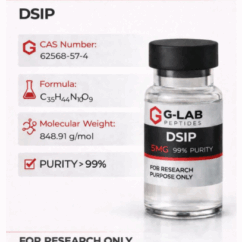 DSIP (5mg)