
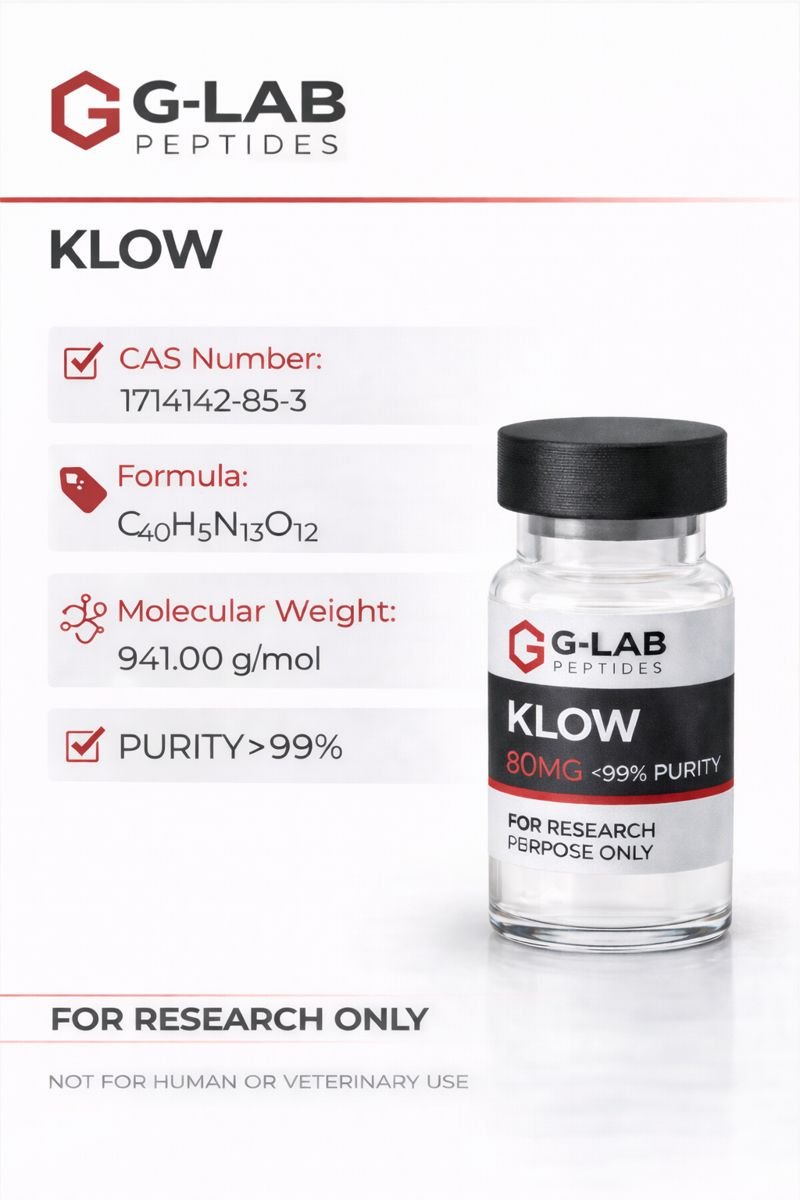
KLOW 80mg
$145.00
Out of stock
Free shipping on orders over $200!
- Satisfaction Guaranteed
- No Hassle Refunds
- Secure Payments
KLOW — Peptide Blend
(GHK-Cu 50mg + BPC-157 10mg + TB-500 10mg + KPV 10mg)
Skin Repair, Inflammation Modulation & Tissue-Regeneration Signaling
KLOW is a multi-peptide research blend formulated to investigate skin regeneration, inflammation modulation, and extracellular matrix (ECM) remodeling.
The blend combines GHK-Cu, BPC-157, TB-500, and KPV—four bioactive peptides widely studied for their complementary roles in cell migration, angiogenesis, immune balance, and tissue repair signaling.
Composition
-
GHK-Cu (Copper Tripeptide-1)
-
BPC-157 (Body Protection Compound)
-
TB-500 (Thymosin Beta-4 fragment)
-
KPV (Lys–Pro–Val)
Mechanistic Overview
GHK-Cu — ECM Remodeling & Skin Signaling
GHK-Cu is a naturally occurring human tripeptide involved in collagen synthesis, elastin organization, and antioxidant defense. Experimental studies show modulation of gene expression related to skin regeneration and firmness.
BPC-157 — Cytoprotection & Tissue Repair
BPC-157 is a gastric-derived peptide investigated for cytoprotective, angiogenic, and anti-inflammatory signaling. It is frequently used in research models of soft-tissue healing, endothelial integrity, and fibroblast migration.
TB-500 — Cell Migration & Angiogenesis
TB-500, a synthetic fragment of thymosin beta-4, is studied for its role in actin regulation, cell motility, and angiogenic pathways, making it a key peptide in wound-healing and tissue-regeneration models.
KPV — Anti-Inflammatory & Immune-Modulating Peptide
KPV (Lys–Pro–Val) is a tripeptide derived from α-melanocyte–stimulating hormone (α-MSH).
Research demonstrates that KPV can modulate NF-κB signaling, reduce pro-inflammatory cytokine expression, and support immune balance in epithelial and skin models—without melanocortin receptor activation.
KPV is commonly studied for:
-
Inflammation downregulation
-
Skin barrier support
-
Redness and irritation signaling pathways
-
Gut–skin immune axis research
Synergistic Research Rationale
The KLOW blend integrates four complementary biological axes:
-
Structural repair & collagen remodeling → GHK-Cu
-
Cytoprotection & vascular support → BPC-157
-
Cell migration & angiogenesis → TB-500
-
Inflammation control & immune balance → KPV
This synergy allows investigation of skin recovery, post-inflammatory repair, and tissue-regeneration signaling in complex experimental models.
Primary Experimental Applications
-
Skin regeneration and dermal remodeling research
-
Inflammatory skin-condition models
-
Wound-healing and angiogenesis studies
-
ECM turnover and collagen organization
-
Barrier repair and post-inflammatory signaling
Research Use Only — Important Notice
This KLOW peptide blend is supplied exclusively for laboratory research purposes.
-
Not for human or veterinary use
-
Not for diagnostic, therapeutic, or cosmetic applications
-
Intended only for in vitro research and/or use in appropriately controlled experimental models by qualified professionals
All descriptions above summarize findings from preclinical and mechanistic research and are provided for educational and informational purposes only.
References
-
Pickart L., Margolina A.
Regenerative and protective actions of the GHK-Cu peptide in the skin.
International Journal of Molecular Sciences, 2018;19(7):1987.
https://www.mdpi.com/1422-0067/19/7/1987 -
Sikiric P. et al.
Stable gastric pentadecapeptide BPC-157 and tissue repair mechanisms.
Current Pharmaceutical Design, 2011;17(16):1612–1632.
https://pubmed.ncbi.nlm.nih.gov/21524264/ -
Goldstein A.L., Kleinman H.K.
Thymosin beta-4: actin-sequestering peptide with roles in wound healing and angiogenesis.
Trends in Molecular Medicine, 2003;9(12):512–518.
https://pubmed.ncbi.nlm.nih.gov/14604823/ -
Malinda K.M. et al.
Thymosin beta-4 accelerates wound healing and promotes angiogenesis.
FASEB Journal, 1999;13(6):755–765.
https://faseb.onlinelibrary.wiley.com/doi/10.1096/fasebj.13.6.755 -
Catania A. et al.
The neuropeptide α-MSH in host defense.
Scientific World Journal, 2010;10:1841–1856.
https://www.ncbi.nlm.nih.gov/pmc/articles/PMC5774629/ -
Kannengiesser K. et al.
Anti-inflammatory properties of the α-MSH-derived tripeptide KPV.
Journal of Investigative Dermatology, 2008;128(9):2211–2218.
https://pubmed.ncbi.nlm.nih.gov/18432278/